
The Semantic Layer Blackhole: From Initial Build to Perpetual Governance
Why every semantic layer eventually collapses under its own governance mass

If we go back to basics, a semantic layer is an agreement. It’s the organization saying “when we say revenue, we mean this, computed this way, from this data.” Agreements are easy to make once, but they are hard to keep.
That asymmetry is the entire story of semantic layers.
Why building a semantic layer is easy
Building a semantic layer is a known, bounded problem. You inventory the business’s most-disputed metrics, you interview the finance and ops teams who own them, you write down a single definition for each, and you encode that definition once. You model the star schema underneath it, wire up row-level security, and ship it.
This is hard, real engineering work. But it is finite work.
It has a start date and an end date. A small team can do it in a quarter. It fails the way projects fail (scope, time, skill) and those failures are visible and fixable.
Why maintaining a semantic layer is a different problem category
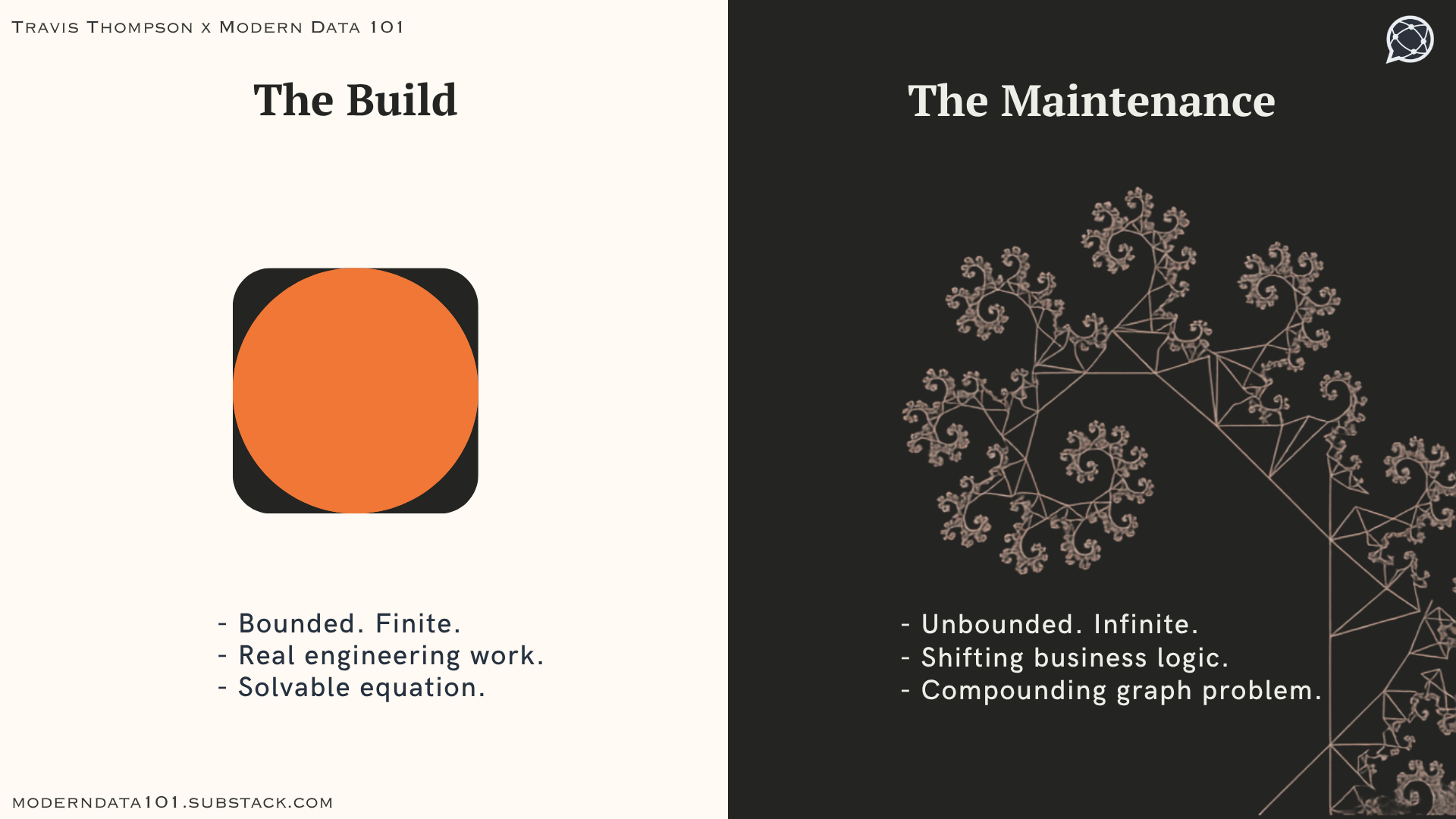
Maintenance isn’t a smaller version of the build. It’s a different category of problem, because the object you’re maintaining isn’t static: the business underneath it keeps changing.
A new product line ships, Finance redefines “active customer” for a board deck, a team spins up a shadow metric in a spreadsheet because waiting for the semantic layer team felt slower than just doing it themselves. Each of these is a small event.
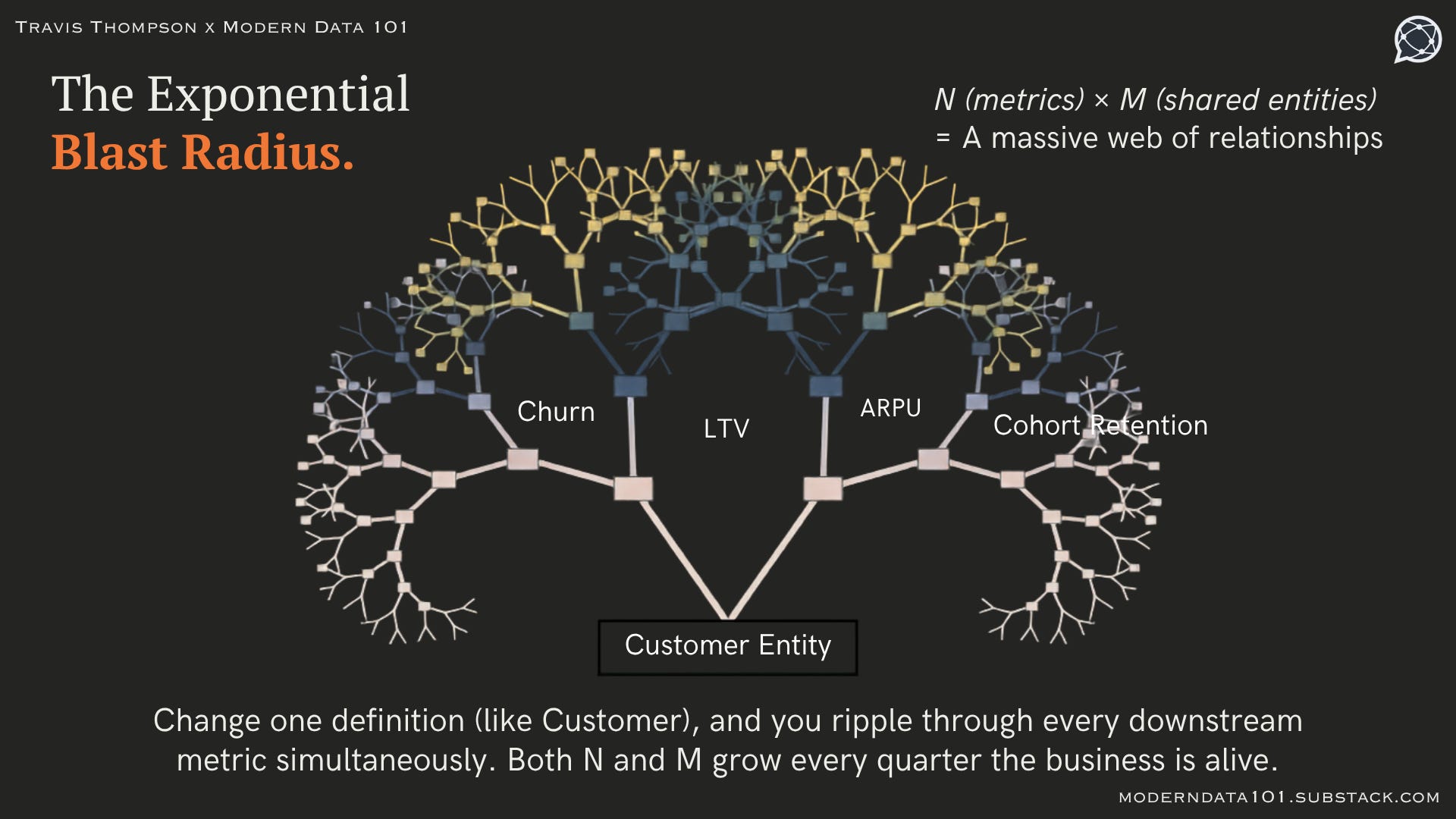
But they compound. And they compound combinatorially, because every metric in a semantic layer is connected to every other metric through shared entities and dimensions.
Change how “customer” is defined, and you haven’t touched one metric. You’ve touched every metric built on top of the customer entity: churn, LTV, ARPU, cohort retention, all of it.
Building adds definitions one at a time. Maintaining has to reason about the blast radius of a single change across a graph of definitions that only gets denser over time.
That’s the exponential part: N metrics built on M shared entities create roughly N×M relationships that a single change can ripple through, and both N and M grow every quarter the business is alive.
This is why the hardest part of a semantic layer is rarely technical. It’s getting people to delete the local KPI hack once the shared definition exists: a social problem, not a modeling problem, and social problems don’t resolve with better SQL.
Fundamental components of a semantic layer
It helps to be precise about what “semantic layer” contains, because the word gets used loosely. Note that these are the fundamental pieces and not enablers like Knowledge Graphs or Ontologies.
A semantic layer is made up of a specific set of interlocking entities:
Entities: the nouns of the business (Customer, Order, Product). These are the join keys that let everything else connect.
Dimensions: the attributes you slice by time, geography, category, customer segment. Dimensions are what turn a single number into an explorable one.
Measures / Metrics: the quantitative facts (revenue, order count) plus the calculation logic layered on top of them. Aggregations, ratios, time-based windows, metrics that reference other metrics.
Relationships and join paths: how entities connect to each other (Order belongs to Customer, Customer belongs to Segment). This is what lets a query about “revenue by region” resolve without a human writing a join.
Hierarchies: ordered relationships within a dimension, like product → product family → category, or day → month → quarter → year, which is what enables drill-down and roll-up.
Business glossary and synonyms: the human-readable layer that maps plain-language business terms to the formal model underneath.
Access and governance policies: row-level security, masking, and entitlements applied consistently regardless of which tool the query comes from.
Metadata repository: the system of record that stores all of the above, plus ownership, versioning, and lineage: which reports and models consume which definitions.
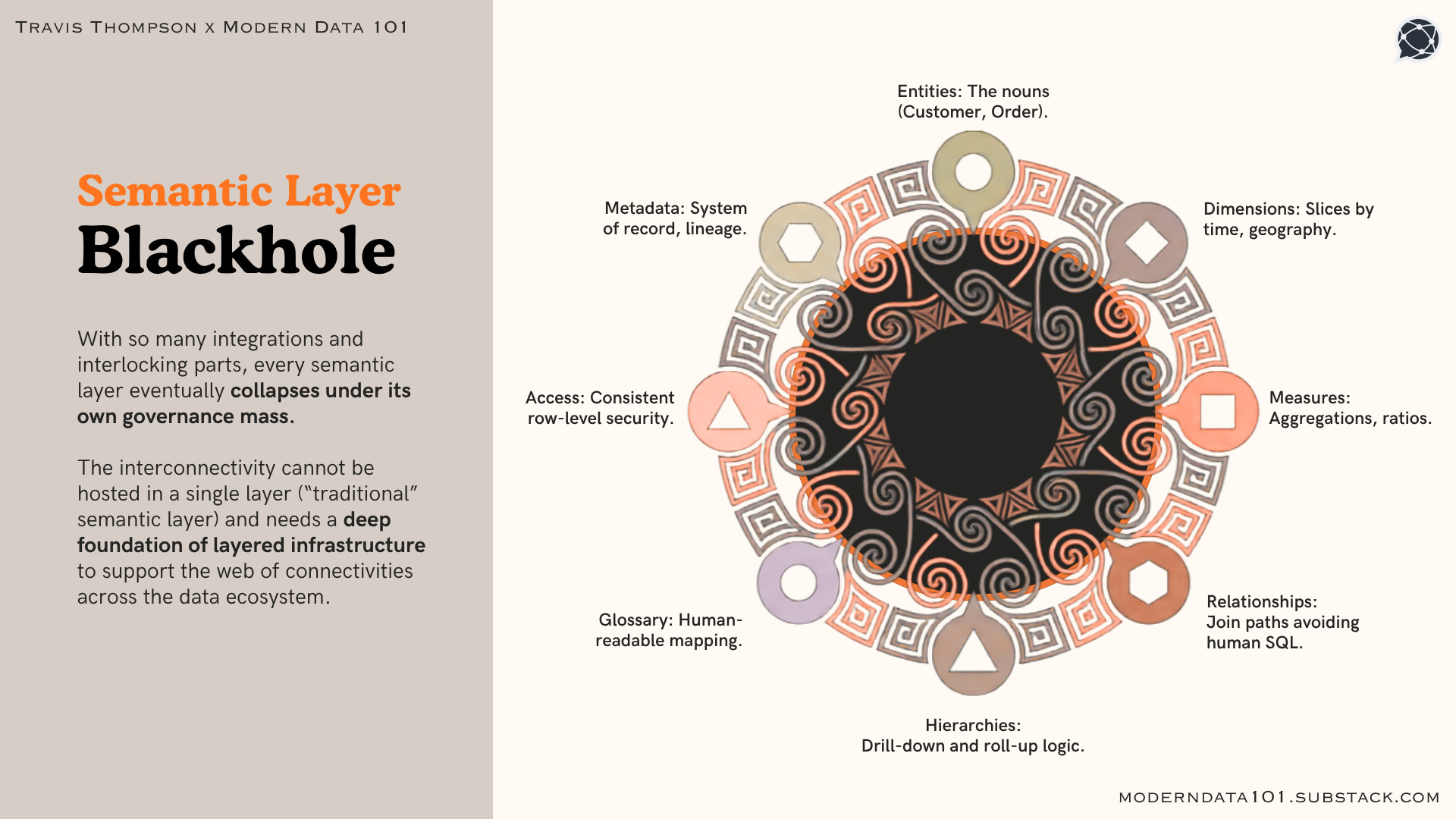
These aren’t independent but connected via a graph.
→ Metrics are computed from measures
→ which are inside entities
→ which connect via relationships
→ which are organized by hierarchies
→ exposed to humans through the glossary
→ gated by access policy
→ all of it tracked by the metadata repository.
Change any one node, and the graph needs re-validating instead of just the node.
Change-management requirements for semantic layer
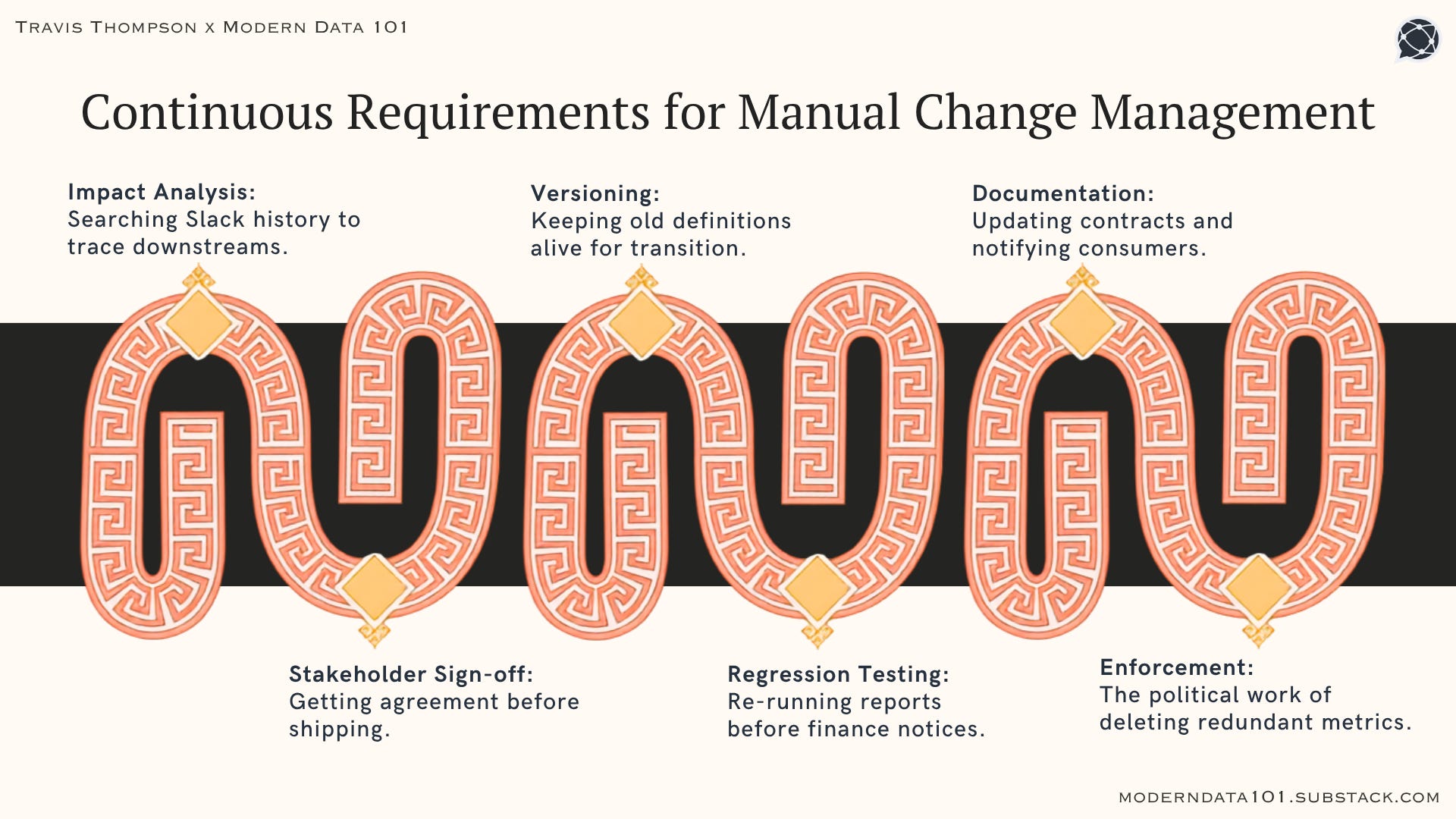
If you don’t have a platform that treats the semantic layer as connected metadata, keeping it alive requires a standing team doing, by hand, roughly the following on every change request:
Impact analysis: trace every dashboard, model, and downstream metric that touches the entity or measure being changed. Without lineage tooling, this is done by searching Slack history and asking around.
Stakeholder sign-off: get the metric’s business owner, and every team consuming it, to agree on the new definition before it ships, not after someone notices the numbers moved.
Versioning and deprecation: keep the old definition queryable for some transition window so historical reports don’t silently change under people’s feet, while clearly marking it as deprecated.
Regression testing: re-run downstream reports against the new definition to confirm nothing broke, ideally before it goes live, not when finance calls asking why quarterly revenue shifted by three per cent.
Documentation and communication: update the glossary, the contract (definition, owner, version history, where it’s consumed), and actively notify every downstream consumer, because undocumented tribal knowledge is exactly what a semantic layer exists to eliminate.
Enforcement: actually get teams to delete the local, redundant version of the metric once the governed one exists, which is the genuinely hard, ongoing, political work.
Every one of those steps is manual labor scaled to the number of consumers and the number of tools in the stack, repeated for every change, forever.
That’s why teams end up needing a dedicated owner or committee just to run this process because coordination doesn’t get cheaper as the organization grows, but gets more expensive.
How a Unified Data Platform Scales Dynamic Semantics
A unified data platform doesn’t remove the need for judgment calls about what a metric should mean. Humans still decide that.
A unified data platform removes the manual coordination overhead around semantic maintenance processes.
We package the semantic model as part of a bundled, versioned data product: the transformation logic, quality contracts, access policies, and consumption APIs all exist and version together as a single governed unit, rather than as separate artifacts a human has to keep in sync by hand.
Because it maintains active metadata and lineage across the stack rather than inside one BI tool, impact analysis stops being a manual search exercise: the system already knows which dashboards, models, and AI agents consume a given definition, so tracing blast radius is a lookup.
Governance (row-level access, masking, policy) is enforced as part of the platform automatically rather than reapplied by hand every time a definition changes, which means compliance scales with usage.
And because the semantic layer is unified across the whole stack rather than bound to one warehouse or one BI tool, a redefinition propagates once to every consumer (dashboards, applications, and AI systems alike) instead of needing to be manually re-implemented in Power BI, then again in the warehouse, then again wherever a team built their own copy.
The value of consolidation
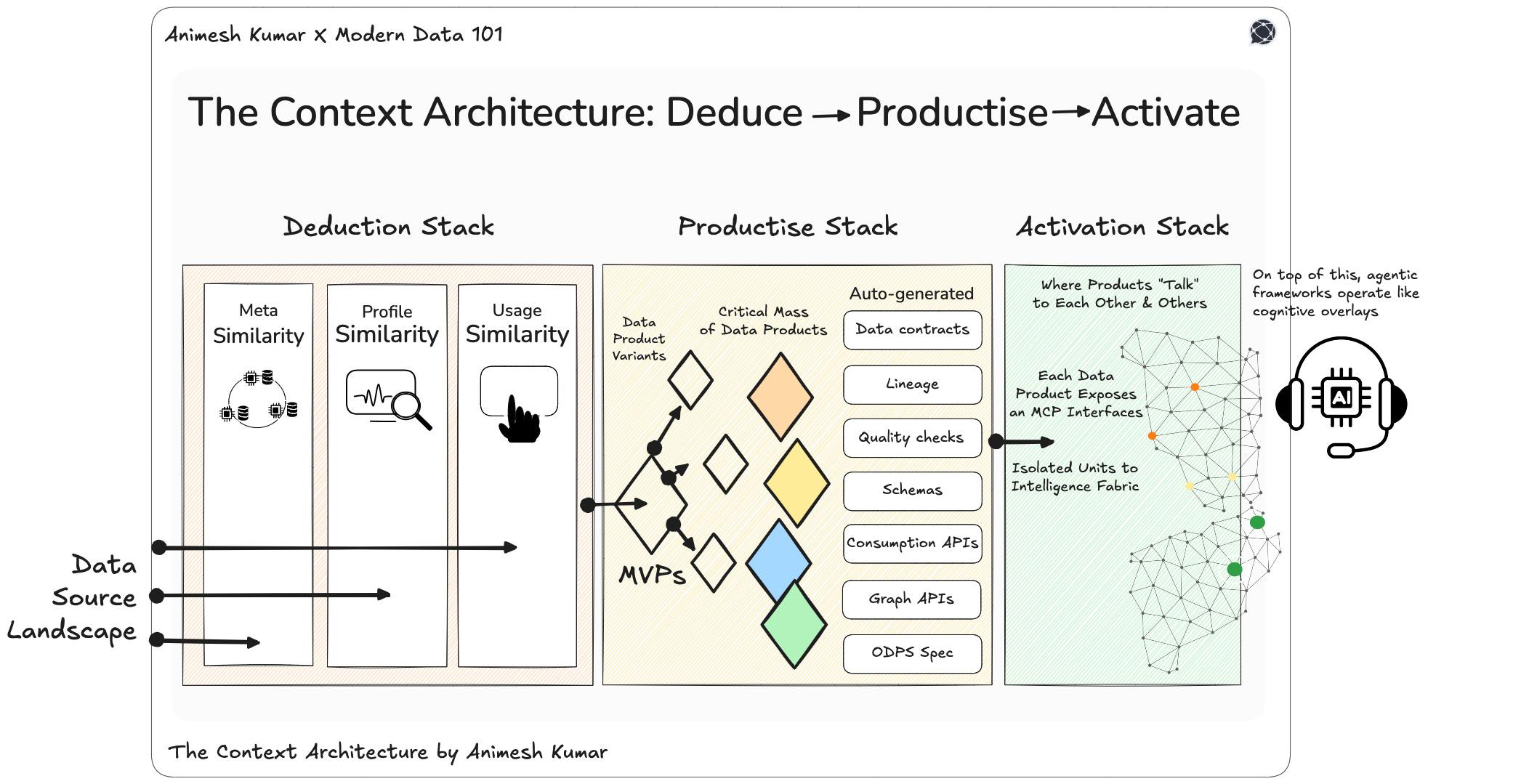
Consolidation does not make the maintenance aspect free. But it changes what the change-management function spends its time on.
Without a unified platform, most of the team’s effort goes into finding out what a change affects and manually propagating it everywhere: pure coordination tax.
That tax mostly disappears when a unified infrastructure takes over that cognitive load by literally maintaining consistent integrations and abstracting them across all parts of the data ecosystem.
MD101 Support ☎️
If you have any queries about the piece, feel free to connect with the author(s). Or connect with the MD101 team directly at community@moderndata101.com 🧡
Author Connect 💬
Connect with Travis on LinkedIn 💬
Data contracts govern the pipe, semantic layers govern the meaning, and this leaves open the layer that governs the confidence. A unified platform propagates a redefinition once, and that same commit quietly voids months of accumulated trust for every consumer downstream. Blast radius as a lookup tells you who is affected, not who should stop trusting the number until that trust is rebuilt. Does the versioned data product carry that trust state, or does propagation move the meaning and leave confidence to rebuild in the dark?
Thanks for this. The AI agent you name in passing as one more consumer is where the stakes of your maintenance problem escalate. A human analyst reading a stale dashboard catches a suspicious number; an agent consuming the same semantic definition acts on it at machine speed, upstream of any review, so the sanity check that currently absorbs the blast radius drops out of the stack. That shifts semantic-layer governance from a maintenance cost into the reliability floor enterprise AI runs on. Only about 7 percent of enterprises have data clean enough to be AI-ready today, and the binding constraint is the discipline gap your social problem names, not the tooling.