
Knowledge Graph for AI: Mapping Capabilities with Distilled AI Primitives
Leveraging the power of graphs to play with probabilities

To understand knowledge graphs for AI, we must first understand what AI fundamentally is. At this point, everyone devours the idea, especially so in the data & AI industry. But the technology has advanced so far beyond us that some of us might be projecting.
We often come across discussions where “thoughts” or “feelings” of AI are addressed, or ideas where people are convinced that AI may soon have a mind of its own. Or the “intelligence” of these AI systems is addressed in a way that it seems to sound and even taste like superintelligence to those who truly believe it.
So, as always, let’s go back to basics.
What is AI when you open up all the parts
There’s a splendid explanation of this by Claude itself. Someone asked what it “feels” to be their LLM, and this is what it came up with:
AI is like a kid who has read a LOT of books and seen a LOT of pictures. Because of that, it gets really good at guessing:
What word comes next in a sentence
What a picture should look like
What answer sounds right
“Thinking” and “feeling” with regard to AI come down to probability calculations. What token comes next? Display the one with the highest chance based on what it has observed or seen many times.
The Denominator
If everything is a probability, it must be calculating the probability on top of something. In simplest terms. That’s your denominator, or all the patterns it has mined from frequent observations and ended up remembering.
That gives you one important primitive of AI:
Memory of patterns (from lots of data)
The Numerator
The numerator is the subject of interest: for what are we calculating the probability?
AI already knows how to remember patterns, compare things, and guess what comes next. But it can only use what it can see right now to output results.
Just like machine learning models use training data to “learn the world” and then keep running on new data to produce outcomes.
That gives us the second important primitive of AI:
The current data
The Calculation
Comparing the Numerator (current data) to all past patterns learned (memory of patterns).
This gives us the third primitive of AI:
The math or equation that finds similarities
How does a Knowledge Graph Work with these AI Primitives
So we have our three primitives:
Memory of patterns (from lots of data)
The current data
The math that finds similarities
Now here’s the problem. Left to itself, the AI’s memory is enormous, but static. It learned the world up to a point in time, from whatever it was trained on. Essentially, the concept of train, test, and novel data.
The moment you have your own data, there’s a point after which AI starts to drift. And the issue with generative AI is that the user cannot explicitly realise or detect where the results started to shift.
You could paste your data into the prompt every time. And for small, simple questions, that works fine. But the moment your question requires connecting dots across multiple facts? Or you need to know where the answer came from? Or whether it’s still true? The pasted-text approach falls over.
This is the gap a knowledge graph designed for human as well as machine users fills.
The Knowledge Graph as a Purpose-Built Memory
Remember the denominator. The AI’s memory of patterns. A knowledge graph for AI extends it with something the base model was never designed to have: your structured memory.
In a knowledge graph, every fact is a small, precise statement about how two things relate to each other.
What that gives you is a memory that isn’t a blob of text.
It’s a web of relationships that can be navigated, queried, and reasoned over.
It maps directly onto how AI actually works with information, that is, with connections.
What Makes a Knowledge Graph AI-Native
Terminology is important. A plain knowledge graph stores facts. A context graph, on the other hand, is the knowledge graph purpose-built for AI. The distinction makes all the difference.
Our implementation of the context graph adds three layers on top of the base knowledge graph:
Neighbourhoods from advanced similarities
State Nodes manifesting at the point of state change (focusing on management of the “current data” primitive, feedback outcomes from the calculations back into the knowledge graph for AI)
Let’s map each of these to our three AI primitives.
1. Neighbourhoods from Advanced Similarities → Extending Memory of Patterns
There are three types of similarities that the Knowledge Graph for AI enables machine users to detect:
Meta Similarity
Profile Similarity
Usage Similarity
Unlike vector embeddings, which capture textual likeness, this model captures relational logic. Vectors work well for language, but data systems aren’t sentences; they are ecosystems of relationships. Similarity here isn’t measured with cosine distance but conceptual closeness across structure, semantics, and behaviour.
~ Rise of the Context Architecture
If traditional Knowledge Graphs were a web of entities and relationships, Knowledge Graphs for AI adds the vertical richness, picture something like this:
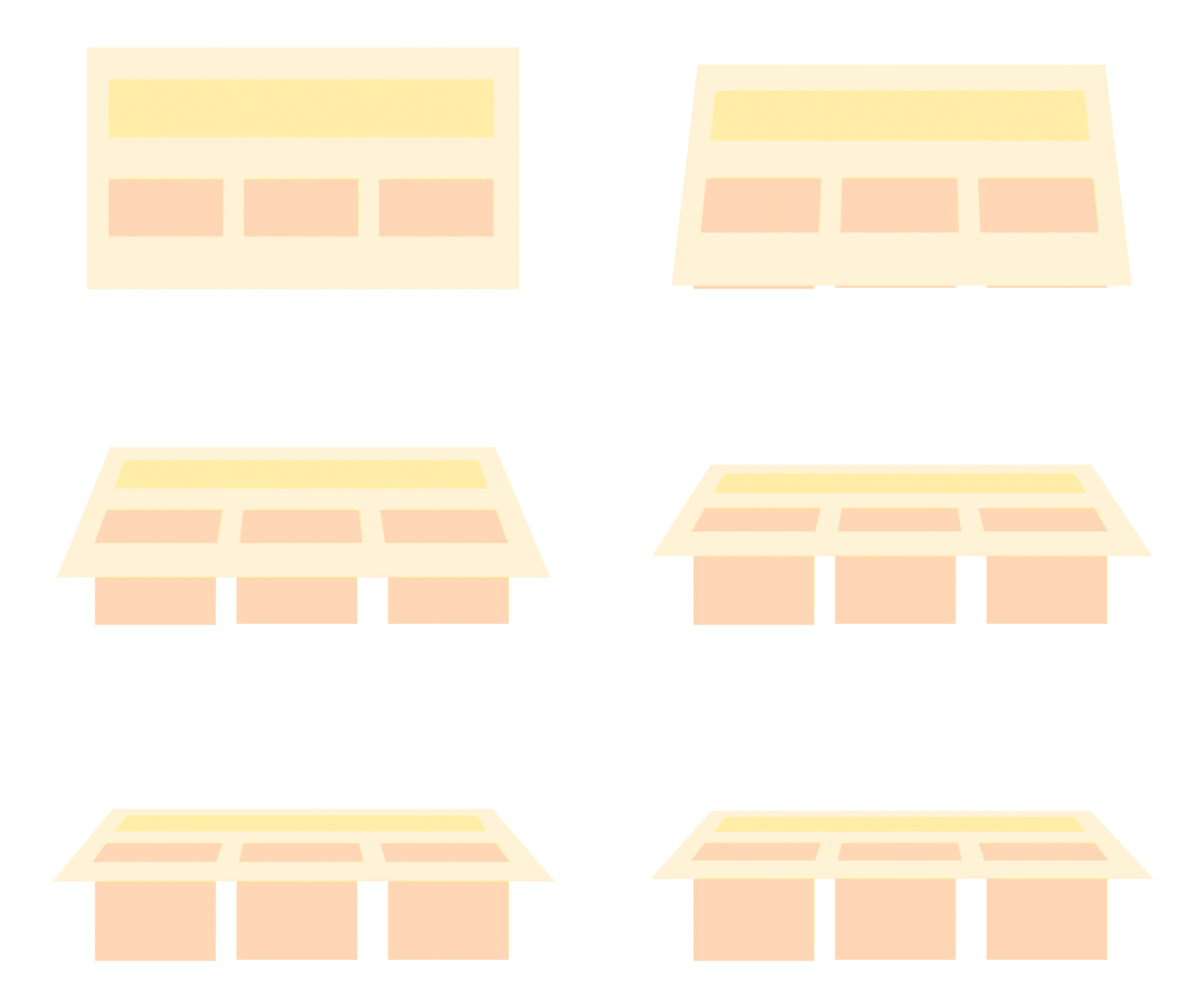
This vertical richness comes from capturing the following as parsable data:
Structural features as data. It scans and records schema design, column count, data types, etc. This is the skeleton that hints at how systems are organised.
Statistical fingerprint of data. It scans and records distributions, regex patterns, PII markers, and anomalies to infer what kind of information the data carries.
Behaviour and intent. It registers who queries a table, how often, and for what purpose. Access patterns become indicators of value.
Based on the above information, the context stack is able to detect and mark advanced similarities on multiple levels. Enabling the capability to deduce and reason on multi-layer context.
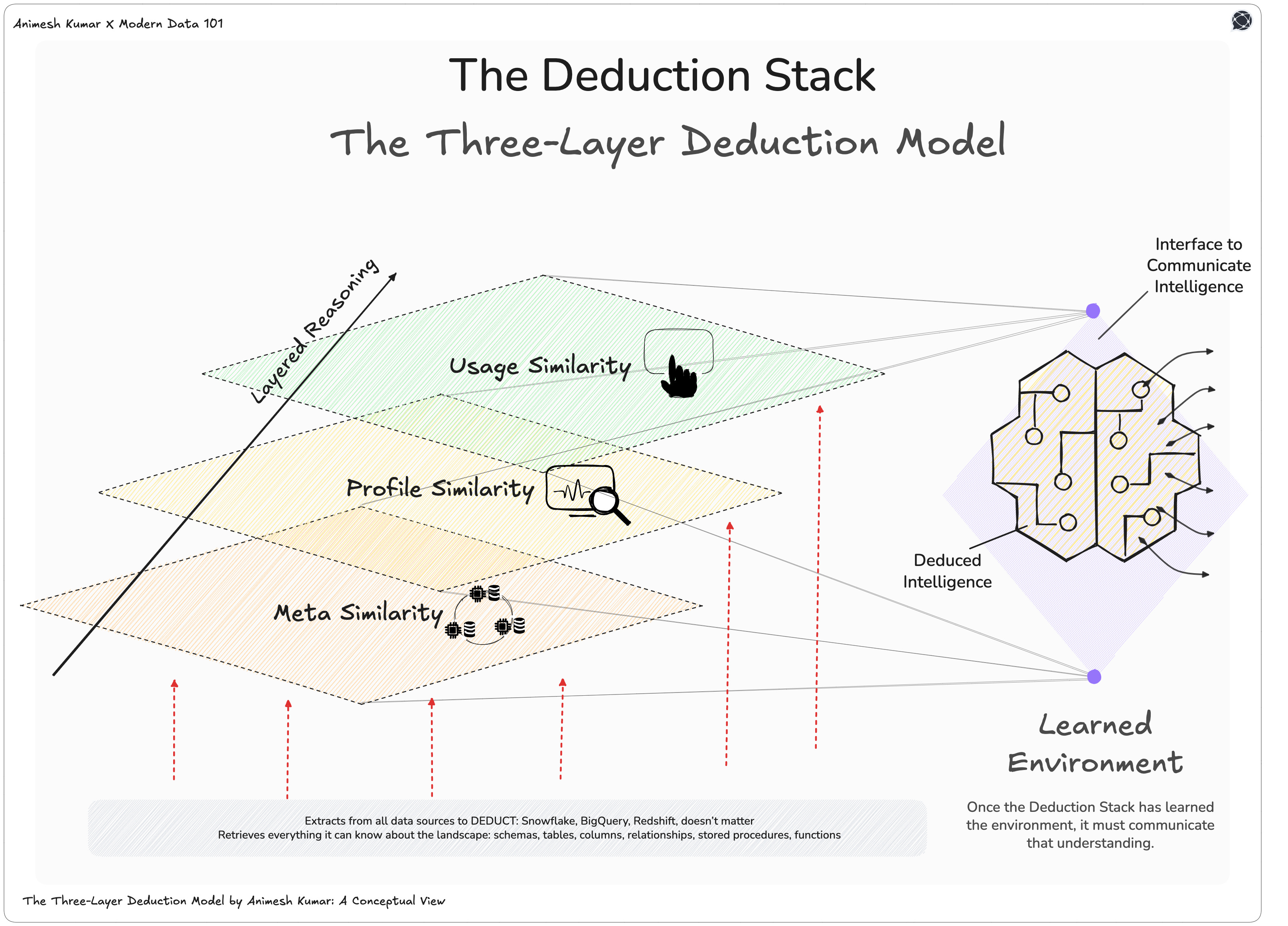
These advanced similarities also enable machines to detect true clusters that are not just clustered based on uni-dimensional vector similarities. Deducing and marking neighbourhoods with layered reasoning: it doesn’t search for matches; it constructs understanding just like we do.
Think of something like pointer nodes that would act as neighbourhood markers or navigational shortcuts, enabling both cost optimisation on searches at scale as well as improving precision and time to output. The AI gets handed a pre-reasoned bridge.
These smart retrievals differ from traditional RAG (Retrieval-Augmented Generation) in one critical way. Standard RAG retrieves chunks of text ranked by vector distance. The knowledge graph for AI retrieves by deduction.
The difference matters enormously when your question requires multi-hop reasoning. A vector search returns the closest paragraph, while the graph traversal would return the connected dots and the chain.
Research in this space bears this out.
Hogan et al.'s 2021 survey on knowledge graphs highlights that graph-based representations offer advantages over flat text retrieval by directly encoding structured, relational information, which helps mitigate the limitations of language models that rely on inference.
Now map this back to the primitive.
Think about how we extend our own minds. We have scores of information stored in books and browsers. When processing a thought that needs more information, we fetch it: a browser search, a library visit, a scan of the table of contents.
We don’t re-read everything. We use a pointer. The browser and librarian surface related and similar items, sparing us from processing the entire archive. Once we have the new information, we append it to the thought and produce an output.
Artificial neural networks work the same way:
The pre-trained network is the memory of patterns
The neuron firings are pattern matches
The fetching is the formation of a new connection
Advanced similarities and deduced neighbourhoods furnish that pointer.
Instead of pattern-matching across an undifferentiated mass of text, the AI now has a map. The deductions tell the retrieval system what kind of thing to look for and how it connects to other things, so the pointer lands on the right cluster, not the nearest-sounding one.
And it doesn’t just make the existing memory navigable, but actively extends it. The AI’s trained memory of patterns is fixed at the point of training. It cannot learn your domain, entities, or internal relationships by itself.
But the AI now has pattern territory it was never trained on, but in a form it can reason over, because the granular context gives it the semantic structure to make sense of what it’s seeing. The memory of patterns grows not by retraining, but by being handed a well-structured extension of itself.
2. State Nodes → Anchoring the Current Data
The second feature addresses a different aspect entirely.
Even with a perfect memory and sharp similarity calculations, the AI is only as good as what it can see right now. The numerator, or the current data, is whatever lands in context at inference time. If that data is a snapshot with no history attached, the AI treats it as a complete picture. Often it isn’t.
State Nodes make change itself a first-class citizen in the graph. When something meaningful shifts (like a status, a relationship, a classification, a value), a State Node materialises. It doesn’t overwrite the prior state. It supersedes it (increasing vertical richness), timestamped, attached to the entity, and connected both to what was true before and what is true now. The full lineage of how something arrived at its current condition is preserved and queryable.
This, in summary, enables decision-trace awareness* that is a key capability of context graphs. (*Decision-trace awareness is the ability of a system to capture judgment at the moment it is exercised, not after outcomes are observed. More thoroughly, decision-trace awareness means the system does not just record what happened, but preserves why a particular path was chosen over all other possible paths.)
The AI’s context window stops receiving a value and starts receiving a value with its history and state/decision lineage. Not just what is, but what changed, when, from what, and why.
Temporal Knowledge Graph research (Leblay and Chekol’s work on time-aware link prediction being a foundational example) demonstrates that models reasoning over entities without temporal grounding make systematically worse predictions.
State Nodes are the practical implementation of that, not asking the AI to infer time from language, but making time explicit in structure.
The second effect is on Memory of patterns.
The third primitive is the math that produces an outcome. When the AI produces assets like a recommendation, a classification, or a generated answer, a user acts or doesn’t. In most architectures, that result evaporates. The system that produced it never learns from it.
State Nodes allow outcomes to be written back into the graph. The result of the AI’s calculation becomes a new node, connected to the entities involved, the context that produced it, and the prior states that preceded it. Over time, the graph accumulates not just facts about the world, but facts about what the AI did with those facts and what happened next, creating new reference patterns.
Final Note
The knowledge graph doesn’t make AI smarter in the way people imagine when they talk about superintelligence. It makes AI accurate, cost-friendly, and faster, and gives the probability engine a clean, structured, domain-specific denominator to calculate against, and a precise, relationship-traced numerator to reason from.
From the Modern Data 101 Team ❤
Just Launched: State of Data Products 2026 Q2
State of Data Products is a quarterly read for senior data and AI decision-makers that reports the industry reality of enterprise data and AI. This edition covers ontology as AI infrastructure, the agentic AI deployment gap, observability blind spots, and why lean AI is the economic reality check the industry needed.

This is a lot of context... "The AI’s context window stops receiving a value and starts receiving a value with its history and state/decision lineage. Not just what is, but what changed, when, from what, and why." That's useful information to have, but the key design question is: does AI really need all this context for every task, or is it best to have that context stored and available for search only when needed?
Adoption numbers are the interesting check on this. Knowledge graphs show a 3x accuracy gain over vector RAG for complex reasoning (Arya.ai's read), and Gartner's 2026 Hype Cycle is positioning context graphs as critical agentic-AI infrastructure — but enterprise KG adoption in production sat flat at 27% in 2025 versus 26% the year before, and GraphRAG still runs 3-5x the cost of baseline RAG once you account for ontology design and curation labor. The gap isn't platform capability, it's organizational readiness to sustain the curation.
State Nodes look like the right answer to something I've seen flagged as unresolved: production graph-memory systems currently lack native temporal decay, so they silently accumulate stale relationships without governance forcing a correction. If state capture actually gets built as a first-class primitive rather than bolted on, that's a real fix — not just an incremental feature.