
Data Ownership in Practice: Defining Decision Rights in Enterprise Data Governance
Why Effective Governance Depends on Explicit Authority, Risk Acceptance, and Designed Decision Rights

About Our Contributing Expert
Antonio Sánchez Gómez | Data Management & Governance Specialist

Antonio is a Data Management & Governance Specialist at Roche, where he focuses on building scalable Master Data Management (MDM) and Data Governance operating models. His work centres on establishing clear data ownership, decision rights, and reusable governance structures that transform master data from technical assets into trusted business capabilities.
Antonio designs and implements governance frameworks that create single sources of truth across critical domains such as customer, product, and pricing. He advocates for governance as an operational discipline, embedding stewardship workflows, quality thresholds, and accountability directly into enterprise execution. His perspective positions Data Governance as a revenue enabler that accelerates product launches, strengthens regulatory confidence, and removes friction from core business processes.
With a background spanning data engineering, analytics, and big data across organisations such as the International Olympic Committee and financial services programs at BBVA via Minsait and Deloitte, Antonio combines deep technical expertise with enterprise governance design. We’re thrilled to feature his unique insights on Modern Data 101!
We actively collaborate with data experts to bring the best resources to a 15,000+ strong community of data leaders and practitioners. If you have something to share, reach out!
🫴🏻 Share your ideas and work: community@moderndata101.com
*Note: Opinions expressed in contributions are not our own and are only curated by us for broader access and discussion. All submissions are vetted for quality & relevance. We keep it information-first and do not support any promotions, paid or otherwise.
Let’s Dive In
Data Ownership is one of the most frequently defined roles in Data Governance, and one of the least effectively exercised.
Despite mature frameworks, operating models, and role catalogs, many organizations still struggle to translate “ownership” into real authority, accountability, and business consequence. In most enterprises, Data Owners exist formally but operate with limited decision power.
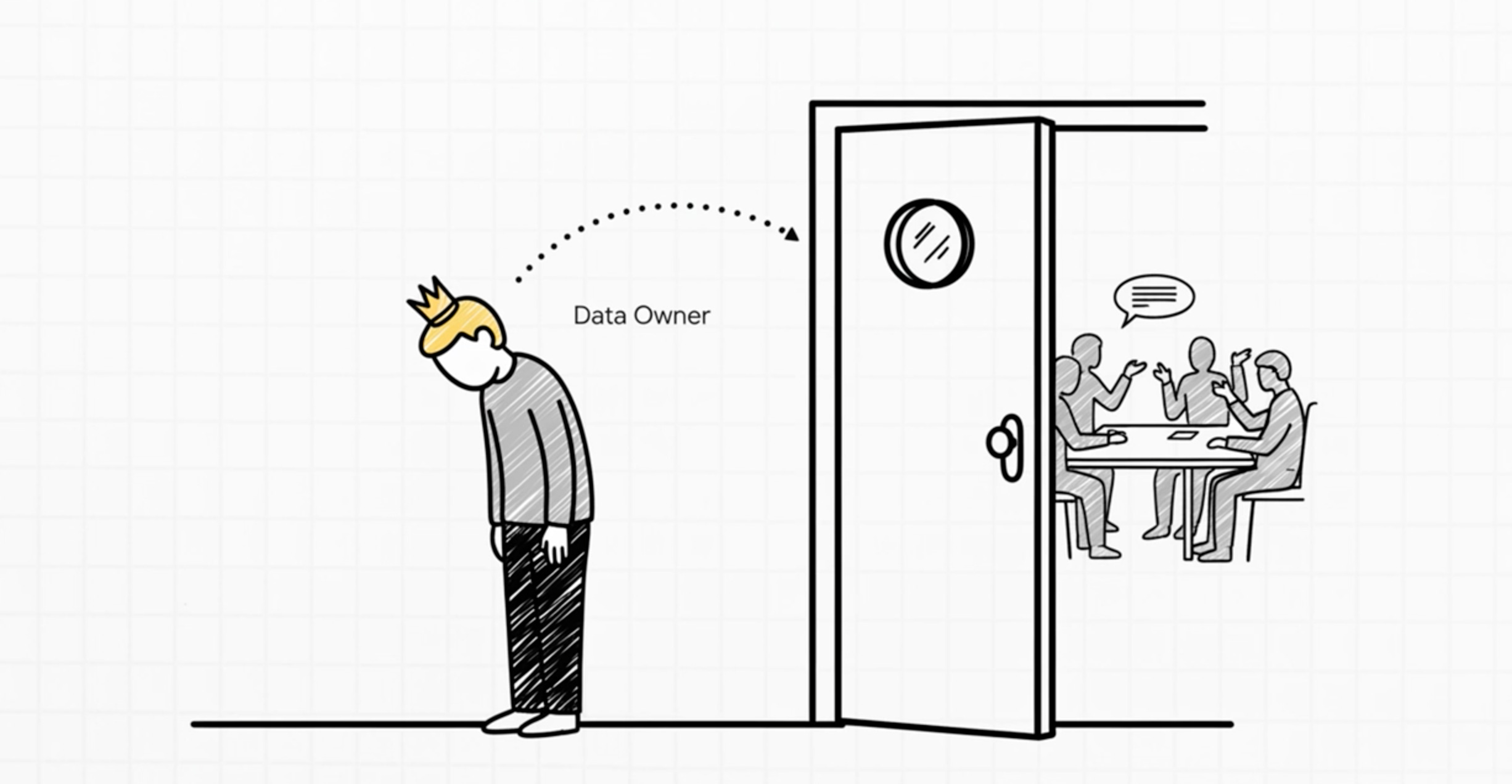
They are documented in RACI matrices and governance policies, yet excluded from the very decisions that define ownership.
Such as accepting data-related risk, approving quality thresholds, authorizing usage, or resolving conflicts between value and control. Ownership becomes visible on paper but is absent where governance must operate.
This is not primarily a problem of role definition, but a problem of decision rights.
Governance fails because authority is not explicitly designed into the operating model. When decision rights are unclear, decisions drift toward operational teams, escalation becomes informal or avoided, and accountability dissolves across organizational boundaries. The result is governance that appears complete but is structurally incapable of governing.
This article reframes Data Ownership as a decision-centric role. Ownership is not a collection of activities, but a formally empowered authority embedded in the enterprise decision system. Only when decision rights are explicit, bounded, and institutionally supported does Data Governance function as an operational capability rather than an aspirational framework.
🔖 Related Read

Why Data Ownership Remains Ineffective
The persistent failure of Data Ownership is not due to a lack of documentation, but due to a systemic misunderstanding of what ownership entails in complex organizations.
In many cases, Data Owners are appointed based on hierarchy or domain proximity, without a corresponding transfer of decision authority. Governance programs emphasize responsibilities (reviews, forums, endorsements) while remaining silent on what Data Owners are actually entitled to decide.
Responsibility is assigned without power.
Matrixed organizational structures amplify this issue.
Decisions around data quality, access, or structural change cut across domains and systems. When decision rights are not explicit, decisions are either pushed downward, endlessly deferred through consensus, or resolved informally by whoever has operational leverage.
The Data Owner is bypassed not out of negligence, but because their authority was never operationalized.
Until Data Ownership is designed around decision rights rather than activities, it will remain symbolic rather than functional.
From Role Definitions to Decision Authority
Governance operates through decisions, not tasks. Outcomes are shaped by who can approve thresholds, accept risk, authorize usage, or prioritize remediation, not by who attends meetings or produces reports.
Many organizations assign Data Owners extensive accountability without granting authority to enforce standards, block usage, or resolve conflicts. This structural asymmetry (responsibility without decision rights) erodes both the credibility of the role and the effectiveness of governance.
A decision-rights perspective forces a different question:
What decisions is the Data Owner empowered to make, under which conditions, and with what consequences?
Decision rights must be explicit, bounded, and supported by formal escalation paths. Authority that exists only through personal influence collapses under pressure. Moving from role descriptions to decision design is not a semantic refinement; it is a structural redesign from governance as documentation to governance as an executable system.
What Ownership Means in an Enterprise Context
Enterprise ownership combines authority, accountability, and risk acceptance.
Data Ownership is inseparable from risk. Decisions on quality thresholds, usage permissions, access models, or structural change all imply acceptance of residual financial, operational, regulatory, or reputational risk.
The Data Owner’s role is not to eliminate risk, but to decide what level of risk is acceptable in light of business objectives.
Data Owners do not own only data artifacts, but also the business outcomes enabled by data. This is why ownership cannot sit exclusively with technical or operational roles. Authority must rest with those accountable for business performance.
Ownership must also be institutionally recognized. Informal authority collapses under competing priorities. Decision rights must be documented, escalation paths defined, and accountability mechanisms enforced. Without this, ownership defaults into coordination rather than governance.
Core Decision Domains of the Data Owner
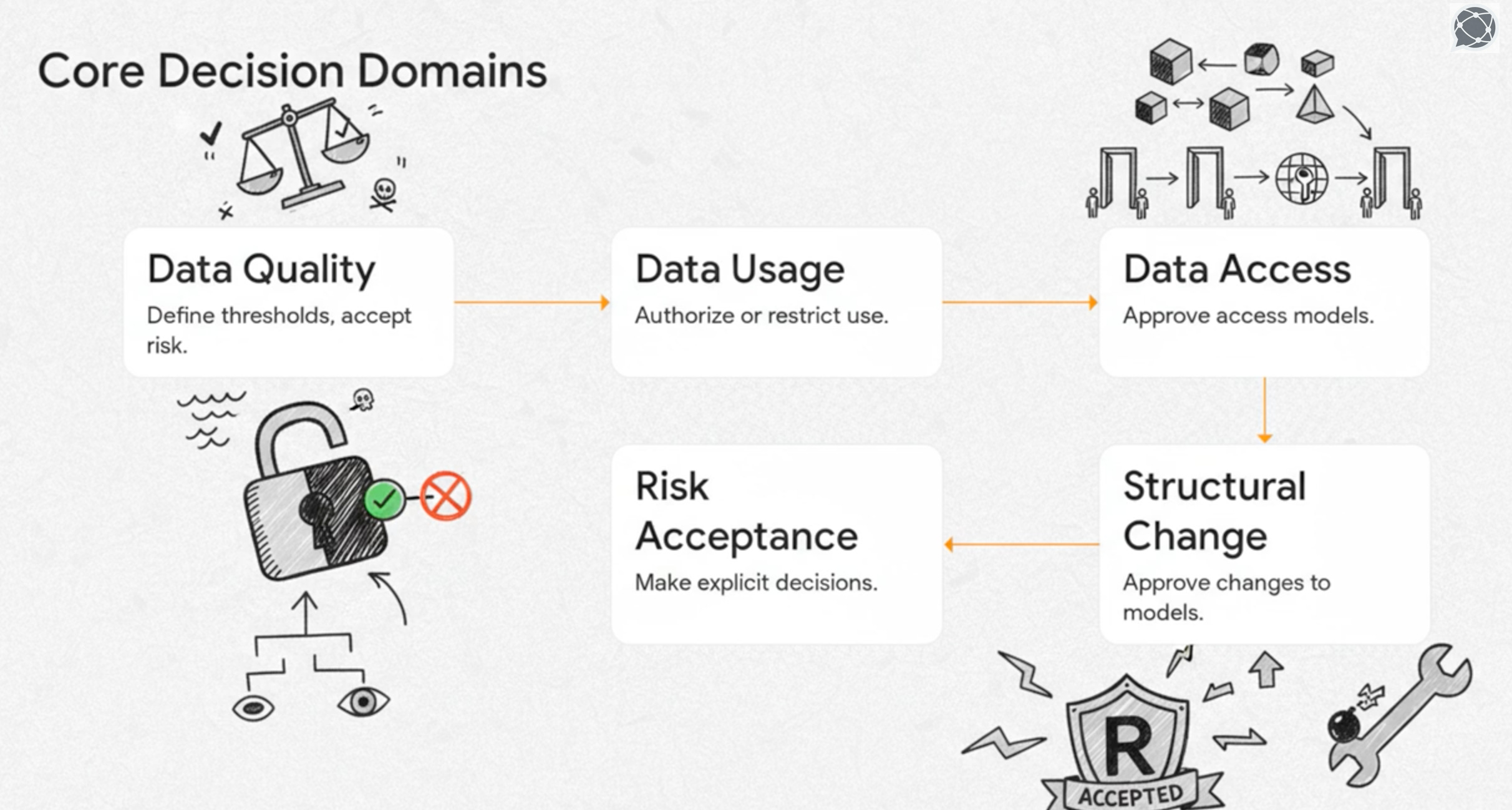
In practice, Data Owner decision rights consistently fall into a limited set of domains:
Data Quality: Defining acceptable quality thresholds, approving exceptions, and accepting residual risk, not monitoring metrics or fixing defects.
Data Usage: Authorizing or restricting use based on value, sensitivity, contractual obligations, or regulatory exposure.
Data Access: approving access models and exceptions. Provisioning is operational while authorization is a business decision.
Structural & Lifecycle Change: approving changes to models, hierarchies, or reference data, balancing short-term delivery against long-term consistency.
Risk Acceptance: making explicit decisions about tolerated exposure and escalation.
These domains define the practical scope of Data Ownership. Without explicit authority in these areas, ownership cannot function operationally.
Data Owner vs Data Steward: The Decision Boundary
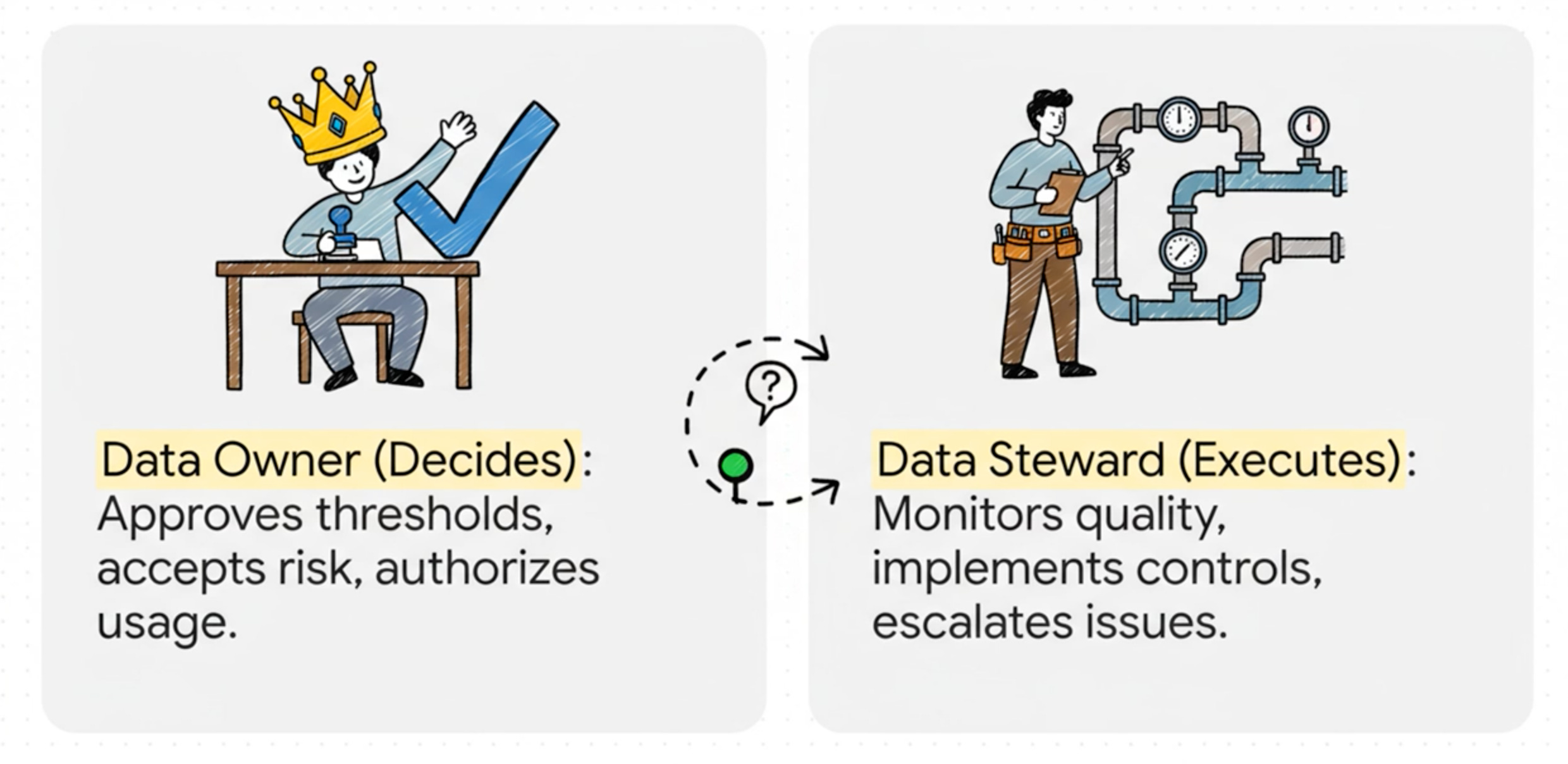
The most common governance failure is not role confusion, but misallocated decision authority.
Data Stewards are frequently asked to approve thresholds, accept deviations, or close issues: decisions that carry business risk they are not accountable for. Conversely, some organizations reduce Data Owners to passive signatories, disengaged from real decisions.
When governance models describe who does what but not who decides what, decisions inevitably migrate toward execution. This is a structural inevitability.
Effective governance requires a clear separation: Data Owners decide and Data Stewards execute, monitor, and escalate.
🔖 Related Read
The Cost of Undefined Decision Rights
Undefined decision rights produce systemic consequences:
Organizationally: Accountability erodes, escalation becomes performative, and ownership is perceived as optional.
Operationally: Decisions stall, exceptions are inconsistent, and teams default to risk aversion or workarounds.
From a business perspective, organizations oscillate between over-control and under-control, slowing delivery or exposing themselves to unmanaged risk.
Most critically, risk ownership becomes invisible.
When incidents occur, decisions cannot be traced back to accountable roles, and governance failures are misattributed to process or tooling rather than design.
Designing Decision Rights into the Operating Model
Making decision rights explicit requires intentional design, not more documentation.
Effective models start from recurring decision points (quality thresholds, usage authorization, access exceptions, structural change) and explicitly assign authority, scope, and escalation criteria. Decision rights must be embedded into workflows, not layered on top.
Escalation thresholds must be predefined to prevent operational roles from absorbing risk by default. Authority must be institutionally reinforced through leadership mandate, alignment with risk management, and performance accountability.
Finally, decisions must be visible and traceable. Governance matures when risk acceptance is deliberate rather than accidental.
How Decision Rights Evolve with Maturity
Decision rights evolve as governance matures:
Early stages: Corrective, visible, and frequent intervention to establish legitimacy.
Stabilization: Focus shifts to approving standards and tolerances, enabling operational autonomy within boundaries.
Advanced maturity: Decisions become strategic and anticipatory, enabling new capabilities and managing trade-offs between innovation and control.
Misalignment occurs when mature expectations are applied to immature structures—or when decision models remain overly prescriptive after governance stabilizes.
Signals of Effective Data Ownership
Functional Data Ownership is visible through behavior:
Clear, timely decisions at escalation points
Explicit, traceable risk acceptance
Consistent decision patterns across similar cases
Confident execution by operational roles
Reduced decision latency and predictable outcomes
Where these signals are absent, ownership exists structurally but not operationally.
Final Note
Governance works when decisions have owners. Data Governance succeeds or fails on the clarity of decision ownership.
Frameworks provide structure, but they do not govern. Governance becomes real only when authority to decide is explicitly assigned, supported, and exercised.
Until organizations design Data Ownership around decision rights, governance will remain an intention rather than an operational capability. Governance works when decisions have owners.
MD101 Support ☎️
If you have any queries about the piece, feel free to connect with the author(s). Or connect with the MD101 team directly at community@moderndata101.com 🧡
Author Connect

Connect with Antonio Sánchez Gómez on LinkedIn 💬
From MD101 team 🧡
The Modern Data Masterclass: Learn from 5 Masters in Data Products, Agentic Ecosystems, and Data Adoption!
With our latest community milestone, we opened up The Modern Data Masterclass for all to tune in and find countless insights from top data experts in the field. We are extremely appreciative of the time and effort they’ve dedicatedly shared with us to make this happen for the data community.
Master Modern Data, One Session at a Time!

 | A guest post by
|