
The Perfume Problem: Why Most AI Demos Smell Amazing and Disappear Just as Fast
AI demos often sell the sensation of intelligence more convincingly than the substance behind it, and buyers need to learn how to tell the difference before they buy the bottle.

About Our Contributing Expert
Salil Athalye | Senior Director, Solutions Engineering

Salil Athalye is a data and analytics leader specialising in decision intelligence, business transformation, and modern data platforms. With more than two decades of experience spanning analytics engineering, product development, Lean Six Sigma, and AI-driven transformation, he helps organisations focus their data investments on the business outcomes that matter most.
Currently serving as Senior Director of Solutions Engineering at The Modern Data Company, Salil brings deep expertise across modern data stacks, graph databases, Microsoft Fabric, and GenAI-enabled productivity. His career includes leadership roles at Constellation Brands, eLogic (now part of Avanade), and Xerox, where he led analytics modernisation, predictive modelling, platform engineering, and enterprise-scale transformation initiatives. Alongside his industry work, he has spent over a decade as an Adjunct Faculty Member and Capstone Coordinator at Rochester Institute of Technology, mentoring graduate students in product development and systems thinking. We’re thrilled to feature his insights on Modern Data 101.
We actively collaborate with data experts to bring the best resources to a 20,000+ strong community of data leaders and practitioners. If you have something to share, reach out!
🫴🏻 Share your ideas and work: community@moderndata101.com
*Note: Opinions expressed in contributions are not our own and are only curated by us for broader access and discussion. All submissions are vetted for quality & relevance. We keep it information-first and do not support any promotions, paid or otherwise!
Let’s Dive In
I have a confession.
I have a favorite shortcut through the mall. I am, as they say, wont to take it. And yes, I just used the word “wont” in an article about AI. We contain multitudes.
This particular shortcut runs straight through the fragrance corridor of a popular department store. It’s a narrow gauntlet of glass cases, white-coated attendants, and enough scent molecules per cubic foot to render a bloodhound temporarily useless.
I was half-daydreaming, turning over the latest AI demo I’d watched the night before. It was one of those conversational interfaces layered on top of a BI platform, fluid and apparently intelligent. Then something stopped me cold.
A fragrance. Sharp and warm, with something more complex underneath. The kind that reaches your feet before your brain has processed anything. I was, briefly and involuntarily, transfixed.
And then it was gone.
Like something half-imagined. I turned around. No attendant. No bottle. No dispenser. Nothing. Just the faint memory of something that had, for one suspended moment, demanded my complete attention.
I thought about that scent the whole drive home.
The Art of the Arresting Demo
Walk through any major tech conference right now, and you’ll find the AI equivalent of that fragrance corridor. Natural-language dashboards. Interfaces that seem to understand what you actually meant, not just what you typed. The kind of thing that makes a VP of Sales turn to a VP of IT and whisper, “Why don’t we have this?”
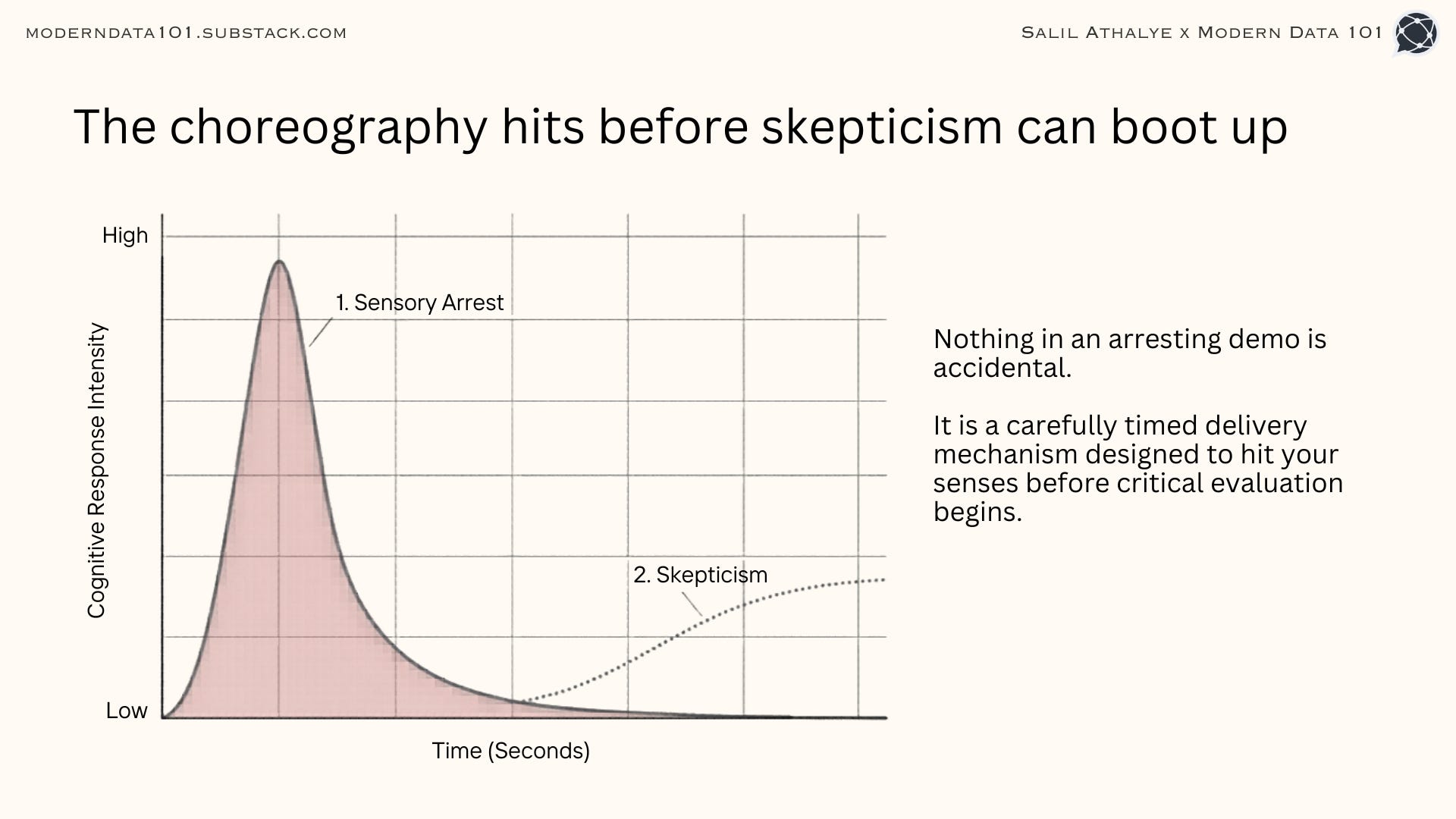
And like an expertly deployed fragrance, these demos are designed to arrest you.
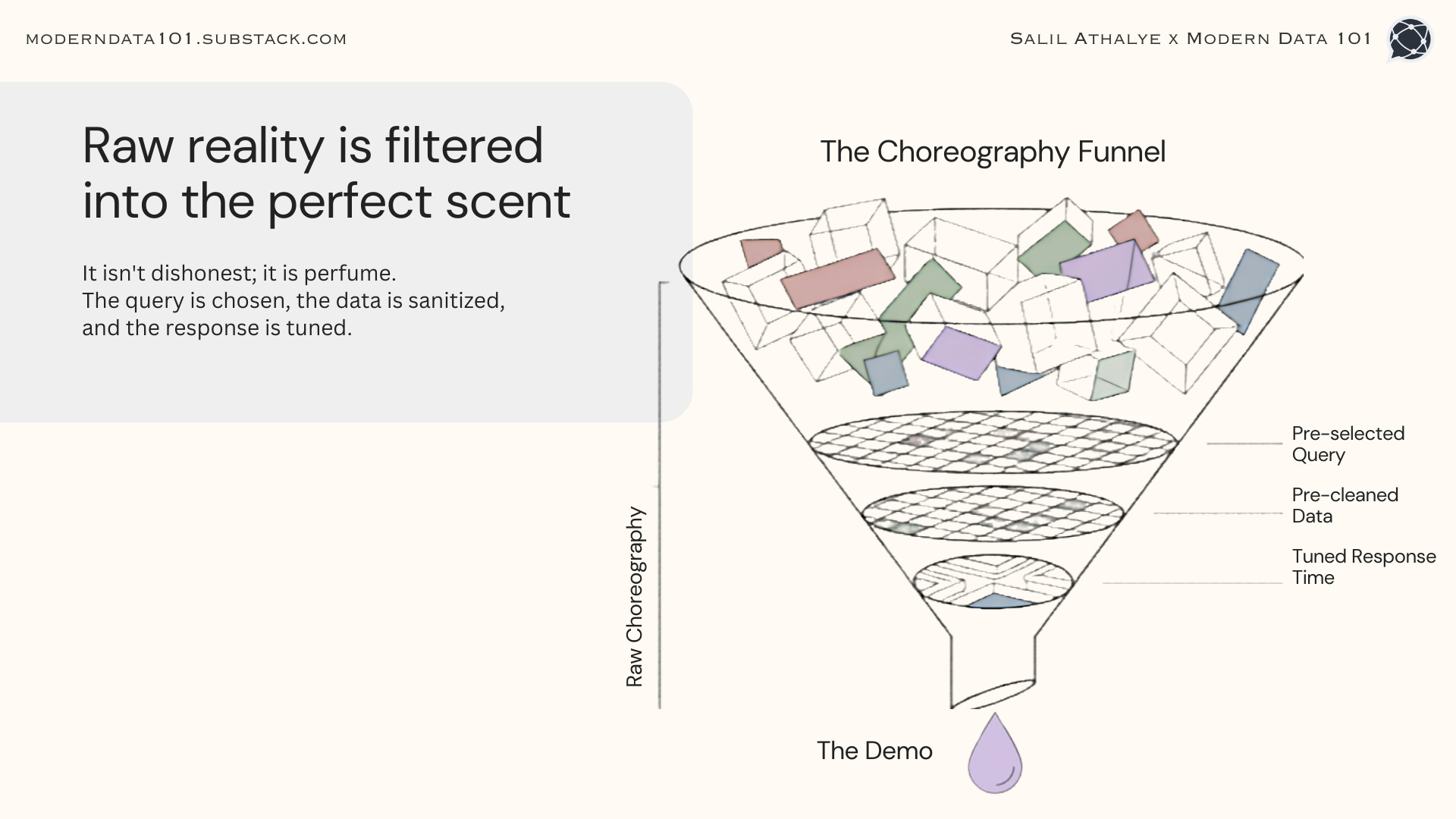
Nothing in that demo was accidental. The query had been pre-selected. The data was already cleaned up. Even the response time had been tuned. The whole thing was choreographed to hit your senses before your skepticism had time to boot up.
I’m not saying it’s dishonest. I’m saying it’s perfume.
What Fragrance Actually Costs
Most of it isn’t the scent. The raw ingredients might cost a few dollars: the Bulgarian rose, the vetiver, the whatever-it-is that stopped me dead in a mall corridor. What you’re paying for is the formulation expertise, the testing, and above all, the delivery mechanism that makes sure it hits you at exactly the right moment.
The demo is the delivery mechanism. The question is what’s actually in the bottle.
When you see an AI-powered BI interface responding to natural language with the apparent intelligence of a seasoned analyst, the question worth asking isn’t “Is this impressive?”
It clearly is. The more important questions are:
What’s the formulation underneath?
How was the data prepared?
How is the semantic model maintained?
What happens when someone asks a question the demo didn’t anticipate?
Who owns the answer when the confident-sounding response turns out to be confidently wrong?
Those questions don’t get asked in the corridor. They get asked three months into implementation, when the magic has worn off, and you’re trying to explain to your CFO why the quarterly numbers don’t match.
The Evanescence Is the Point
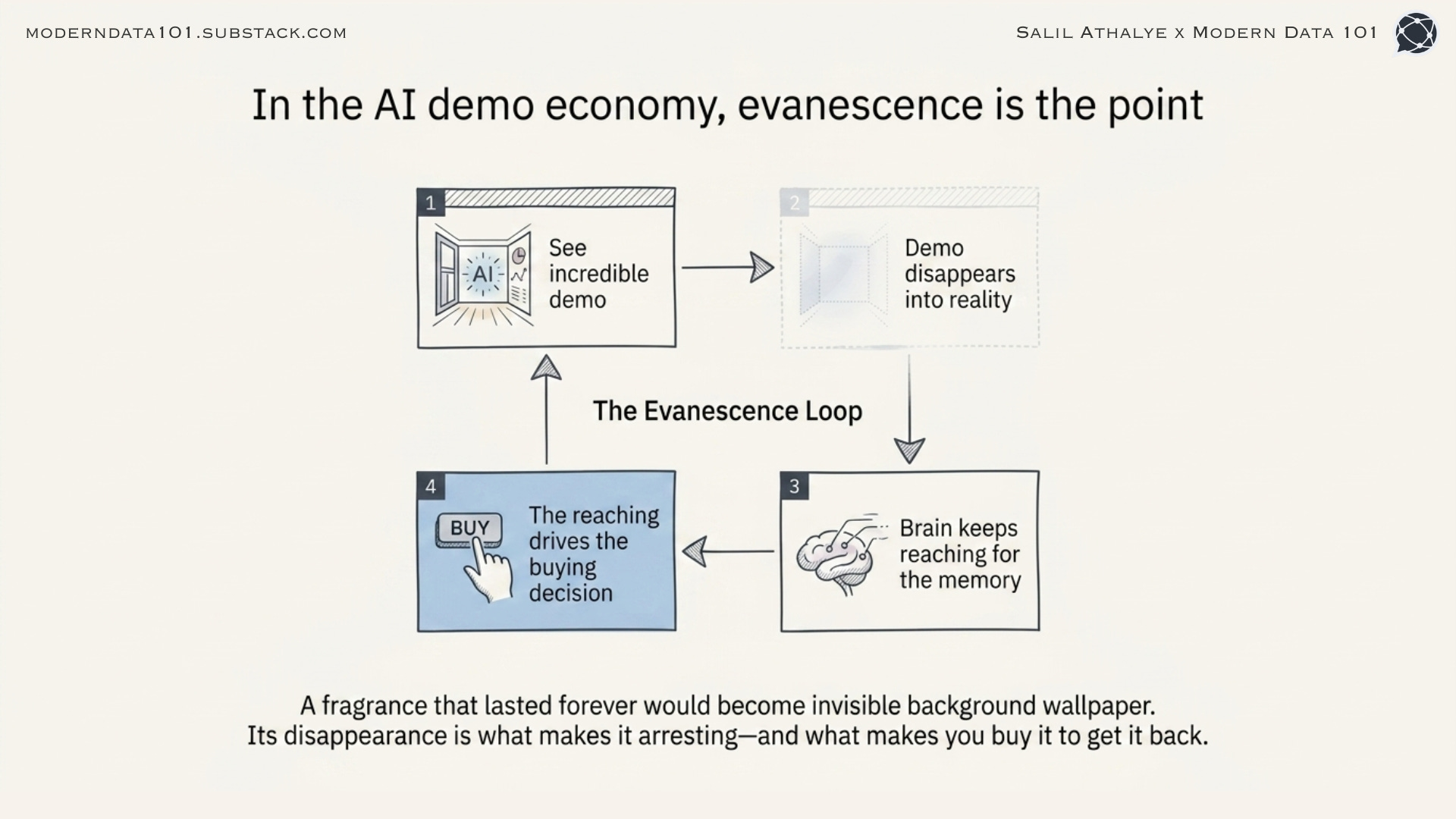
What I keep coming back to is this: in the AI demo economy, evanescence is part of the appeal.
A fragrance that lasted forever wouldn’t make you think about it all night. It would become invisible, just background noise or wallpaper, something you stop noticing.
The fact that it disappears is what makes it arresting.
The same dynamic powers the demo cycle. You see something incredible, briefly, and then it’s gone. Then you’re back in your real environment, with your real data, your real infrastructure, and your team’s actual capabilities. Your brain keeps reaching for it. And that reaching is what drives the buying decision.
The good vendors have substance behind the scent. In my experience, that substance is rarer than the demo implies.
How to Tell the Difference Before You Buy the Bottle
There are simple filters I now apply to any AI demo that make me stop in the corridor.
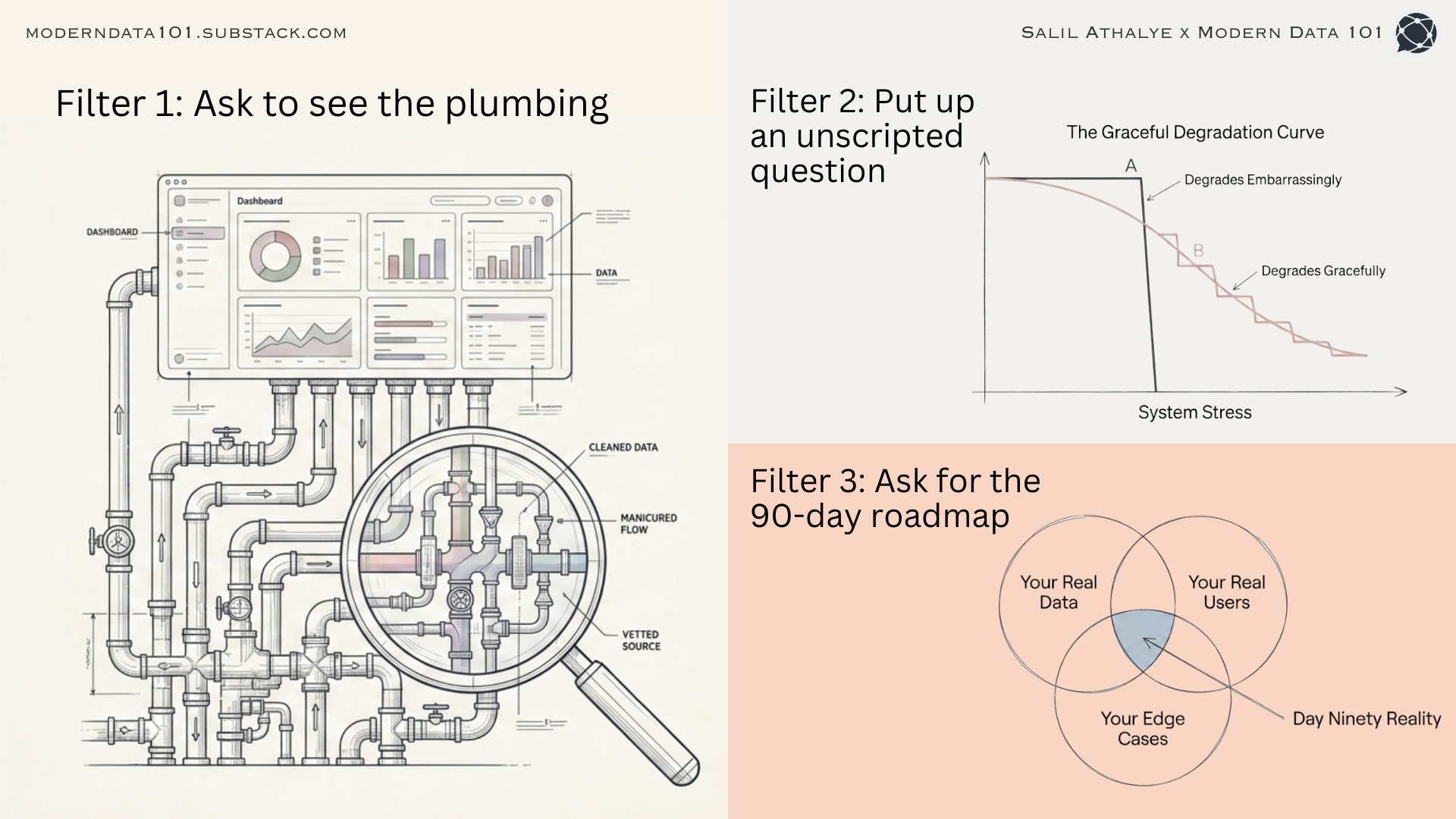
Ask who prepared the data, and what that actually took. Every great AI demo sits on top of carefully prepared data. Ask to see the plumbing.
If the answer is vague, the demo is the product.
Ask what failure looks like. Put a question in front of it that wasn’t in the script. A well-architected system degrades gracefully; a demo degrades embarrassingly. The response to an unexpected question tells you more than the choreographed sequence ever will.
Ask what “live” looks like on day ninety. Not the launch or the pilot. Day ninety, with your data, your users, your edge cases. Ask for a reference customer who can tell you that story.
The answers will tell you whether you’re buying a system or a scent.
The fragrance I encountered in that mall corridor was real. Genuinely remarkable. I still don’t know what it was or where it came from. And that’s fine for a mall corridor. It’s less fine for your data strategy.
MD101 Support ☎️
If you have any queries about the piece, feel free to connect with the author(s). Or connect with the MD101 team directly at community@moderndata101.com 🧡
Author Connect 💬

Connect with Salil on LinkedIn 💬
From the MD101 team 🧡
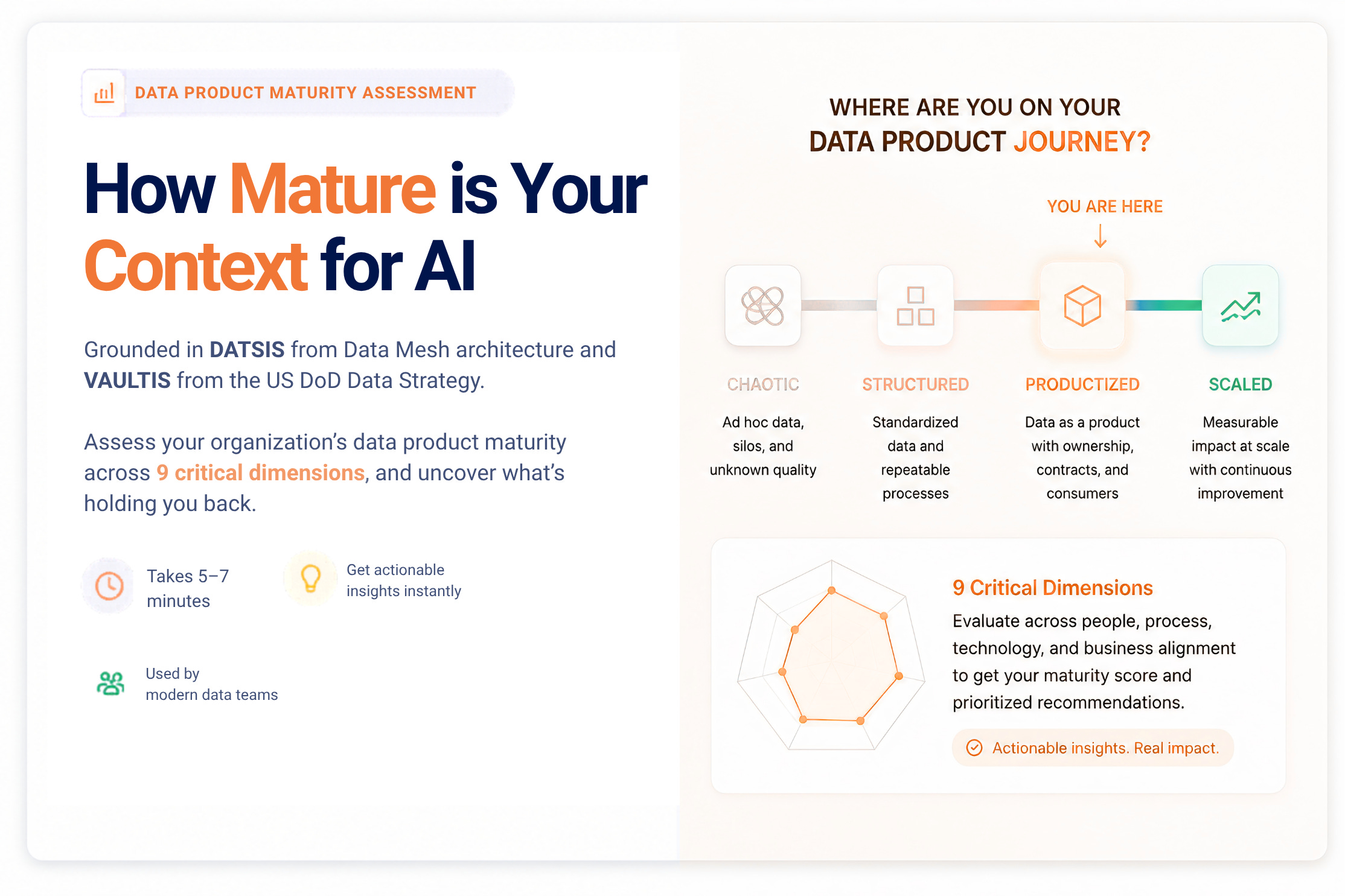
The Data Product Maturity Assessment
 | A guest post by
|
This metaphor hits differently when you're actually allergic to perfume. I don't slow down in that fragrance corridor. I hold my breath and cover my nose to get through it.
Which is probably the more honest response to most AI demos too.
Your piece made me think about Gartner's Hype Cycle. For most GenAI applications we're sitting somewhere between the Peak of Inflated Expectations and the Trough of Disillusionment. Knowing where you are on that curve is the skill that separates good buyers from expensive ones. The "perfume effect" is what inflates the expectations in the first place: a perfectly engineered sensory hit before skepticism boots up.
The real question isn't whether the demo is impressive. It's where you are on the cycle when you evaluate it. Because the deflation is coming either way. The only variable is whether it lands before or after you've signed the contract.
Great piece. Next time, maybe skip the fragrance corridor entirely.