


Something strange happens when you say a word out loud too many times
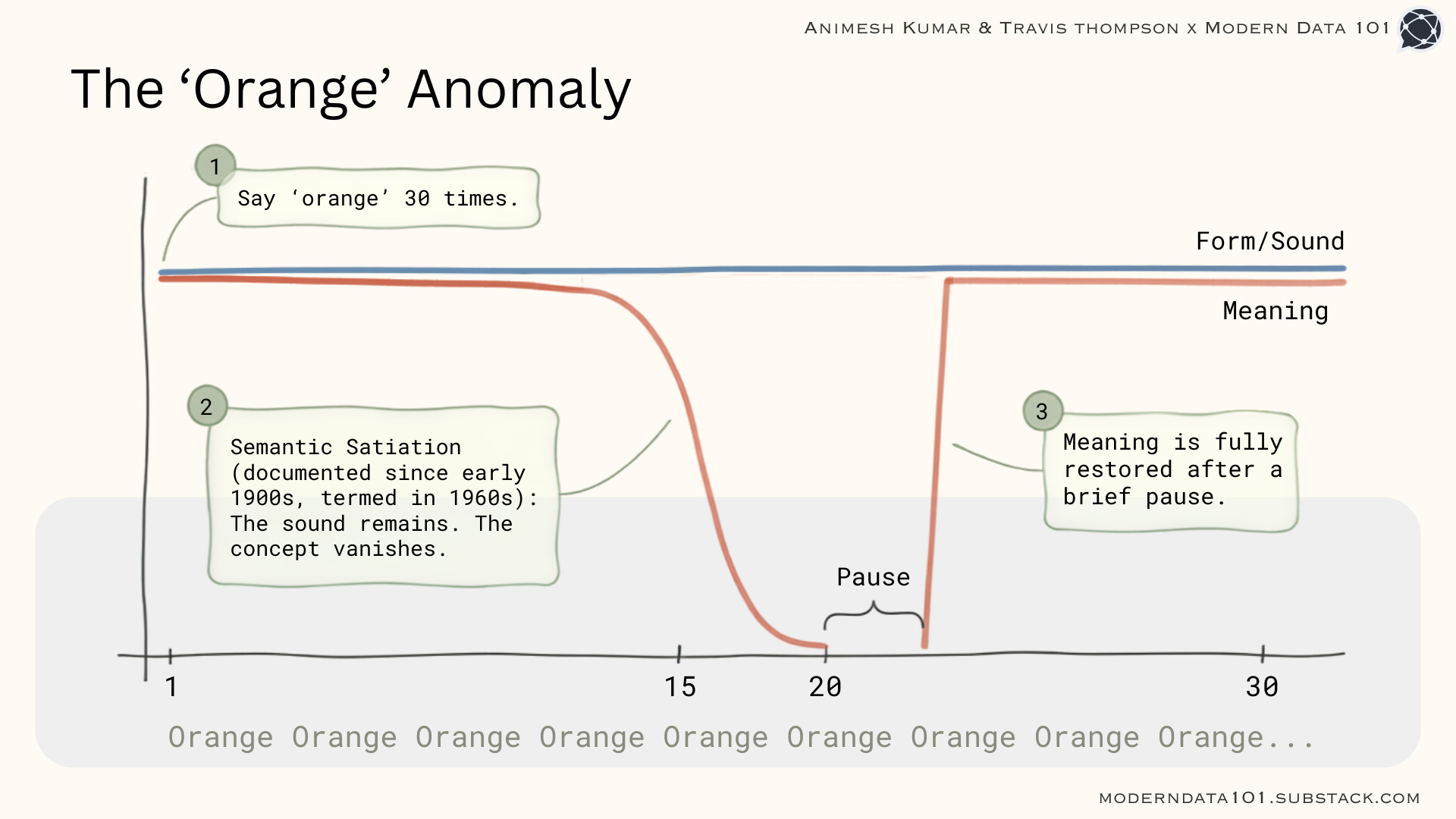
Say “orange” right now. Say it again. Now say it thirty more times, out loud, back to back. Somewhere around repetition fifteen or twenty, the meaning is lost. “Orange” stops being a colour, stops being a fruit, stops being anything.
It becomes a noise your mouth makes. A pure sound-shape with no payload attached. Linguists call this semantic satiation, and it’s been documented since at least the early 1900s, though the term itself came later, in the 1960s, coined by psychologist Leon Jakobovits James.
Once you stop and wait a few seconds and say “orange” one more time, the meaning is just back. Fully restored, like it never left.
As data architects and data platform developers, we find this almost unreasonably useful as a starting point for thinking about NLP, because it reveals the entire architecture of how language works.

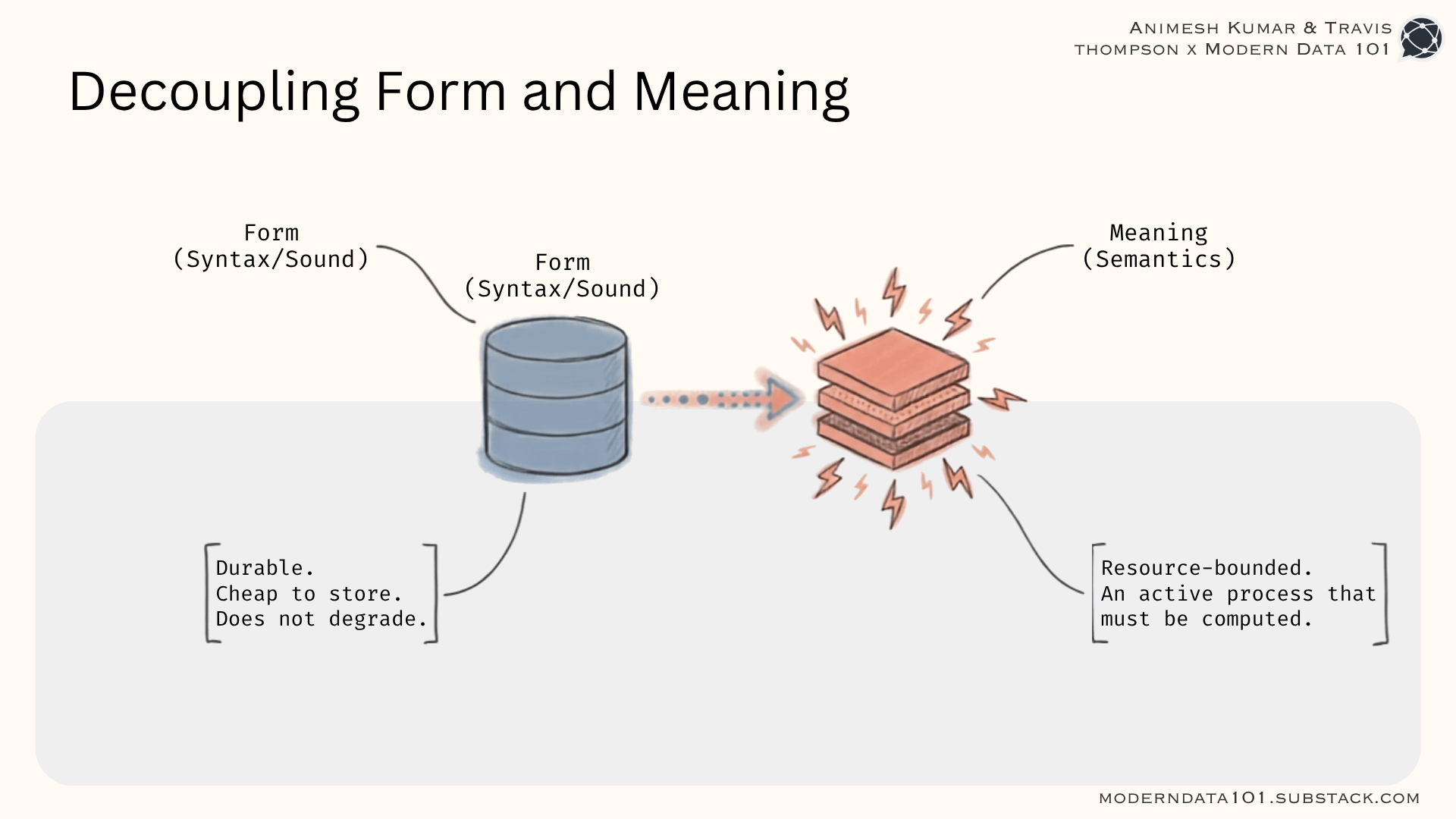
It shows you that form and meaning are stored and processed in different places, on different timescales, governed by different mechanics.
The sound/spelling of “orange” is stable and doesn’t degrade. What breaks down is your access to the meaning layer sitting behind it. You’ve temporarily exhausted some kind of priming or activation resource that links the symbol to the concept.
The link isn’t broken but overworked into a brief, local fatigue. Once the surface-level repetition stops, the underlying semantic association, which exists in a much more durable, structural part of your cognitive system, reasserts itself instantly.
This is, in miniature, the entire history of natural language processing. We spent fifty years building systems that were extremely good at handling the form (syntax, structure, symbol-shuffling) while meaning sat there, stubbornly, as the abstract object we couldn’t quite reach or code into plain accessibility.
The story of NLP is the story of slowly, painfully, moving the centre of gravity from form to meaning.
Generation 0: Words as opaque tokens (1950s-1980s)
The simplest possible thing you could do with text is treat each word as an atomic, meaningless symbol. A token with an ID, nothing more.
Early machine translation and rule-based systems largely revolved around this idea. A word like “bank” was token_4471. You could write grammar rules to decide where it could go in a sentence (syntax), but the system had no representation of what a bank is.
This is functionally identical to what happens to your brain mid-satiation: you have access to the symbol, you can manipulate it, slot it into structures, but the connection to meaning is either absent or assumed to exist somewhere else outside the system.
Early NLP didn’t suffer from satiation.
It simply never had semantics to lose in the first place.
These systems were syntax-only by design.
Generation 1: Statistics over symbols (1990s-2000s)
The next move was to stop hand-writing rules and start counting. N-gram models, Hidden Markov Models, statistical parsers. These systems asked, “Given the last two words, what’s the probability of the next one?” This is still syntax, but it’s syntax with a probability distribution riding on top of it. These kinds of mechanisms are still largely in use to date.
Crucially, this era introduced something architecturally important:
Co-occurrence as a proxy for meaning.
If “doctor” and “nurse” show up in similar contexts across millions of sentences, maybe that similarity in distribution tells you something about similarity in meaning. This is the distributional hypothesis, and it’s the conceptual seed of everything that follows. We hadn’t cracked semantics yet, but we’d found a measurable shadow it casts on syntax.
We think of this as the moment we stopped modelling language as a grammar and started modelling it as a signal. The unit of storage shifted from rules to frequency tables: massive sparse matrices of word-by-context counts. Still no real meaning representation. But now we had a number which distantly represented meaning.
Generation 2: Words as vectors (2013 onward: word2vec, GloVe)
This is where the journey from syntax to semantics gets its first real foothold. Models like Word2vec and GloVe took the distributional hypothesis and gave it geometry: every word becomes a point in a high-dimensional space, and words used in similar contexts end up near each other.
Suddenly, “king” minus “man” plus “woman” lands near “queen.” This was a step beyond syntax since syntax cannot do arithmetic on meaning. This is the first time an NLP system has held something that behaved like a semantic relationship.
But the architectural limitation here maps beautifully back to satiation: these vectors were static. “Orange” had exactly one vector, whether it meant the colour, the fruit or the county in California.
There was no mechanism for context to modulate meaning. If you said “orange” fifty times in a row inside one of these systems, nothing would change at all because the system had no dynamic relationship between repetition and access to meaning.
It had baked meaning into a fixed lookup table. Robust, but inert.
Real human semantic satiation requires a dynamic activation system that can be fatigued.
Word2vec had no such system because it had no online process, just a static table you queried. A vector space is necessary but not sufficient for semantics. You also need a mechanism that uses context, at inference time, to decide which part of the meaning is relevant right now.
Generation 3: Context-sensitive meaning (2018 onward: attention, transformers, contextual embeddings)
Models like ELMo, BERT, and GPT introduced contextual embeddings: the representation of “orange” is no longer fixed, but computed fresh, every time, as a function of the surrounding words.
The self-attention mechanism is, in essence, a learned, dynamic process for deciding how much each surrounding token should influence the meaning of this token right now.
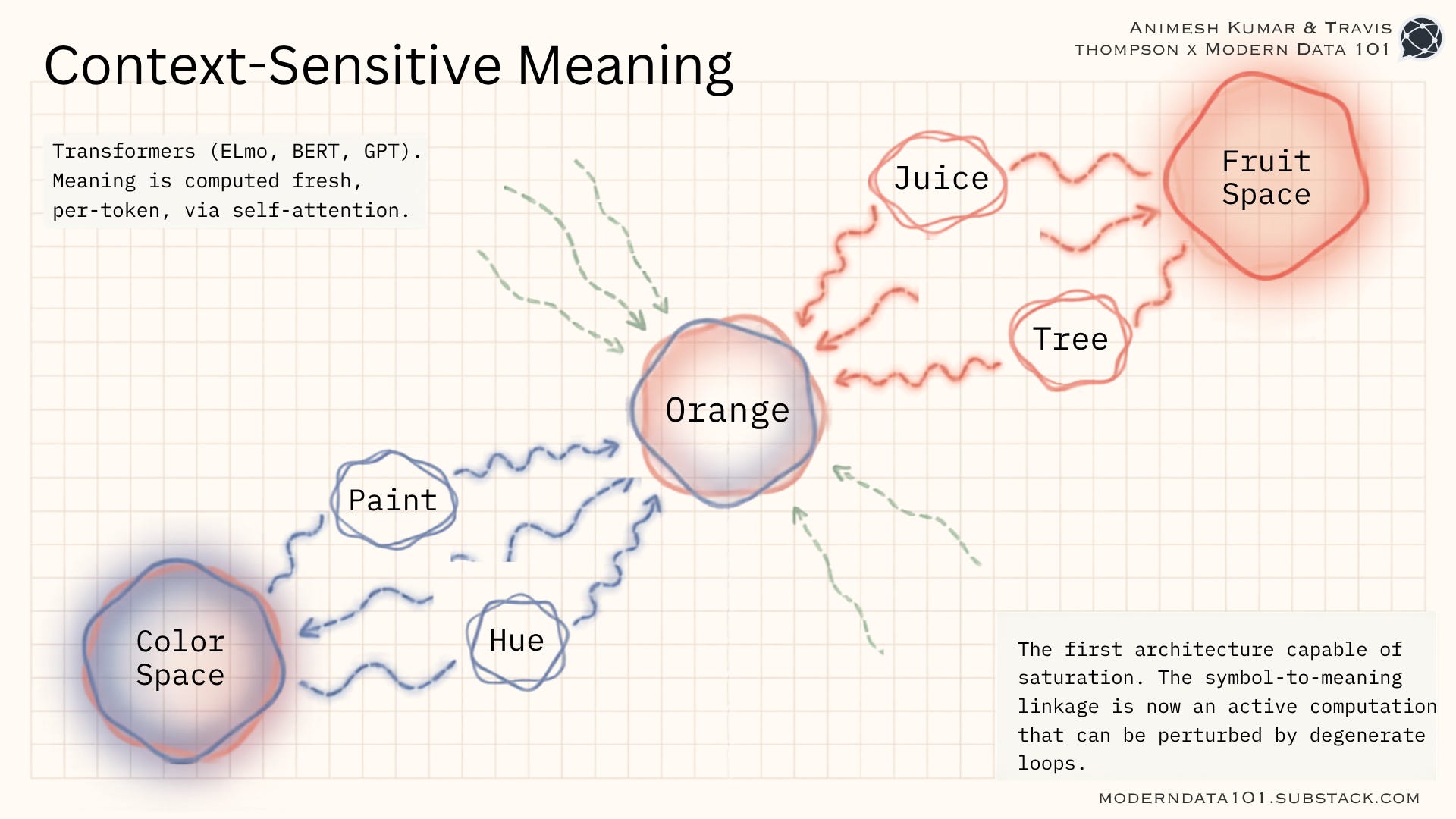
This is the first NLP architecture that has anything resembling the machinery for satiation, even if no one designed it for that purpose. There is now a dynamic, repeated, attention-weighted process happening at inference time that links symbol to context-dependent meaning.
A more natural process that can, in principle, be saturated, overridden, or destabilised by unusual repeated input.
People have informally noticed that pushing large language models into repetitive, degenerate loops can produce strange, glitchy, meaning-light output.
This is not proof of an identical mechanism to human satiation, but a sign that the symbol-to-meaning linkage in these systems is an active computation, and active computations can be perturbed.
That’s a significant shift from syntax to semantics: syntax is structure you can store; semantics, at least the way humans seem to do it, is a process you have to run.
Generation 4: Meaning grounded in use, task, and world model (2022 onwards)
These are models that don’t just compute context-sensitive representations but are tuned against human judgments of what a “good,” “true,” or “helpful” response looks like and increasingly ground language against other modalities (images, code execution, structured data, tool use).
This is significant architecturally because it adds a feedback loop outside the text itself: meaning is no longer just “what correlates with what in a giant corpus,” it’s “what correlates with what and aligns with human-verified outcomes.”
This is the closest NLP has come to something like grounded semantics, where the word “orange” connects not just to other words, but, via multimodal training and tool use, toward something resembling the actual concept: colour values, fruit images, real-world facts you can verify.
We still don’t have anything like full grounding. A model has never bitten an orange. But the trajectory is unmistakable: each layer added a mechanism that brought the system one step closer to context-sensitive, dynamically computed, externally validated meaning.
We are distinctively moving further away from “meaning as a static label on a token” and closer to “meaning as a dynamic process shaped by everything around it.”
Organisations satiate too: The semantic layer as a corrective mechanism
Semantic satiation shows up at a completely different scale in organisations and natural language systems. Organisations suffer from semantic satiation just like human cognition does.
Walk into any company of meaningful size, and you’ll hear the same handful of words constantly: customer, revenue, active user, churn. These words get repeated across meetings, dashboards, Slack threads, and quarterly reviews so often that everyone assumes the repetition itself is proof of shared understanding. That’s so far from the truth.
Ask five different teams what “Active User” means, and you won’t get five answers. You’ll often get seven, because some teams hold two competing internal definitions simultaneously without realising it.
Marketing might count anyone who opened the app. Product might require a meaningful action within a session. Finance might tie it to a billing event. The word stays constant while the concept underneath it has fragmented.
This is structurally the same thing happening to “orange” after thirty repetitions. The symbol is intact, fluent, instantly recognisable, and the link to a single, stable meaning has been de-linked.
The difference is that an organisation doesn’t get the few seconds of silence that let your brain’s links snap back. Without an intervention, the gap just persists until someone builds two reports that disagree with each other and a meeting gets spent arguing about whose number is “right.”
A semantic layer is the organisational equivalent of that recovery mechanism. Architecturally, it does exactly what the move from static word vectors to contextual embeddings did for NLP: it stops treating the term as a label everyone privately re-derives meaning for and instead defines it once, formally, as a governed object.
“Active User” stops being a phrase and becomes a contract: a precise, queryable definition with explicit logic, sitting in one place, that every dashboard, report, and downstream consumer is required to point back to.
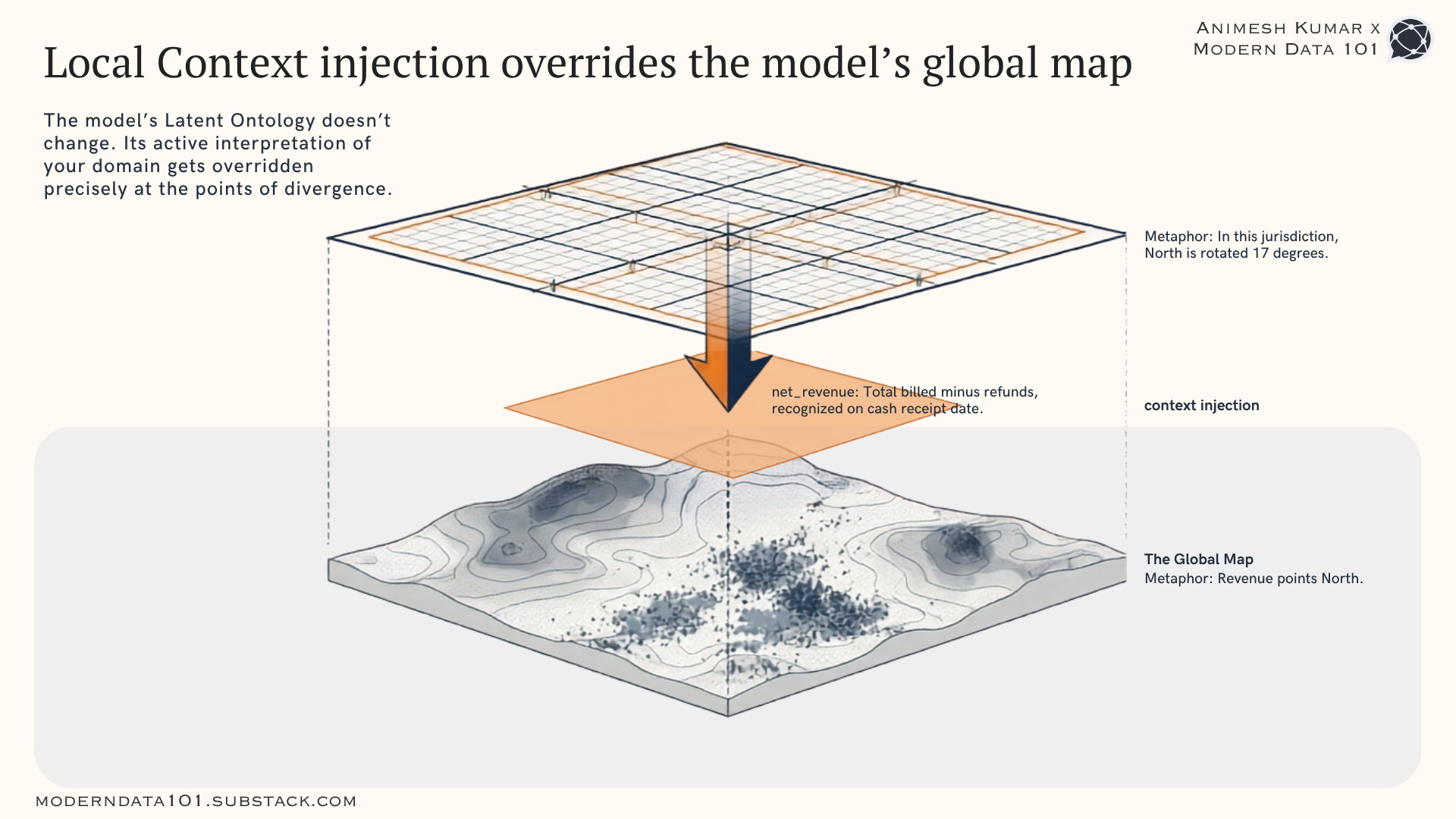
Most importantly, it also preserves local projections, enabling downstream systems to derive meaning based on everything around the object.
The semantic layer doesn’t add new words. It restores the broken link between the word and a single, agreed meaning, which is precisely why it’s becoming foundational infrastructure for AI-enabled analytics, rather than a nice-to-have.
The semantic layer doesn’t just magically enable this by connecting the entire ecosystem. The underlying infrastructure is super important to enable this broad interconnectivity. Which is why the conversations on data products and unified data platforms with inherent context management are essential and key to converging global and localised projections of meaning through the semantic layer.
🔖 Related read


Agents inherit the same: Semantic drift
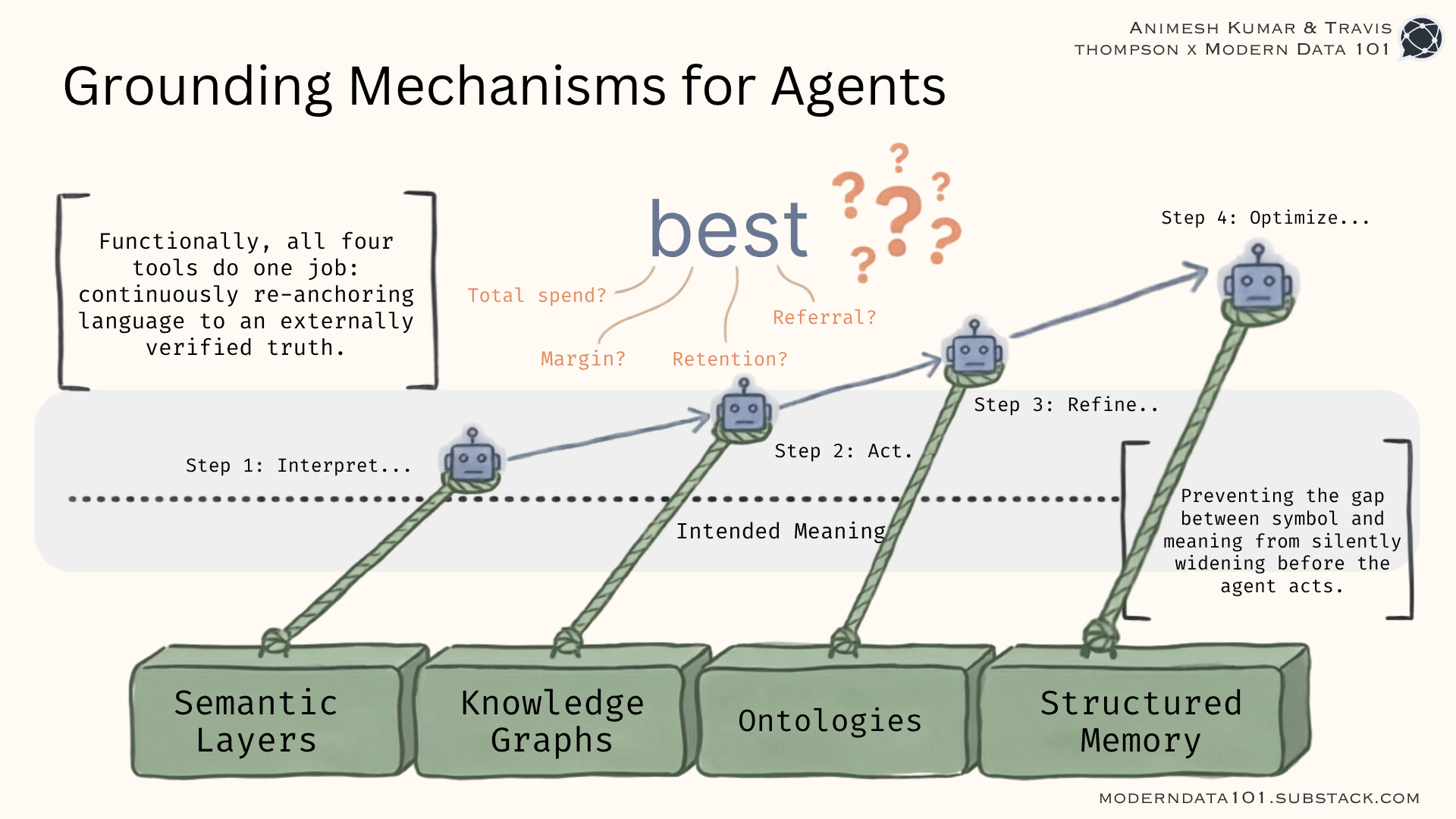
Human semantic satiation is self-correcting. The link snaps back the moment repetition stops. Semantic drift in an agent doesn’t self-correct but compounds because each step the agent takes is built on the (unverified) interpretation from the step before.
This is why modern agent architectures increasingly lean on the same family of grounding structures: semantic layers, knowledge graphs, ontologies, and structured memory.
Functionally, all four are doing one job: continuously re-anchoring language back to a single, externally verified meaning before the agent is allowed to act on it. They are, in the architectural sense we’ve been building throughout this piece, anti-satiation mechanisms: systems whose entire purpose is to prevent the gap between symbol and meaning from widening.
The principle that ties the neuroscience, the model architecture, and the org chart together into one idea:
Meaning was never contained in the word itself. It’s contained in the relationship between the word and anchors outside it.
Repeat a word enough times in isolation, with nothing reinforcing that outside relationship, and the relationship is what frays instead of the word. This is true at every layer we’ve walked through.
In every case, the fix is the same shape: rebuild the relationship, not the word.
This is also why the loudest current conversation in applied AI isn’t really about language generation anymore. Models are already excellent at producing fluent, grammatically perfect sentences.
The harder, unsolved problem is making sure that when an agent says “customer,” “revenue,” “active user,” or “profit,” that word is tethered to the exact meaning the business intends.
We moved from syntax to semantics by building systems where meaning had to be actively, dynamically computed, which is the only architecture flexible enough to do what your brain does automatically every time you stop repeating a word.
MD101 Support ☎️
If you have any queries about the piece, feel free to connect with the author(s). Or connect with the MD101 team directly at community@moderndata101.com 🧡
Author Connect 💬
Connect with Animesh on LinkedIn 💬
Connect with Travis on LinkedIn 💬
I do not share the thesis that in the commented case, "access to the meaning layer" is destroyed. For me, the existence of a "semantic layer" as something that can be connected (or disconnected) "as a whole" is highly debatable. But with regard to the case, I would raise questions such as: how is the connection that is destroyed identified, how is it destroyed, is there a trace of it after the destruction, etc.
Similar questions arise about the restoration of the connection after the word stops repeating, that is, the event for processing the word stops happening. It turns out that the absence of an event is an event that starts a restoration process, which is a little difficult for me to understand.
In my opinion, things are much more prosaic. The human brain is a resource with a limited capacity for processing information. The repetition of a word, in addition to its meaning, generates additional meanings for perception/processing - for example, why is the word repeated, why is it repeated so much, why is it spoken loudly, does anyone else react to this repetition, etc. etc.
This is how a sequence/queue of requests is formed, as the human brain's resources begin to become exhausted with processing, they begin to lag, which accumulates unprocessed requests in the queue and thus processing is blocked, which in computers we call "exiting real-time mode".
If the repetition of the word stops, the overload of the queue of requests for processing to the brain also stops and the queue is emptied. Thus, the brain is unblocked and it begins to function again, which is presented with a restored ability to perceive, but not only the word, but everything else that comes to it. In computer terminology, "the brain restores its work in real time".
This explanation is more plausible to me, including because it does not include what the connection is, its identification, destruction, restoration, etc..
Psychologists point to an analogous case with those sentenced to death. In the agonizing expectation of the execution of the sentence, they repeatedly experience this and at one point these agonizing experiences block the brain and they do not care. If I remember correctly, psychologists call this "banalization of the problem" and point out that this also happens in normal conditions of everyday life.
Here the "Real time" explanation is fully applicable, and the commented "destroyed/restored connectivity" cannot be reduced to a single connection...