
The AI-Native's Woes of Persistent Memory
Memory debt is coming. This is a case for governing it now, while the opportunity is still cheap instead of waiting for the architecture to harden around its absence.

Type “AI-native” into any search bar, and you’ll find a hundred companies claiming the label and almost no shared definition of what it requires.
This is a consequence of mass-herding. Am I also not writing about AI-native here while opposing the same trend? Every few months, an industry term gets so popular it stops meaning anything, despite having made sense at some point.
After repeating a perfectly good phrase so many times in completely different contexts, the phrase loses the ability to help people understand the value, context, and meaning and is instead met with confusion or a vague understanding. “AI-native” is having that moment right now.
This is definitely a big problem, but not really an interesting one. The more interesting aspect is:
What does being AI-native set us up for that nobody is building today?
Because, believe it or not, at this rate of technology’s growth, what we are solving today is going to become a baseline in six months or even less.
There will be a new problem, manifested from the new layers and complexities of new technologies and implementations. And again, too soon, there will be another gap and no lack of people hankering for a quick solution to jump that crack in the stack. Not in five years or ten years like it used to be. In months.
Understanding AI-Native
Strip away the AI-generated contexts on thousands and thousands of web pages. Let’s go back to basics and draw a fairly consistent picture of “AI-native”.
AI-native = Enabling core workflows
AI-native, in simplest terms, means AI is part of the core stack that any team is using. A marketing team can be AI-native if the martech stack has AI as part of the day-to-day workflow handling management, analysis, and action. Or a platform team can be AI-native if it’s using AI to self-serve and build data products.
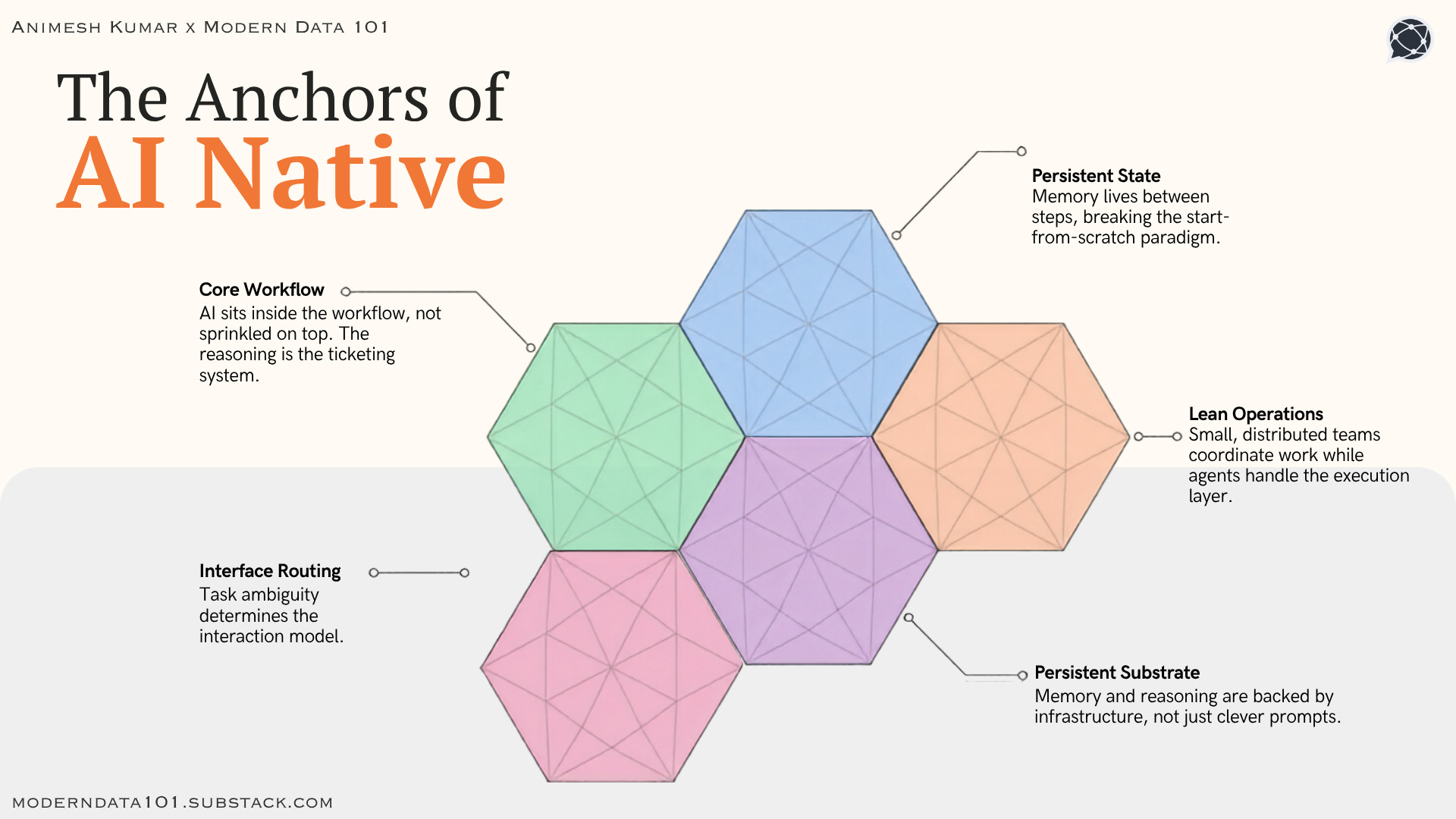
AI essentially is in the core workflow rather than being sprinkled on top as an assist.
A more direct example:
Not AI-native: A support tool with a chatbot bolted onto a traditional ticketing system.
AI-native: A tool where the ticketing is the AI reasoning through the case.
AI-native = Memory persists somewhere AND is discoverable
“Memories are the key not to the past, but to the future.” ~Corrie Ten Boom
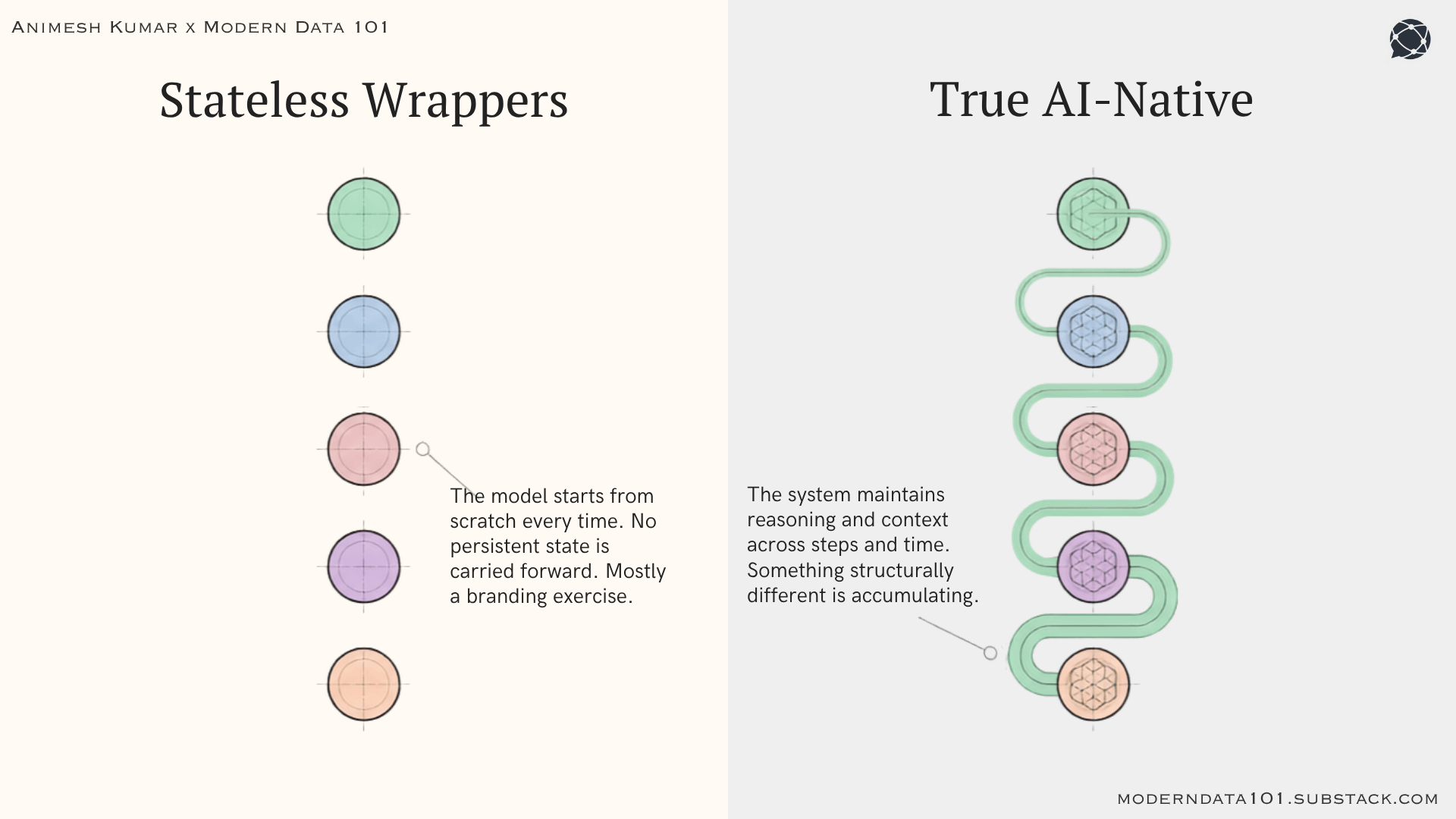
More diagnostically useful, practitioners have started using a specific test to separate real AI-native products from repackaged ones. The test is to understand where the system’s memory exists between steps.
If every interaction starts the model from scratch with no persistent state carried forward, the “AI-native” label is mostly branding. If the system maintains reasoning and context across steps and time, something structurally different is happening.
Human → Experiences <something> with senses → Locates a memory from the entire ecosystem → Triggers and acts
Agent → Experiences new data → Locates a localised memory from the entire data and context stack → Triggers and acts
At scale, to become AI-native, there needs to be a persistent layer for the agent’s memory and reasoning.
AI-Native = Task-directed UI
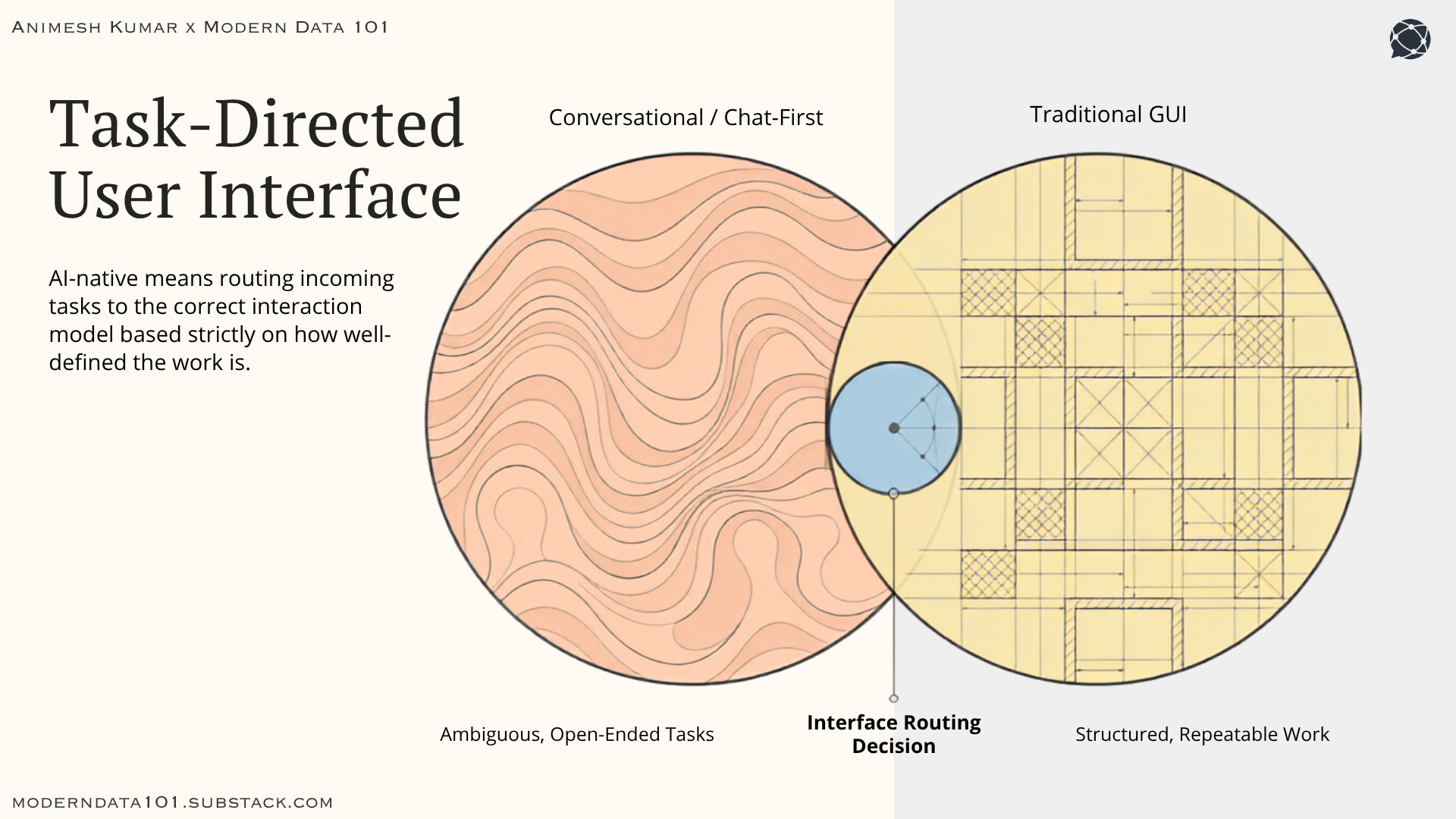
There’s an emerging interface pattern: conversational, chat-first interfaces work well for ambiguous, open-ended tasks, while structured, repeatable work still gets a traditional GUI.
Replacing every interface with a chat box isn’t the right test for AI-native. AI-native is routing tasks to the right interaction model based on how well-defined the task is.
AI-Native = Autonomous Execution Layer
Small teams are starting to run surprisingly large operations by leaning on agents and documented playbooks instead of headcount. Lean, distributed teams where a handful of people coordinate work that would traditionally require a much larger org chart, with agents handling the execution layer.
The problem hiding inside “persistent memory”
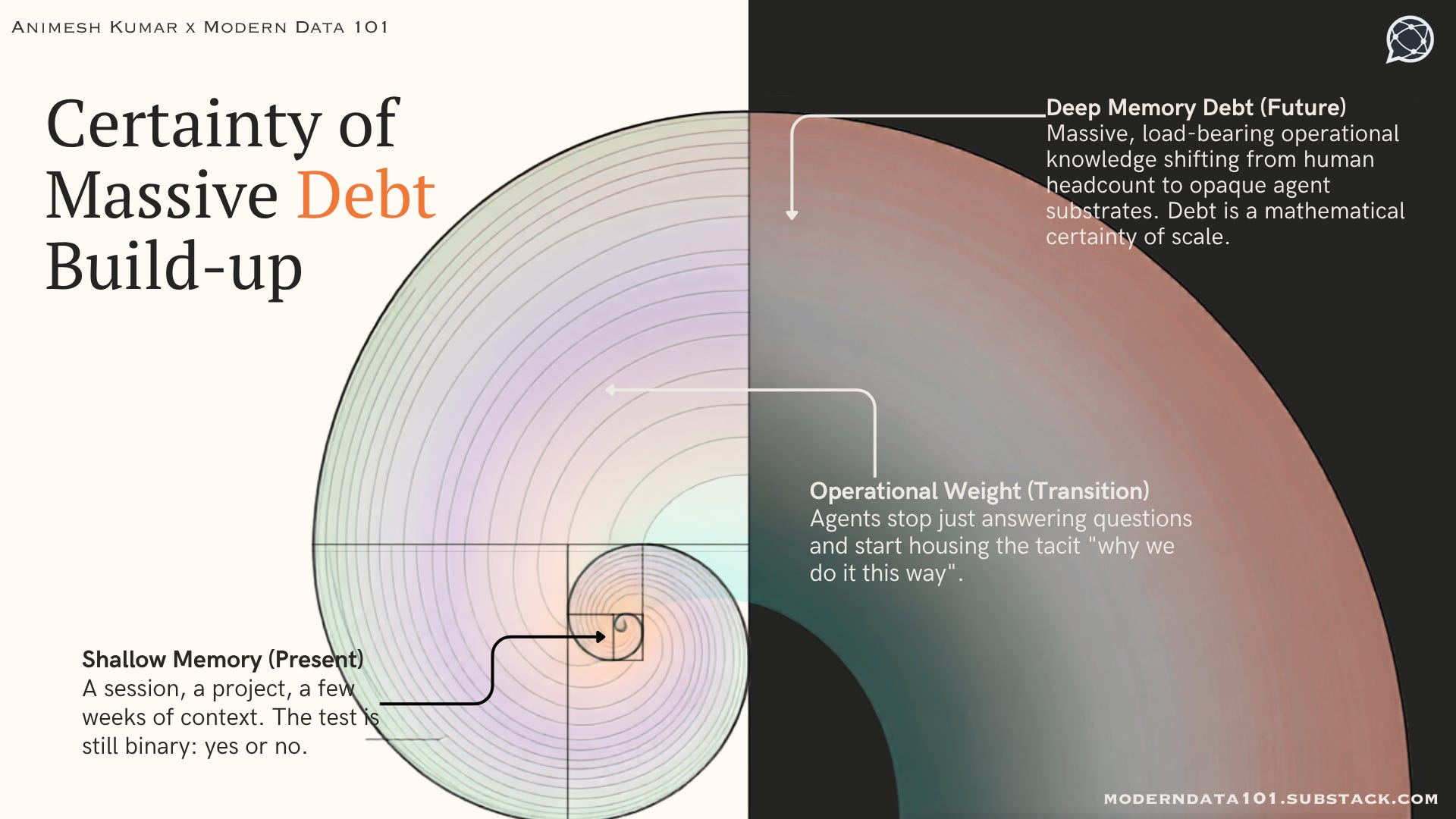
Right now, most AI-native systems have shallow memory. Bounded within a session, project, or maybe a few weeks of context. The “where does memory exist” test is still mostly binary: yes or no.
But the path is becoming more obvious. Memory is getting deeper, more persistent, and more load-bearing. Agents aren’t just answering questions anymore, but becoming the layer where operational knowledge travels.
Everything from the reasoning behind a client decision, the accumulated context of a project, the tacit “why we do it this way” that used to solely exist in a senior employee’s head, for example.
While memory management at scale is not a problem today (because the degree of reliance is still rare), it will become a serious problem soon. This is for a reason software engineering already learned the hard way:
Anything that accumulates state without governance accumulates debt.
As the patterns of terminology go, let’s call it memory debt. The accruing gap between how much operational reality an AI system’s memory holds and how well anyone can inspect, correct, audit, or transfer that memory.
A few concrete ways this will surface as AI-native systems mature:
Drift without version control.
A persistent agent memory that’s never been “wrong enough to notice” can accumulate stale assumptions, outdated client preferences, or contradictory facts absorbed at different points in time. Software solved this with version control and change logs. Agent memory largely has neither yet.
Institutional knowledge with no backup.
When a small team runs its operations through an agent’s accumulated context, that accumulated context becomes a key-person risk. Except the key person is a memory unit owned by a vendor. If that substrate is migrated, deprecated, or corrupted, the “why” behind months of decisions can disappear with it, and no one documented it elsewhere because the agent was handling it.
Provenance that nobody can reconstruct.
As agents move from answering questions to taking actions, the audit trail question gets harder. It’s one thing to ask a chatbot why it said something. It’s another to reconstruct why an autonomous agent, drawing on months of accumulated memory across multiple steps, took a specific action, especially once several agents are writing to shared context and no single log tells the whole story.
Onboarding humans into a system that doesn’t explain itself.
If chat-first interfaces increasingly replace documented processes for ambiguous work, the operational knowledge of a company starts manifesting in conversational residue instead of runbooks. That’s fine until a new hire, an auditor, or a regulator needs to understand how a decision got made, and then the answer would be “it’s somewhere in the agent’s memory, we’re not entirely sure where.”
All of these are the predictable consequence of deeper memory, more autonomous execution, leaner teams leaning harder on agents. The more successfully AI-native a company becomes, the faster it accumulates this kind of debt, because the whole value proposition is letting the agent carry more of the operational weight.
So, take this write-up as a head start into working towards governance that severely fell apart during the rise of big data. Set up memory and context governance right at the beginning before organisational memory even starts growing limbs.
Because context and memory are sure to build up for any organisation approaching AI alignment, and when it does happen, it’ll be good to spend time and energy building upwards rather than fixing the underground plumbing yet again.
MD101 Support ☎️
If you have any queries about the piece, feel free to connect with the author(s). Or connect with the MD101 team directly at community@moderndata101.com 🧡
Author Connect 💬

Connect with Animesh on LinkedIn 💬
It's worth recalling that our ability to predict the past tops out at slightly under sixty percent.