
What Human Memory Teaches Us About Building AI Memory
How human memory research explains LLM memory limitations and how foundational data architecture is a precursor to durable, retrievable AI memory.

The more we unravel the essence of memory, the more it illuminates the structure of autonomous intelligence and how we may lend God’s work (the structure of our own minds) to Man’s work or to machines.
This is one of the most interesting resemblances we came across while building memory architectures. Two separate pieces of classic memory research.
Ebbinghaus (1880s): The ‘Forgetting’ Curve
Hermann Ebbinghaus was a German psychologist who ran some of the first rigorous experiments on memory, using himself as the subject. He memorised lists of nonsense syllables (things like “WUX,” “ZOK”, which were deliberately meaningless, so he wasn’t relying on existing associations) and measured how well he could recall them after varying delays.
This is where the “forgetting curve” comes from: the finding that memory decays fastest right after learning and then levels off.
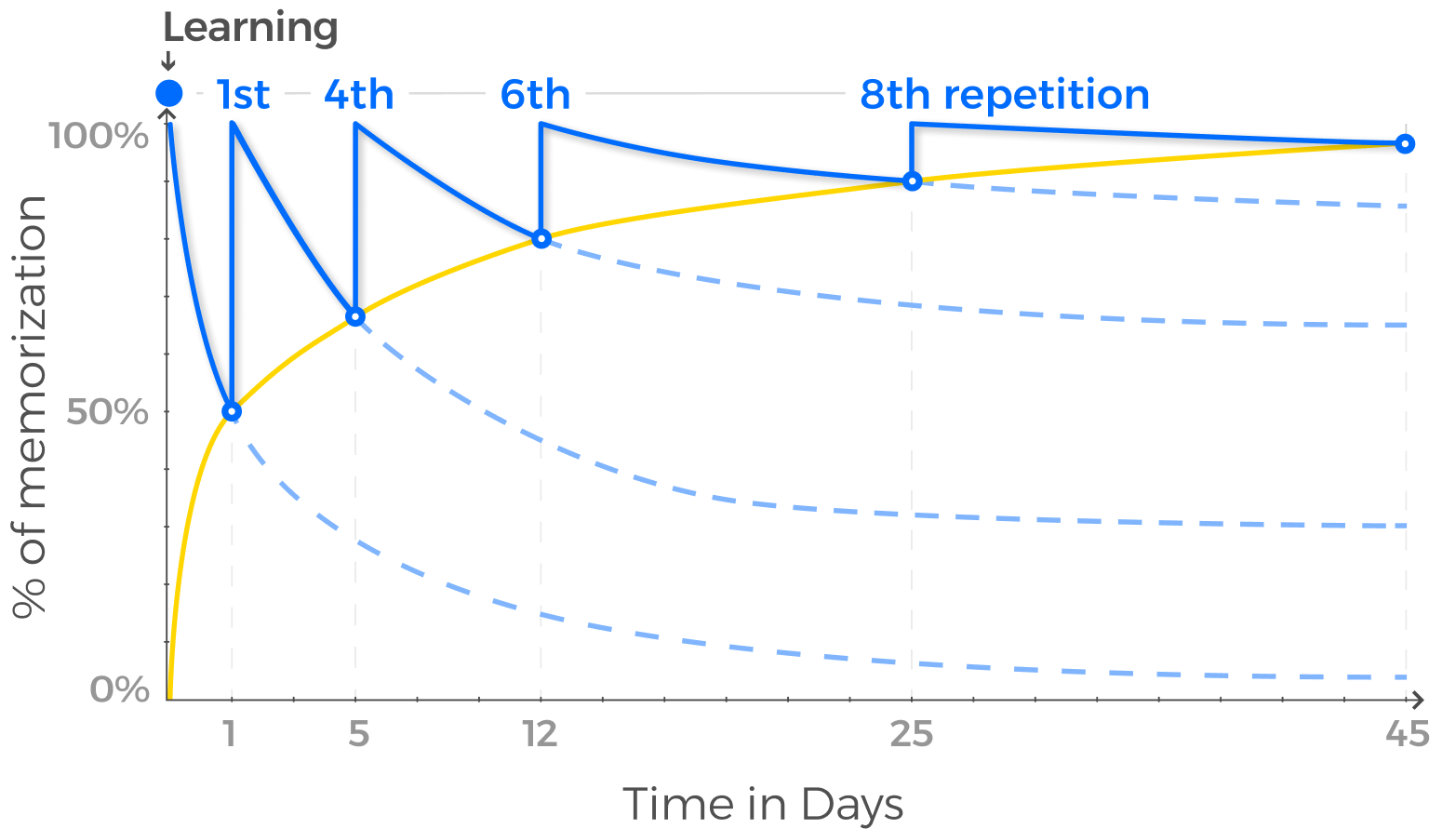
He didn’t focus specifically on list position, but his method of controlled list memorisation as a way to study memory mechanics set the template every serial-position study since has followed.
Murdock (1962): The ‘U’ shape of Lost Memory
Bennet Murdock ran the experiment that’s now the textbook demonstration of the serial position effect.
He’d read subjects a list of words (say, 20 items) at a steady pace, then immediately ask them to recall as many as they could, in any order, what you could call “free recall.”
When you plot recall accuracy against each word’s position in the list, you get a U-shaped curve:
Primacy effect: early items are recalled well, because they got rehearsed more and had time to move into long-term memory.
Recency effect: the last few items are recalled well too, because they’re still sitting in short-term/working memory, fresh.
The middle: sags badly since those items got neither the rehearsal benefit nor the freshness benefit.
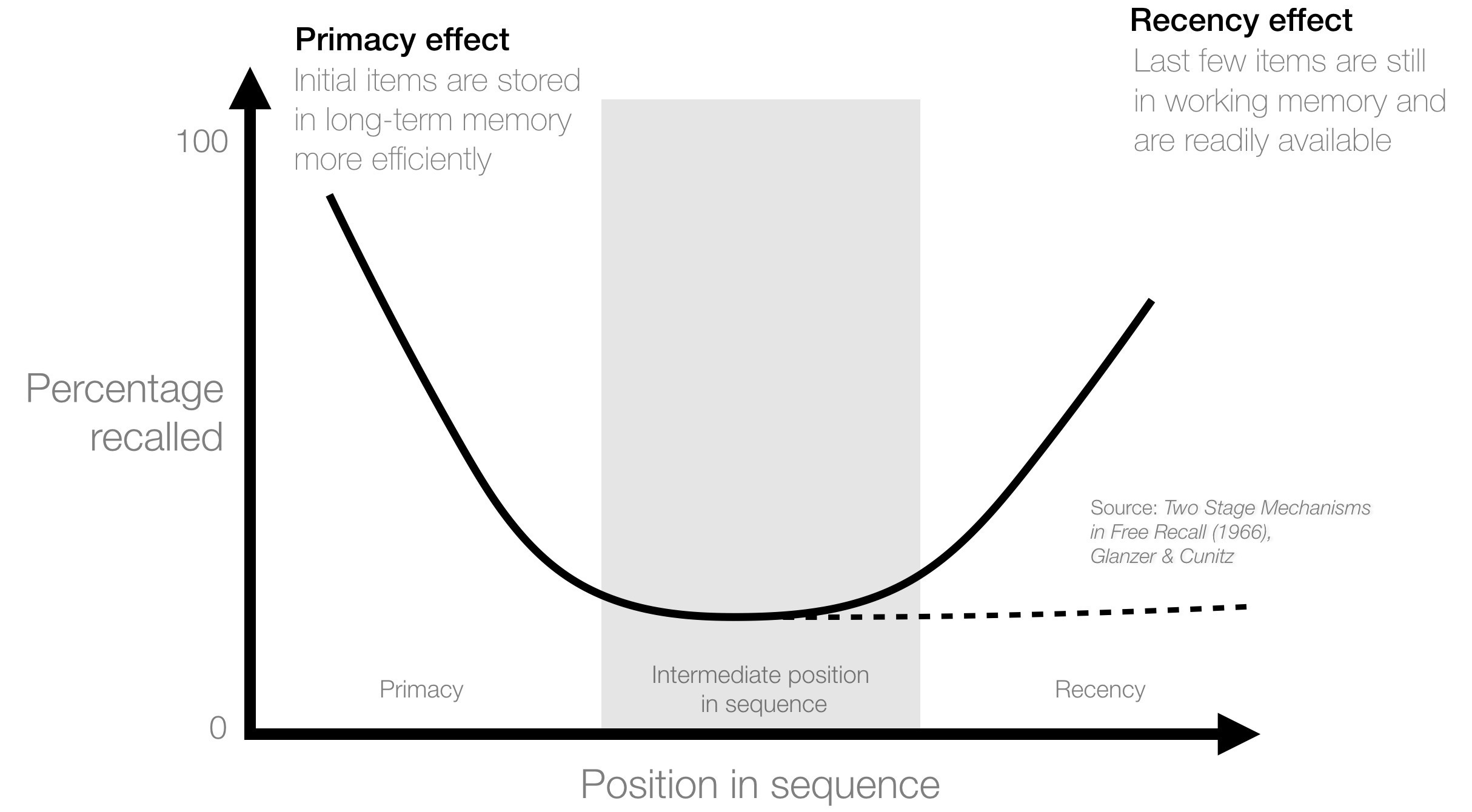
That U-curve is Murdock’s signature result, and it’s mechanistically explained by a two-store model of memory (short-term vs. long-term) that was very influential in cognitive psychology.
How the research opens gates for AI’s memory architecture
The “lost in the middle” phenomenon in LLMs, as also recently cited by an article on context and memory engineering, shows resemblance almost to the T.
Structural Placement
Where information sits in the window affects how reliably the model uses it. Models attend more strongly to content at the beginning and end of long contexts, with material in the middle receiving significantly less weight. This is known as the “lost in the middle” effect
~ beamnxw ./ (twitter user)
If we go back to Murdock’s research, the similarities of the “lost middle” in both mind and machine are spectacular.
The observation is that models attend more to the start and end of a long context and underweight the middle, producing the same U-shaped curve Murdock found in humans, just for a completely different mechanism (attention weighting in a transformer vs rehearsal/working-memory in a brain).
While the article treats it as an LLM-specific engineering quirk to route around, it is critical to note that this pattern follows the same shape of memory breakdown that’s been studied in human cognition for over a century.
The Precursor to Resolve the Memory Seepage
If the “lost in the middle” effect and Murdock’s U-curve share a root cause, it’s because the underlying problem is architectural: the model has no durable, addressable memory outside its context window.
Every conversation starts as Murdock’s list all over again, a flat sequence with no encoding, no consolidation, and no retrieval path except position.
Human memory solves this by refusing to rely on position at all. Rehearsal moves an item out of the fragile middle of the list and into long-term storage, where it can be retrieved by meaning rather than by where it happened to sit.
That is the lesson underneath the forgetting curve and the serial position effect: the fix isn’t an optimised list. It’s a system that stops treating memory as a list in the first place. And how it helps to push items down enough to associate with meaning.
Data Products as Consolidation: Pre-Encoding Context Before It Reaches the Model
A data product is a governed, reusable unit that bundles the data itself along with its transformation logic, semantic model, quality contracts, access policies, and documentation into one platform-managed asset.
🔖 Learn more about Data Products
The Complete Guide to Data Products ↗️
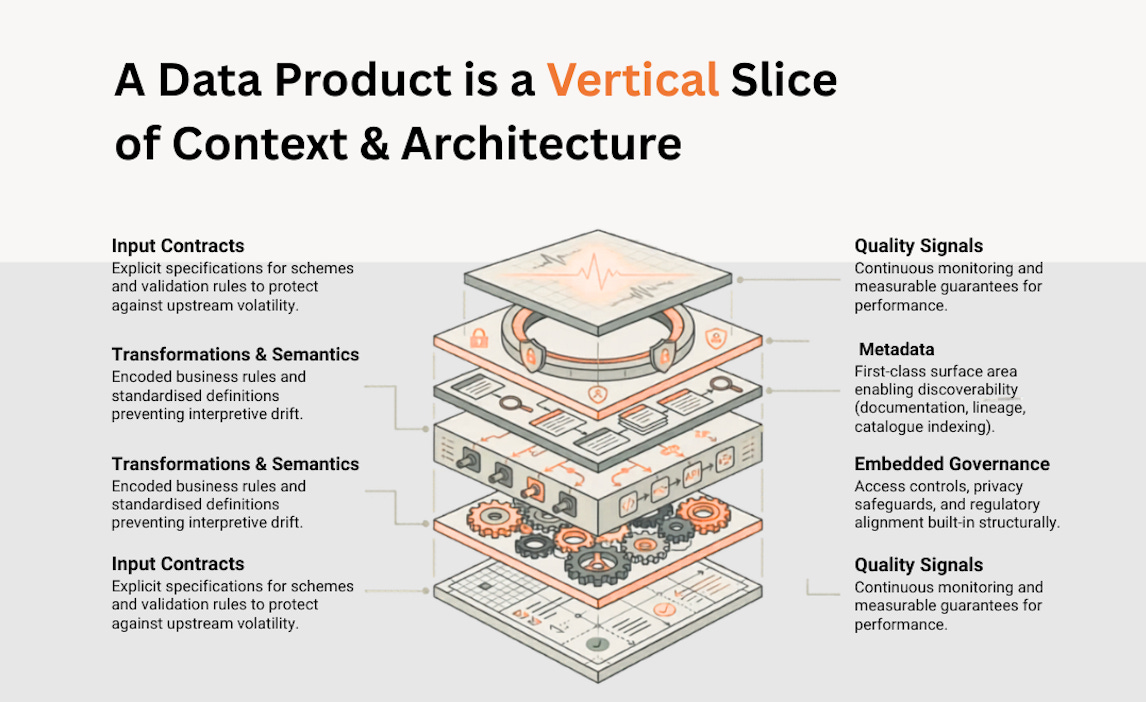
A Practical, End-to-End Guide to Architecture, Ownership, Metrics, and Business Impact of Productised Data Management
In memory terms, this is consolidation happening before the agent ever sees a prompt. Instead of an LLM receiving raw rows and being asked to infer what “customer” or “active user” means in the middle of a long context window, that definition is already encoded, versioned, and attached to the data product itself.
This matters directly for the middle-sag problem. If meaning is pre-consolidated into the data product rather than re-explained inline every time, there is nothing fragile sitting in the middle of the context to lose.
The agent isn’t recalling a definition from position 11 of 20; it’s retrieving a governed object by its address.
The Semantic Layer as Rehearsal: From Working Memory to Long-Term Storage
The semantic layer standardises how terms like “campaign success,” “active customer,” or “policy decision point” are defined once and reused everywhere, so that every agent and every LLM call resolves the same term the same way regardless of where in a session it’s invoked.
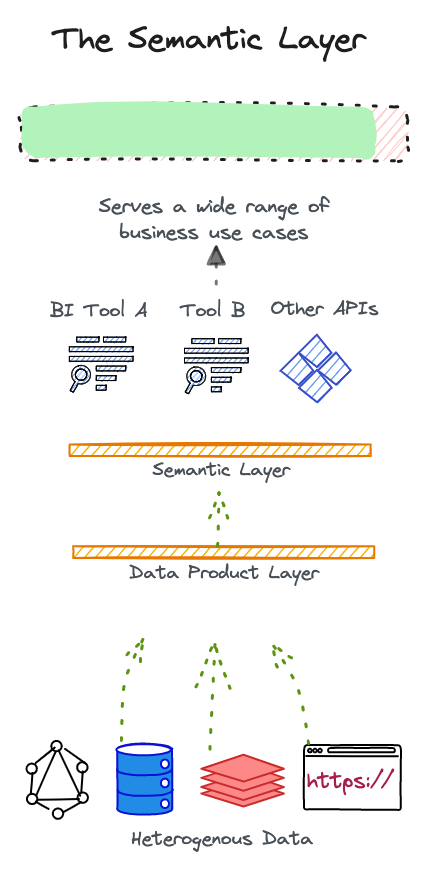
This is the closest structural analogue to rehearsal in Ebbinghaus’s framework. Rehearsal is what pushes an item out of decaying short-term memory into stable long-term storage.
A semantic layer does the same job for enterprise meaning: instead of an LLM re-deriving what a metric means from scattered context on every call (and losing that derivation if it happens to land mid-context), the definition already exists in long-term, queryable storage.
Lineage as Episodic Memory: Provenance Instead of Positional Guesswork
Ebbinghaus’s forgetting curve describes decay in the absence of reinforcement.
Every data product carries lineage, ownership, and quality signals as native metadata. This is functionally episodic memory: a record of where a piece of information came from, what happened to it, and whether it’s still trustworthy.
An agent that can trace lineage doesn’t need to “remember” provenance from earlier in a conversation; it can retrieve it on demand, at any position, with the same fidelity every time.
Policy Enforcement as Selective Attention: PEPs and PDPs as a Governed Filter
Murdock’s curve is really a story about attention allocation under scarcity: the mind can’t rehearse everything equally, so it prioritises.
This is handled with policy enforcement points and policy decision points that govern, at the point of retrieval, exactly which data an agent or principal is allowed to see, filtered by attribute-based access control rather than by however the request happened to be phrased.

This is selective attention with a governance layer attached. It doesn’t just decide what’s relevant; it decides what’s permissible, and it does so consistently regardless of where in a chain of reasoning the request occurs.
Final Note
The notes in this article are a precursor to pure memory architecture. It stresses the necessity of having and supplying governed and specific data (instead of shoving down everything) to downstream memory infrastructures or even directly to data consumers.
MD101 Support ☎️
If you have any queries about the piece, feel free to connect with the author(s). Or connect with the MD101 team directly at community@moderndata101.com 🧡
Author Connect 💬

Got questions? Find Animesh on LinkedIn or drop a comment below. 💬
Animesh authors frequently on Modern Data 101 alongside a growing community of Data and AI Experts who wield their pens to advance the field. Follow along or grab yours🖋

From the Modern Data 101 Team ❤
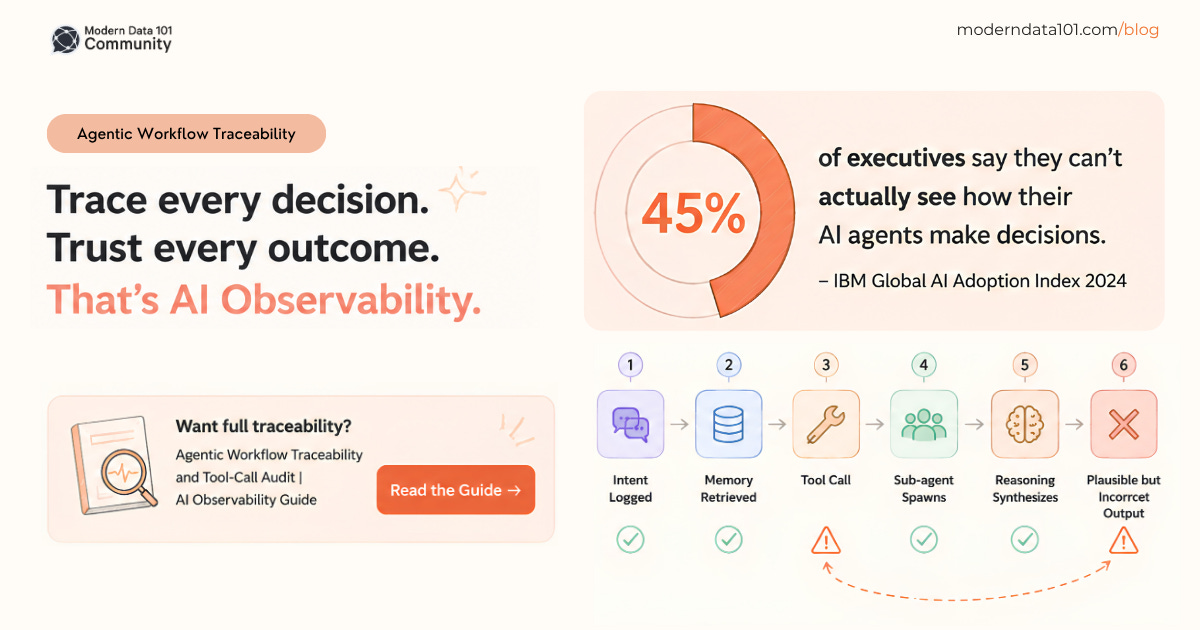
A full traceability framework helps you track agentic decisions end to end. A single bad reasoning step can cascade through five more steps, each one logging a clean success.
And the stats back this up: 45% of executives say they can’t actually see how their AI agents are making decisions. That’s flying blind on autonomous systems making real calls in production.
Start tracing AI decisions and outcomes with the AI Observability Framework: An End-to-end Enterprise Stack & Guide for 2026.
That’s a great read!
Hmmm I think the key here is that forgetting is not a bug. Ebbinghaus's curve isn't memory failing, it's memory selecting: the brain discards what didn't earn reinforcement, and that discarding is what keeps retrieval fast and relevant.