

TOC
Materialising a Knowledge Graph for AI
What Makes a Knowledge Graph AI-Ready
Essential Clarity when Building One
Consider this: every data product already has meaning. Each data product carries its own semantics, like column descriptions, business rules, or domain vocabulary. Now consider this: these data products do not know about each other.
The marketing campaigns table has no idea that it shares a causational relationship with the revenue ledger. Even if you tried to tell it, where would you put that information? Inside the table itself? That would corrupt the data product. In documentation? That’s unqueryable, non-traversable, and invisible to machines.
Semantic information is siloed at the product level, but organisational reasoning operates across products.
When a CMO asks, “Did our Q3 campaign drive revenue?”, they are not asking a question that exists inside any single data product. The answer requires a chain of reasoning that spans marketing data, revenue data, and an organisational understanding that campaigns influence revenue.
The goal of a Knowledge Graph for AI is to enable a space where data products plug in their semantic information with organisational ontology and where AI is able to play around in the conjunction.
Materialising a Knowledge Graph for AI
Data Products: Indivisible Units of Context
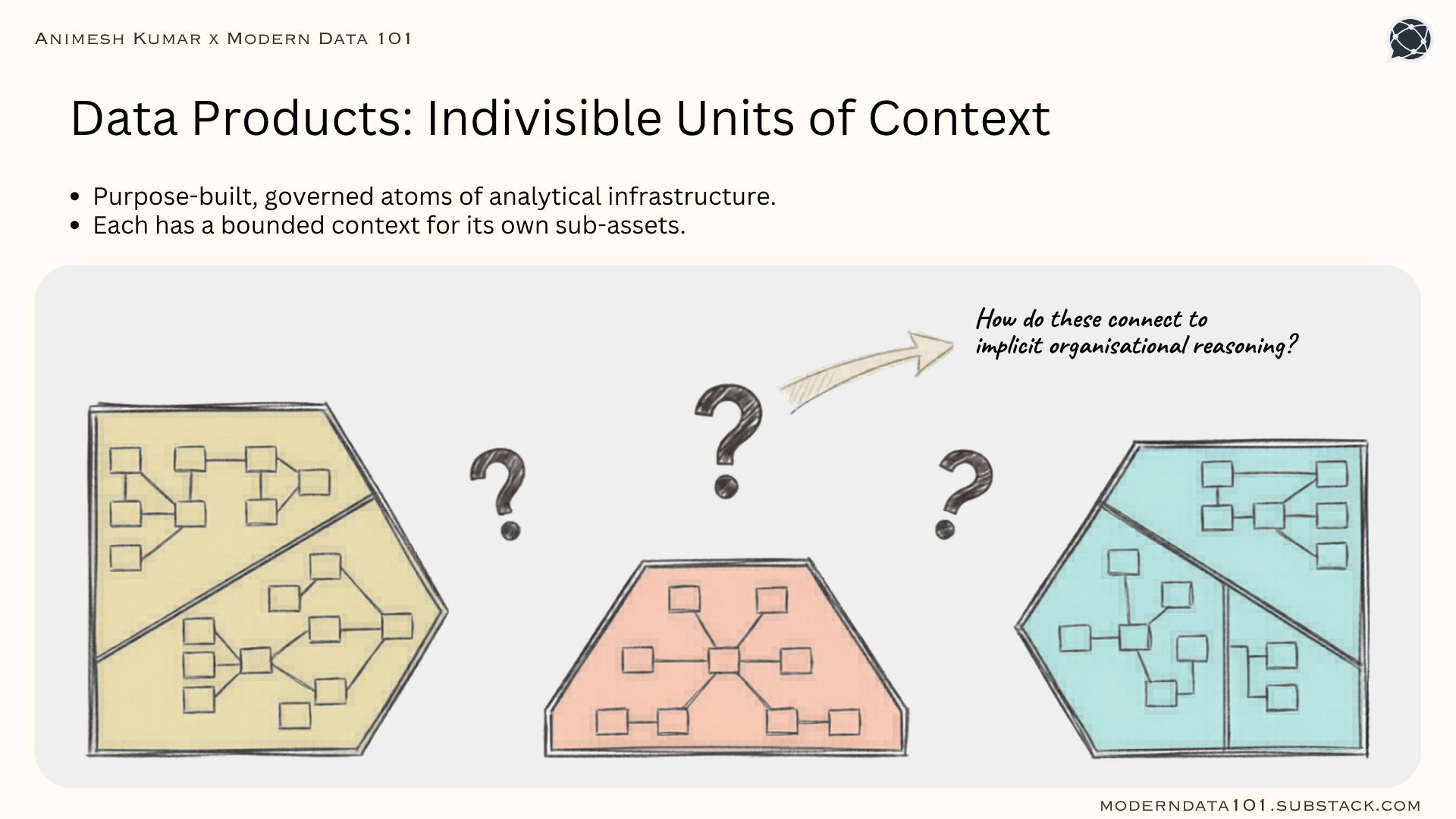
Modern data architectures produce data products: purpose-built, well-defined, quality-tested and governed units that serve as the atoms of an organisation’s analytical infrastructure. Each data product comes with its own bounded context on all its sub-assets and how they are structurally related.
But how do the data products connect to each other and to implicit organisational reasoning?
The Semantic / Ontological Layer
This is the layer that knowledge graphs address. It goes by many names: semantic layer, ontology layer, context graph, knowledge graph, because different communities arrived at the same need from different directions. Ultimately, the objective is the same.
The names are less important than the function:
A single layer where the meaning of data, the structure of an organisation, and the relationships between concepts are made explicit and machine-readable.
Data Changes with Context.
This single statement defines the core purpose of a Knowledge Graph for AI. Data CHANGES, based on the context you surround it with. And context is a dynamic event, that changes based on user queries, domains referenced, or purpose and goal.
A purpose-built knowledge graph is that portal that enables machines to swiftly turn their heads and look at any direction necessary to make sense of data at hand in accordance with the goals of queries or tasks.
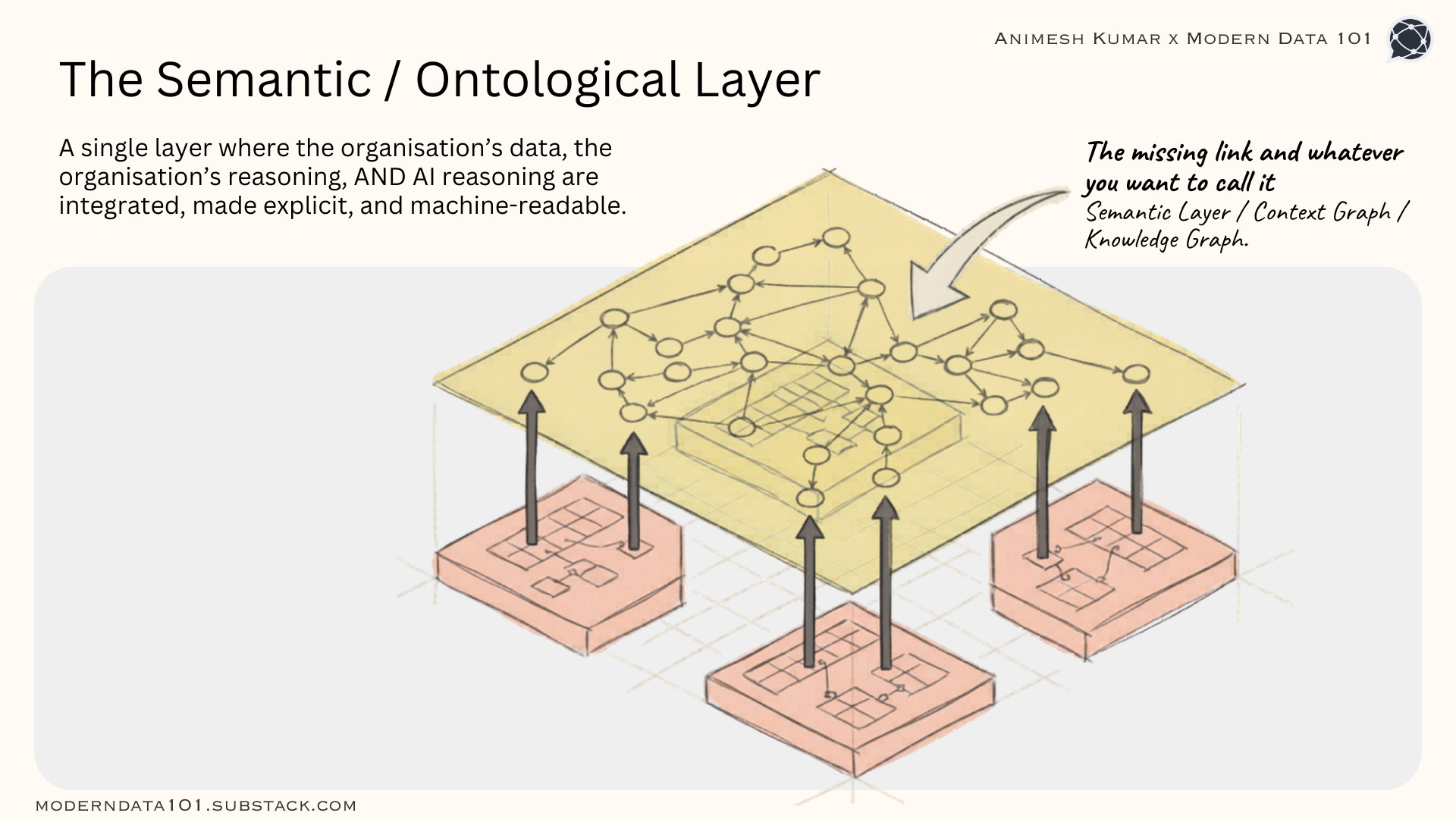
The layer on top of the organisation’s data products does three things simultaneously:
Captures the various “meanings” of the same data.
When a data product exposes a column called net_rev, the semantic layer holds the organisational definition of “net revenue”: how it is calculated, what it excludes, and how it differs from gross revenue.
Captures organisational ontology.
Every organisation has a conceptual model of itself, usually implicit. Finance knows that bonus disbursement is downstream of net revenue. Product knows that NPS is a leading indicator of churn. These relationships are organisational knowledge, and they do not belong to any single data product, but they are essential for reasoning across them. The semantic layer makes them explicit: campaign_spend influences pipeline_revenue; net_revenue drives bonus_disbursement. These are typed relationships, machine-readable.
Captures context about who is asking.
A CMO and an engineer looking at the same underlying data need different framings, different aggregations, different vocabulary. The semantic layer can encode persona-level preferences and roles, so that retrieval is not just data-aware but audience-aware. The same ontological query surfaces differently depending on who is querying.
The result is a machine-readable graph of how concepts in an organisation relate to each other, and how those concepts map to semantics in actual data products.
AI Reasoning On Top
Large language models like Claude, GPT-4, and Gemini are becoming the interface through which people interact with information. They are, in effect, building their own browsers: persistent, identity-aware environments where users develop a running relationship with the model.
Claude already knows who you are within a session. ChatGPT accumulates memory across conversations. The model itself is becoming the personalisation layer.
This has a sharp implication: We do not need to rebuild personalisation inside our data infrastructure.
The LLM already handles that. What we need to give the LLM is the meaning of our data, delivered in a form it can reason over efficiently: the organisational ontology, the relationships between data products, and the semantic grounding of our domain vocabulary. If we can deliver that, the LLM will do the interpretive work.
Building your own personalisation layer on top of a knowledge graph, when LLMs already handle personalisation, is like building a browser to host a website. The browser already exists. Focus on the content.
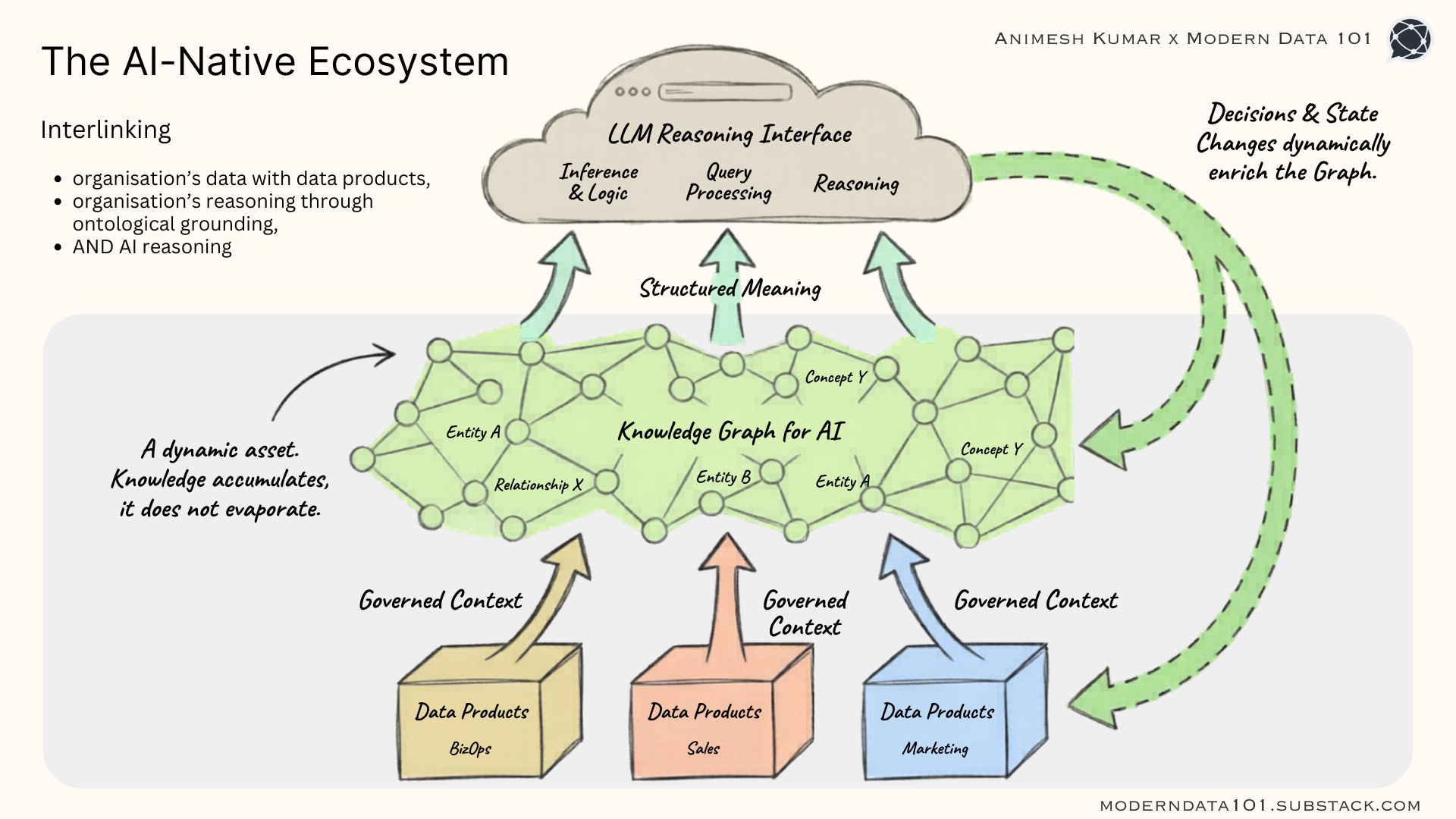
What this means in practice is that the knowledge graph becomes the primary integration point between:
the organisation’s data,
the organisation’s reasoning,
AND AI reasoning.
What Makes a Knowledge Graph AI-Ready
Traditional knowledge graphs were designed for human analysts and rule-based systems. Retrofitting them for LLM-based reasoning requires three capabilities that most existing implementations do not prioritise. These are the features that separate a knowledge graph from an AI-native knowledge graph.
1. Ontological Grounding
An LLM is a pattern-matcher operating on language. When a model encounters a term like “conversion,” it might associate it with marketing funnel performance, file format transformation, or even financial currency exchange, depending on context. Imagine such a deficit in a complex and scaled data ecosystem. Without explicit semantic typing, the model guesses.
Ontological grounding solves this by using formal ontologies like OWL (Web Ontology Language) to give every entity and every relationship an unambiguous semantic type. The LLM does not have to infer what “conversion” means in your domain. The ontology tells it.
This also enables inference.
OWL reasoners can derive implicit relationships. If something is defined as a subclass, it inherits all the properties and rules of the broader category (the “parent” or “superclass”). So anything true for the parent is automatically true for the subclass, without needing to restate it.
In the context of reasoning systems, this matters because rules don’t have to be written repeatedly for every specific case. Once a rule is defined at a higher level, it applies to all its subclasses by default, allowing the system to infer relationships and make decisions more efficiently. The LLM inherits this reasoning when it operates over an ontologically grounded graph and does not start from scratch on every query.
2. Subgraph Serialisation
LLMs read context (the text (or structured data) placed inside their context window) before they generate a response. This creates a retrieval problem: how do you extract the right subgraph from a large knowledge graph and present it to the model in a form that maximises reasoning quality?
This is what context-window-native subgraph serialisation addresses. The relevant subgraph is extracted and serialised into formats like RDF Turtle or JSON-LD. These are structured representations that preserve semantic relationships, entity types, and provenance in a compact, hierarchically readable form.
The design requirement is to build retrieval pipelines that are graph-query-aware (SPARQL or Cypher at the backend) but LLM-context-aware at the output, extracting subgraphs at the right level of granularity for the question being asked, and serialising them in a form the model can maximally comprehend.
3. Decision-Awareness
Explainability is lost in AI systems, but it is fatal to the organisation, even though forgivable by individual users. The AI-native Knowledge Graph that sits between your data and AI reasoning captures the full lineage of actions.
This especially involves capturing decisions or state changes as part of the graph itself to enable decision-trace awareness*. (*Decision-trace awareness is the ability of a system to capture judgment at the moment it is exercised, not after outcomes are observed. More thoroughly, decision-trace awareness means the system does not just record what happened, but preserves why a particular path was chosen over all other possible paths.)
The AI’s context window stops receiving a value and starts receiving a value with its history and state/decision lineage. Not just what is, but what changed, when, from what, and why.
This, in fact, autonomously alters the entire graph, making it a truly dynamic asset that moves with AI reasoning.
Makes the graph progressively richer: AI interactions are themselves a form of organisational knowledge, and treating them as graph-native objects means that knowledge accumulates rather than evaporates after each session.
Creates an auditable reasoning history: You can trace why the model gave any particular answer or what model version produced the conclusion.
Enables learning: Patterns in which queries lead to high-quality outcomes can be identified and used to improve retrieval strategies.
Essential Clarity when Building the Knowledge Graph for AI
It is worth being precise about scope, because this architecture abuts several adjacent ideas that it should not be conflated with.
It is not data activation.
Activation is pushing data to downstream systems, triggering workflows, and personalising experiences. It is a separate layer built on top of the knowledge graph. These are distinct concerns and should remain architecturally distinct.It is not a data product.
The knowledge graph does not own data. It holds the meaning of data and the relationships between data products. The data products remain sovereign; the graph is their interpretive context.It is not a replacement for LLM capabilities.
The LLM handles personalisation, generation, conversation memory, and natural language understanding. The knowledge graph handles domain semantics, organisational ontology, and relational structure. Neither replaces the other but complements.
Food for thought
The bet underneath this architecture is that LLMs are becoming the primary interface through which people interact with organisational information. They are good at reasoning. They are bad at knowing what your organisation’s data means.
The knowledge graph for AI bridges that gap. We do not rebuild what LLMs already do well, but supply the one thing they cannot infer on their own: the meaning of your world.
If you have any queries about the piece, feel free to connect with the author(s). Or connect with the MD101 team directly at community@moderndata101.com 🧡
Author Connect 💬
Connect with Animesh on LinkedIn 💬
From MD101 team 🧡
The Data Product Playbook
Here’s your own copy of the Actionable Data Product Playbook. With 4000+ downloads so far and quality feedback, we are thrilled with the response to this 6-week guide we’ve built with industry experts and practitioners. Stay tuned to moderndata101.com for more actionable resources from us!
The decision-trace awareness section is the most interesting part of this. Most graph implementations treat the knowledge graph as a static asset you build it, you query it, it doesn't change based on what the AI does with it. Making AI reasoning itself a graph-native object that accumulates back into the graph is a meaningful architectural shift, and it's the piece that separates a graph that's useful at launch from one that gets more useful over time.
The one tension worth sitting with: subgraph serialisation quality becomes the critical bottleneck in this architecture. The ontological grounding and the decision lineage are only as useful as the retrieval pipeline's ability to extract the right subgraph for a given query. Getting that granularity right across a large, evolving graph is harder than it looks in the diagram.
Writing about a related failure mode how organisational data diverges silently from reality even when the semantic layer is clean in my newsletter if this framing resonates.
I describe the actual schema Ive been using to compress and store context directly inside dbt’s semantic layer https://substack.com/@datatripper/note/c-226424478