

About Our Contributing Expert
Dia Adams | Chief Data & AI Officer, ex-White House, Keynote Speaker & Best-Selling Author

Dia Adams is a Chief Data & AI Officer, former White House Enterprise Data Strategist, and Board Chair of The AI Table, where she helps shape the future of responsible AI and enterprise transformation. With more than two decades of experience in data strategy, AI governance, and digital transformation, she has led high-impact initiatives across federal agencies and global enterprises.
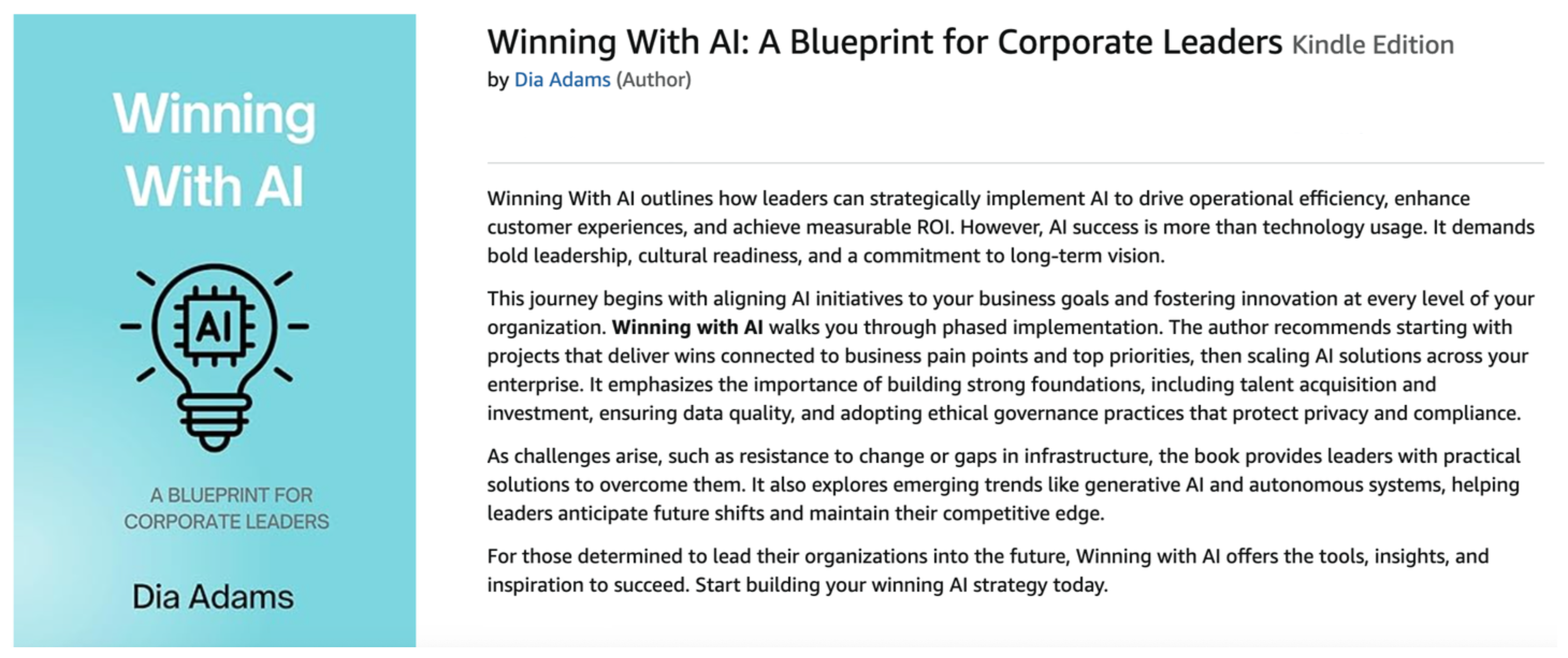
An accomplished author of Winning With AI: A Blueprint for Corporate Leaders, Dia equips executives, including CDOs, CIOs, and CEOs, with practical frameworks to successfully adopt AI while aligning technology with business strategy. Her work spans AI policy, MLOps, data governance, and data literacy, with a strong emphasis on building human-centred, compliant, and scalable AI systems.
Dia’s public sector contributions include advancing data-driven decision-making at the White House and developing AI-powered applications at the U.S. Securities and Exchange Commission. As an ACT-IAC Fellow, keynote speaker, and educator, she continues to influence the next generation of data and AI leaders while helping organisations operationalise AI with clarity, control, and purpose. We’re thrilled to feature her insights on Modern Data 101.
We actively collaborate with data experts to bring the best resources to a 20,000+ strong community of data leaders and practitioners. If you have something to share, reach out!
🫴🏻 Share your ideas and work: community@moderndata101.com
*Note: Opinions expressed in contributions are not our own and are only curated by us for broader access and discussion. All submissions are vetted for quality & relevance. We keep it information-first and do not support any promotions, paid or otherwise!
Let’s Dive In
A revolution is underway, spurred by algorithms. These step-by-step computational processes are rewriting the rules of how companies manage, protect, and leverage their most valuable asset: data.
For decades, data governance, the policies, processes, and technologies that ensure data is accurate, secure, and compliant: has been a staid, if essential, function. Governance was once confined to brittle, rule-based workflows: hand-coded data quality checks, static metadata repositories, and siloed policy enforcement, all managed through a patchwork of legacy tools, custom scripts, and tribal knowledge.
But as artificial intelligence seeps into every corner of the enterprise, it is transforming data governance from a back-office chore into a dynamic, predictive, and sometimes even autonomous discipline.
The Old Guard: Data Governance Before AI
Traditional data governance was built on control. Companies established strict rules about who could access what data, how it should be classified, and how long it could be retained. Compliance officers and data stewards acted as gatekeepers, manually reviewing datasets and enforcing policies.
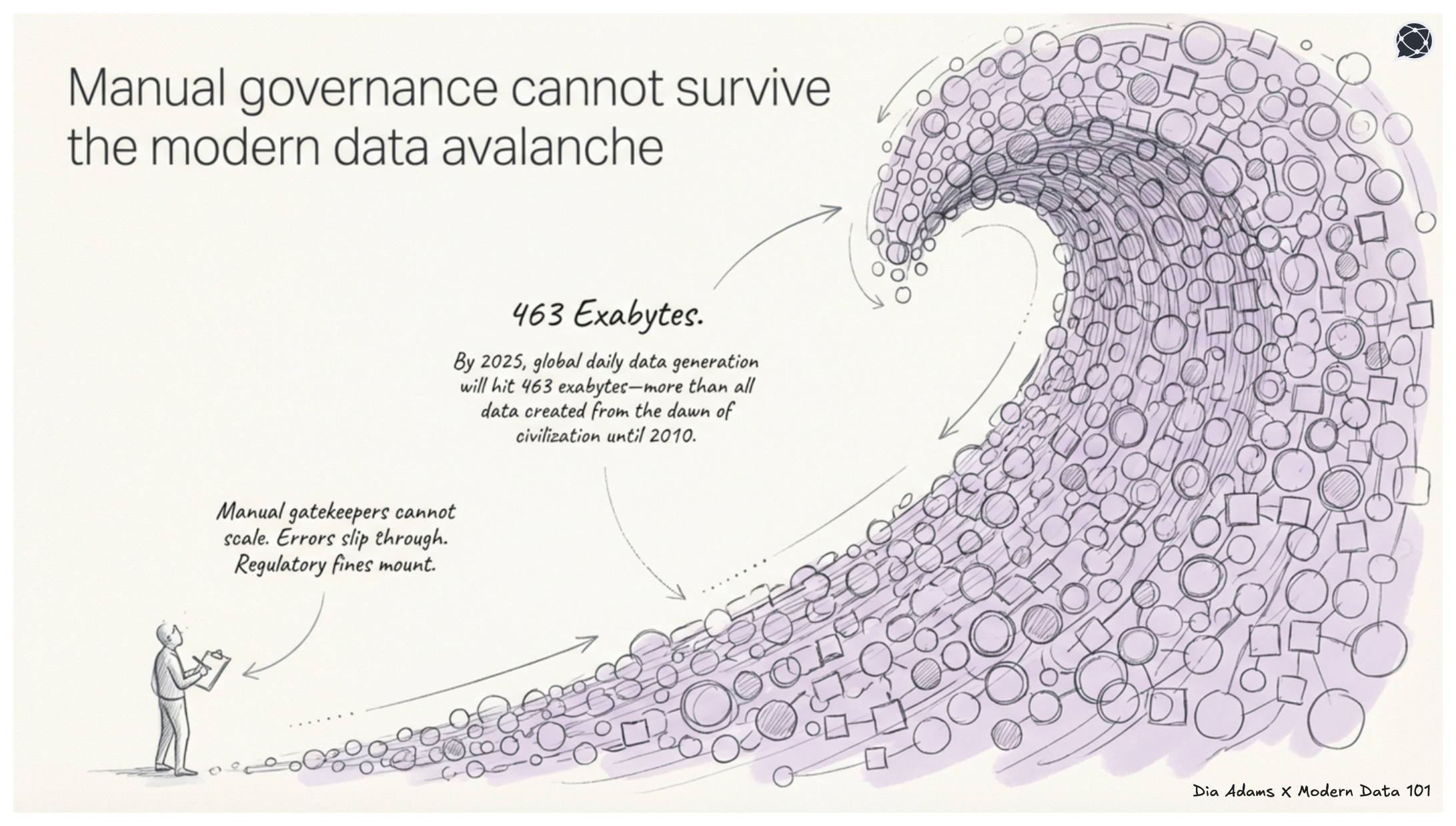
But this approach struggled to keep pace with the explosion of data. By 2025, the world was generating an estimated 463 exabytes of data each day: more than all the data created from the dawn of civilization until 2010. Manual governance couldn’t scale. Errors slipped through. Regulatory fines mounted.
AI Steps In: From Reactive to Predictive
Enter AI. Machine learning models, natural language processing, and generative AI are now being embedded into the very fabric of data governance. The results are profound. AI can now scan vast datasets, identify sensitive information (like personal identifiers or financial records), and classify it in real time, without human intervention.
Predictive Data Quality
Instead of waiting for errors to be reported, AI models analyze patterns to predict where data quality might degrade. A global retailer uses AI to flag potential inconsistencies in its supply chain data before they cause disruptions, saving millions in lost sales.
Dynamic Compliance
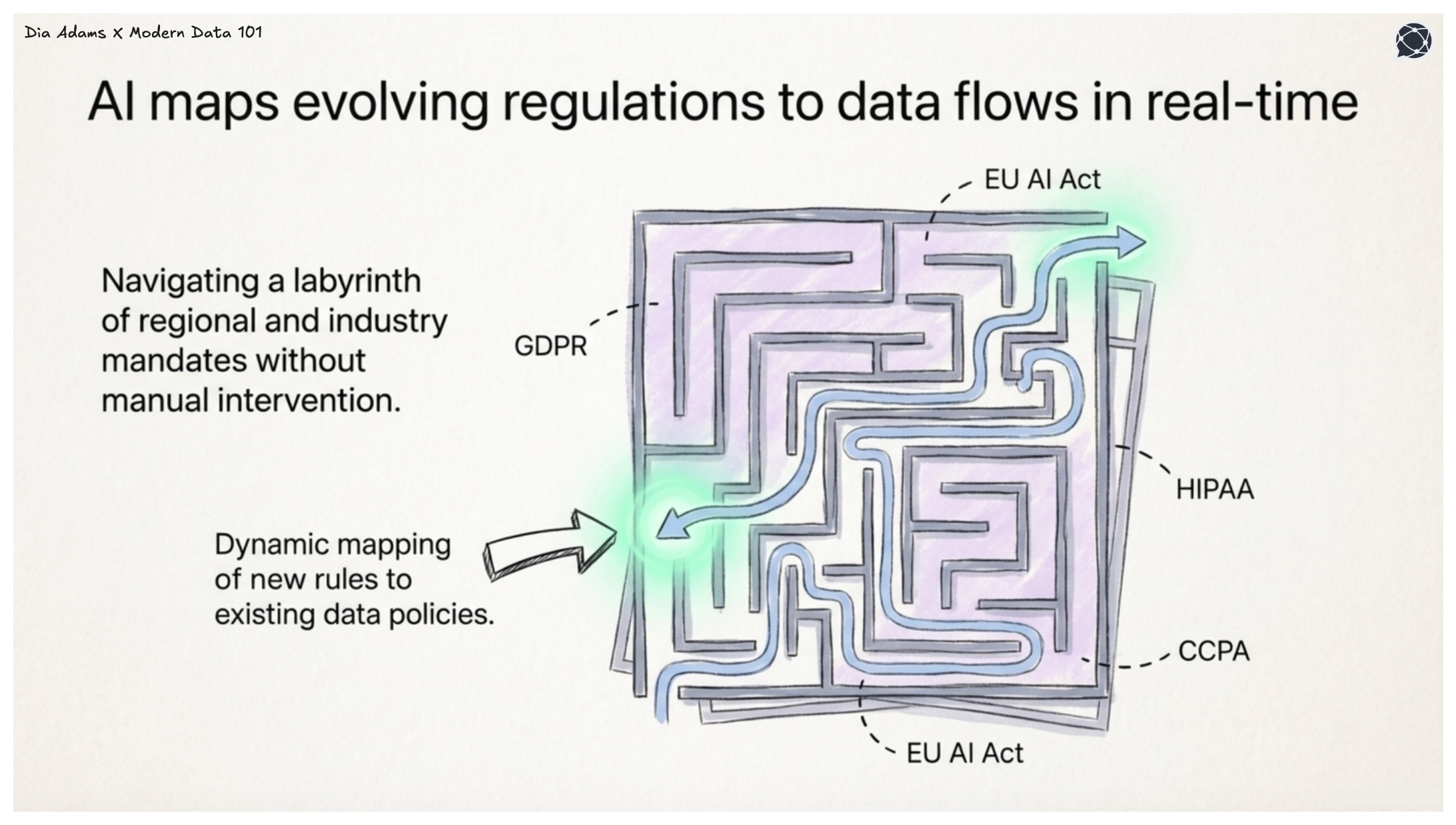
Regulatory requirements are constantly evolving, forcing data teams to juggle a labyrinth of regional, industry-specific, and emerging compliance mandates. AI systems can now monitor changes in laws such as GDPR, the EU AI Act, or sectoral frameworks like HIPAA and CCPA, while dynamically adjusting data handling policies, mapping new rules to existing data flows without manual intervention.
Self-Healing Data Pipelines
When data pipelines break, or more critically, when they degrade in ways that traditional monitoring fails to detect, AI does not simply flag anomalies in logs or dashboards. It traces root causes across intricate system dependencies, correlates failures with recent upstream changes, and in the most advanced deployments, autonomously remediates issues by rerouting workflows, adjusting resource allocations, or rolling back problematic data transformations.
🔖 Related read

The Rise of the Data Fabric
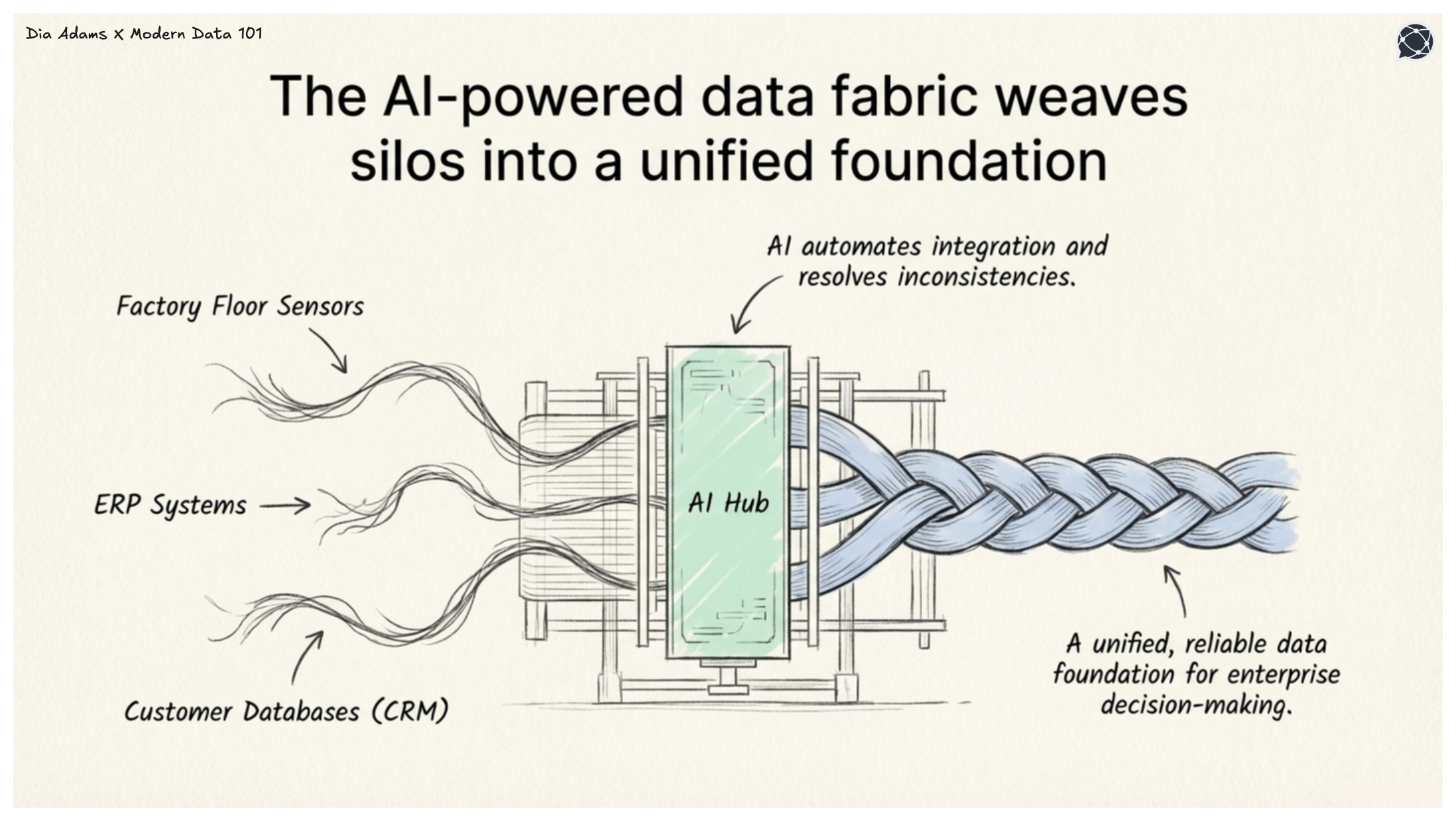
The most significant advancement in modern data governance is the development of AI-powered data fabric architectures. These systems integrate disparate data sources, automate data integration processes, and maintain consistency across the enterprise.
A prominent example is found in the manufacturing sector, where data fabric implementations use AI to resolve inconsistencies among factory floor sensors, ERP systems, and customer databases. Previously, these systems operated in isolation, creating inefficiencies and data silos. AI now enables seamless integration, providing a unified and reliable data foundation for decision-making.
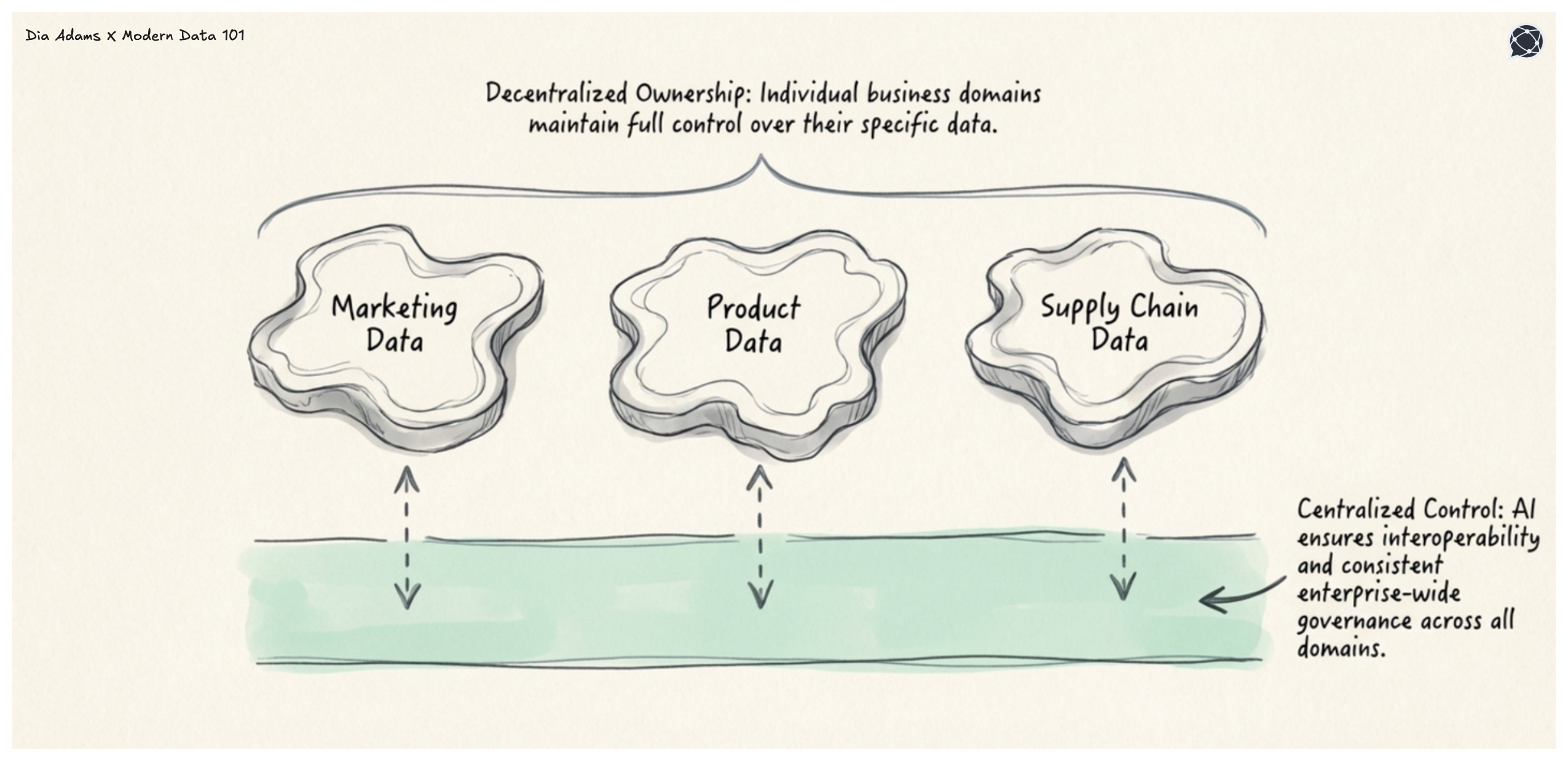
This architecture also supports the adoption of data mesh principles. In this model, individual business domains maintain ownership of their data, while AI ensures interoperability and centralized governance. The result is a system that combines domain-specific autonomy with enterprise-wide consistency and control.
Key Challenges in AI-Driven Governance
Despite its advantages, AI-driven governance introduces several challenges that organizations must address.
Transparency and Explainability
AI models can be inherently opaque, making it difficult to explain governance decisions to regulators or stakeholders. When an algorithm flags data or enforces a policy, the lack of transparency can create accountability issues. Organizations require AI systems that are not only effective but also interpretable, ensuring that decisions can be justified and audited.
Skills and Expertise
The shift to AI-driven governance demands a new blend of technical and ethical skills. Data stewards must now possess AI literacy, while organizations need to incorporate ethicists and compliance experts who can assess algorithmic fairness and mitigate bias. The rapid evolution of these requirements has created a skills gap that many companies are still working to close.
Regulatory Dynamics
As AI assumes a greater role in governance, regulatory frameworks are evolving to keep pace. Initiatives such as the EU AI Act introduce stringent requirements for automated decision-making, adding complexity to compliance efforts. Organizations must now treat compliance as an ongoing, adaptive process rather than a static checklist.
Organizational Adoption
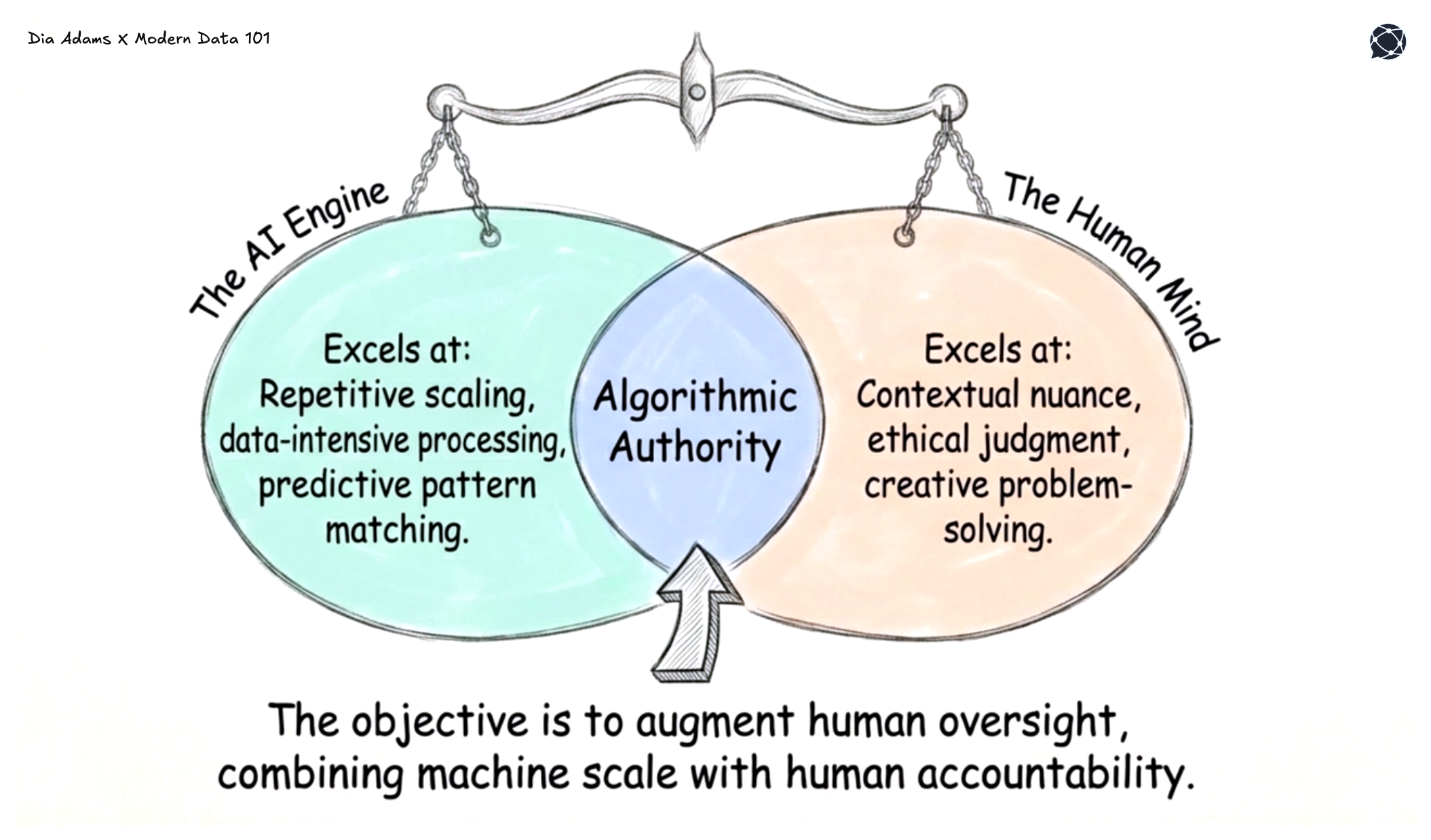
There is often resistance to the increased reliance on AI for governance. Concerns about the replacement of human judgment persist, even though the objective is to augment, not replace, human oversight. Successful implementation requires clear communication about the role of AI and the continued importance of human expertise in governance processes.
🔖 Related read

Balancing AI and Human Oversight
It would be most effective to achieve a balance between AI automation and human oversight. AI excels at handling repetitive, data-intensive tasks, while human professionals contribute critical context, ethical judgment, and creative problem-solving.
Looking ahead, several trends are expected to shape the future of AI-driven governance:
Autonomous Governance: AI systems will not only enforce existing policies but also identify emerging risks and propose adaptive governance measures.
Ethical AI Frameworks: Organizations will embed mechanisms to ensure that AI-driven governance remains fair, transparent, and accountable.
Industry Standards: As AI governance matures, standardized frameworks (similar to ISO quality management standards) will likely emerge, providing benchmarks and best practices for implementation.
The New Era of Data Governance
The integration of AI into data governance represents a significant change in how organizations manage and use their data. In this new environment, governance is centered upon intelligence and adaptability, requiring organizations to continuously modernize their strategies, tools, and skill sets to keep pace with technological and regulatory advancements.
MD101 Support ☎️
If you have any queries about the piece, feel free to connect with the author(s). O connect with the MD101 team directly at community@moderndata101.com 🧡
Author Connect 💬
Connect with Dia on LinkedIn 💬
More from Dia Adams
Winning with AI
The AI Table
From MD101 team 🧡
🌎 Global Modern Data Report 2026
The Modern Data Report 2026 is a first-principles examination of why AI adoptions are getting blocked inside otherwise data-rich enterprises. Grounded in direct signals from practitioners and leaders, it exposes the structural gaps between data availability and decision activation.
With hundreds of datapoints from 540+ data leaders and experts from across 64 countries, this report reframes AI readiness away from models and tooling, and toward the conditions required and/or desired for reliable action. Already downloaded 1000+ times, this report is enabling key insights for several industry practitioners this year. Join the discussions!

Strong piece. The shift from static governance to something operational and real-time is spot on.
What stood out to me is how this connects to correctness at the system level — even when pipelines look clean, systems can still drift in subtle ways, and models tend to amplify that drift.
I’m writing about similar production failure modes in my Substack. If this resonates, feel free to subscribe.
“Instead of waiting for errors to be reported, AI models analyze patterns to predict where data quality might degrade. A global retailer uses AI to flag potential inconsistencies in its supply chain data before they cause disruptions, saving millions in lost sales”
a really interesting set of use cases here. in a fan of the predictive stuff. i’ve seen them be really powerful. great read :)