

Every era of enterprise data has been defined by what was scarce.
First, it was the data scarcity itself.
Transactions went unrecorded, customer interactions disappeared into filing cabinets, and value belonged to whoever could capture what actually happened.
Then capture became cheap
…and the constraint moved downstream to storage, compute, and movement. The warehouse, the lake, and the modern data stack were all answers to the same question: how do you land, model, and serve this much data at scale?
Both of those bottlenecks are now largely solved. What follows is a third era, and it runs on a different kind of abundance.
Primitives of the third era are bounded
Every dataset in your enterprise reduces to a handful of primitives. Bits form values. Values form fields. Fields form records, records form tables, and tables describe the entities and events your business runs on.
Unstructured data reduces the same way: documents, logs, call transcripts, and images all end up as tokens and numbers.
Everything an organisation knows is an arrangement of a finite set of recorded observations.
If the inputs are finite, the set of things you can derive from them is also bounded. Enormous, but bounded. Every join, aggregation, forecast, segment, anomaly flag, and narrative summary your data could ever support already exists in principle.
Now, generation is cheap: Unbounded results from within bounds
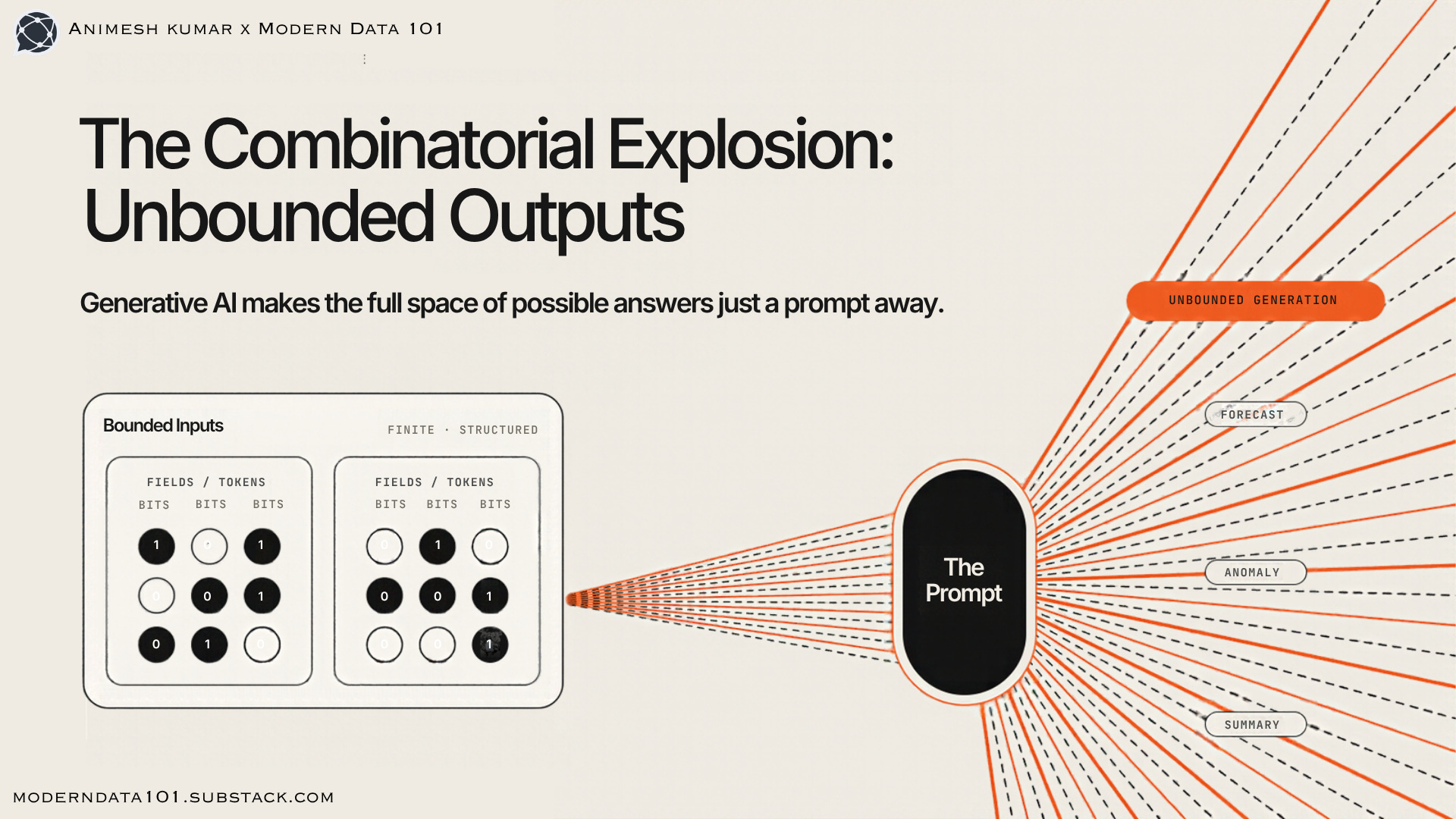
For most of the history of data, that bound was irrelevant, because almost nothing inside it ever got produced. Each answer had to be built by someone.
Generative AI removes that constraint. The full space of possible answers is no longer theoretical, but a prompt away.
This is the era of generation. And as with the two before it, removing one bottleneck does not end scarcity. It moves it.
The library that holds every answer
The idea that a finite set of symbols contains every possible output is much older than the data warehouse.
In 1901, Kurt Lasswitz published a story describing a library that held not only every existing written work, but every possible one. His logic was pure combinatorics: because writing systems use fewer than a hundred symbols that combine in a limited number of ways, all possible literature must be printable in a finite number of volumes.
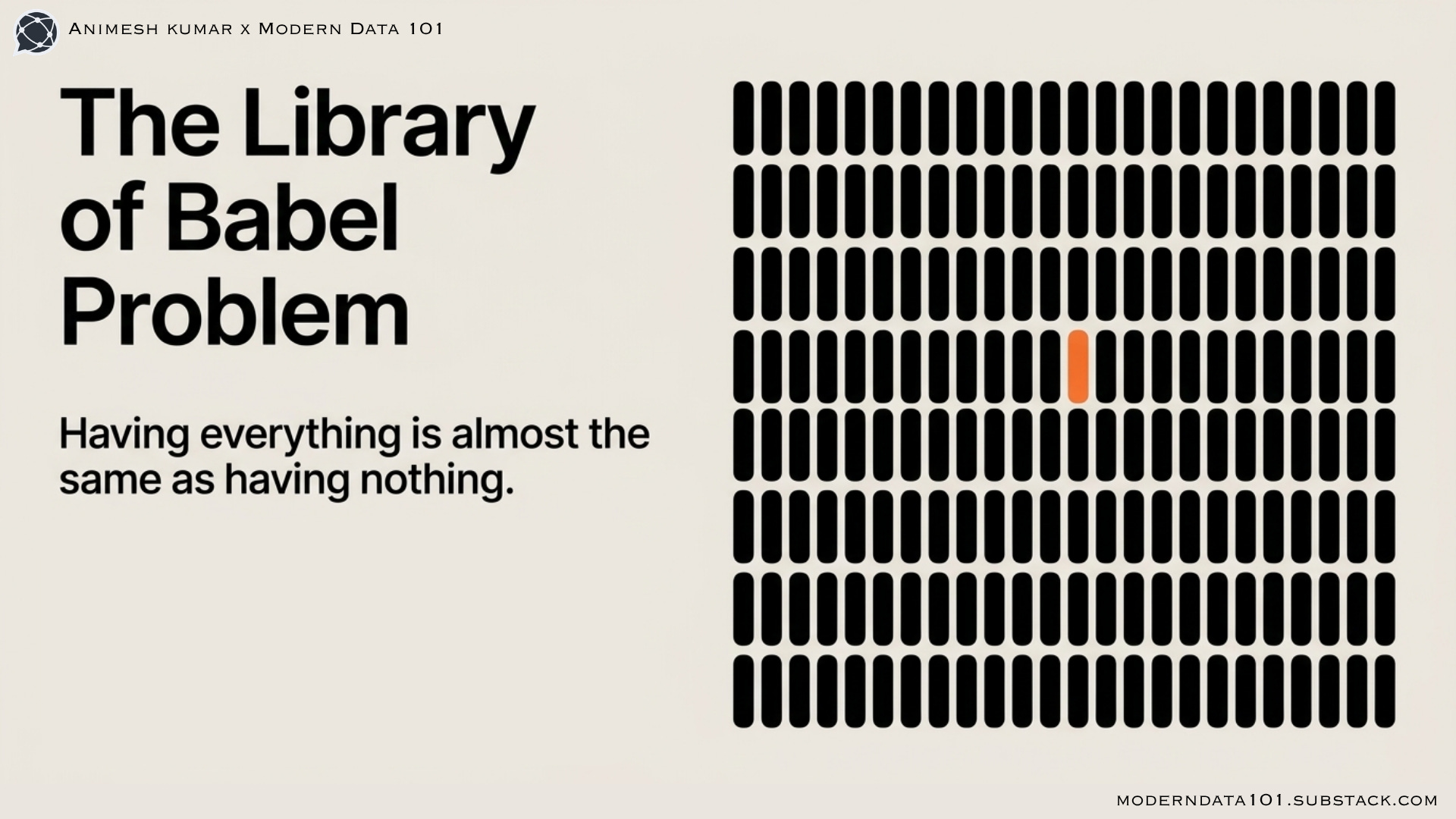
Borges later turned this into “The Library of Babel,” where every book is a combination of the same 25 symbols, so every conceivable book must exist somewhere on the shelves.
Swap letters for columns and books for query results, and you have described the modern data estate. For decades, it was a library with closed stacks.
Every answer was on a shelf somewhere, but each one had to be fetched by hand: an engineer built the pipeline, an analyst wrote the SQL, a BI team built the dashboard. Every insight had a labour cost, and that cost decided which questions ever got answered.
How AI changed the state of combinatorics
Generative AI has opened the stacks. An agent can write the query, build the chart, and draft the board memo in minutes, and anyone who can type a question can now pull a book.
That is exactly where the scarcity moves.
Borges noted that a library holding every book creates a problem no librarian had faced before.
Borges’ problem is now your problem
In Borges’ story, the library held the true catalogue alongside thousands and thousands of false ones. Having everything turned out to be almost the same as having nothing, because there was no reliable way to tell the true book from the plausible ones.
Every data leader has seen the enterprise version. Ask an agent for last quarter’s churn rate, and you can get five different, well-formatted, syntactically perfect answers, depending on which table it read, how it defined an “active customer,” and what date grain it assumed.
Each one is a book from the library. Only one matches the definition your CFO will defend in front of the board.
But generation is not knowledge. Knowledge is generation + selection + verification.
When generation becomes nearly free, selection and verification become the entire game.
Herbert Simon described this dynamic in 1971, in an essay “Designing Organizations for an Information-Rich World.” His argument was that information consumes the attention of its recipients, so “a wealth of information creates a poverty of attention.”
Fifty-five years later, AI has pushed the supply of plausible answers toward infinity, while the number of decision-makers who can absorb and trust them has not changed at all.
Why agents cannot close the loop on their own
The obvious response is to let AI verify AI. The research suggests this degrades quickly without human-grounded data in the loop.
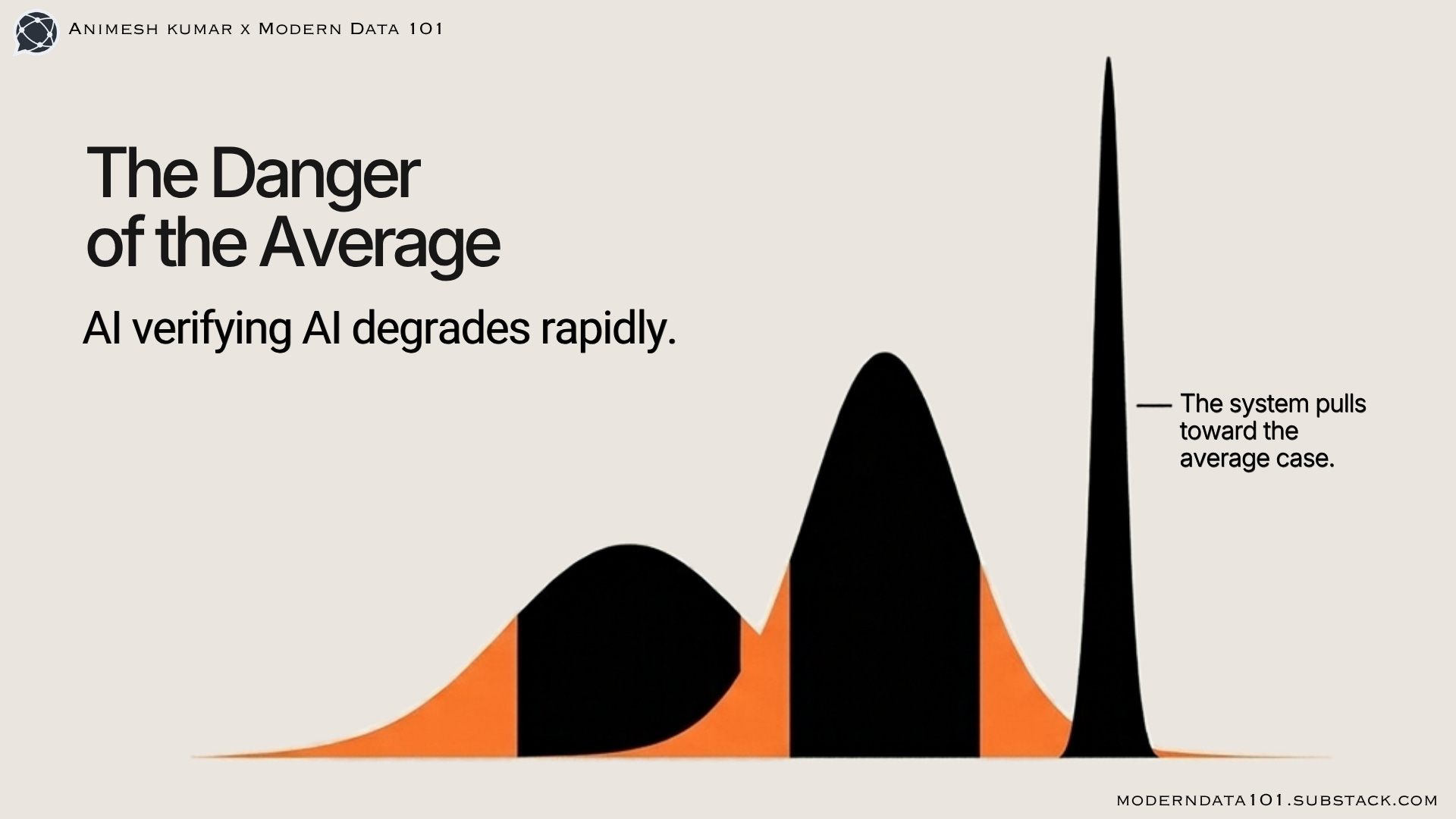
In a 2024 Nature paper, Shumailov and colleagues showed that indiscriminate use of model-generated content in training causes irreversible defects, in which tails of the original content distribution disappear.
In one of their tests, text about medieval architecture drifted over nine generations into a list of jackrabbits. They also observed that firms relying on human-generated content may be able to train more effective models than competitors.
Translate that into enterprise terms.
Agents summarising other agents’ summaries.
Synthetic data training production models.
Generated documentation becoming the retrieval corpus for the next agent.
Each loop pulls the system toward the average case.
Now think about what exists in the tails of your data: the edge-case customer, the fraud pattern, the regulatory exception, the supplier anomaly, the segment that behaves differently from the forecast.
Those are precisely the things data teams exist to catch. A system that loses its tails does not just get slightly worse. It gets confidently wrong about the cases that cost the most.
Who is the Aggregator and what is their role in the (Now) AI Universe
Think of the benders in Avatar: The Last Airbender. A waterbender does not create water. They pull it from the river and the air and shape it with intent.
The Aggregator does the same with enterprise knowledge: they draw from everything the data and the models can generate, shape it into something true and fit for purpose, and hand it to agents and applications to present and distribute.
In data terms, the function has five moves:
Framing. Translating a business question into the right entities, metrics, grain, and time window before any query runs. A vague question returns the average of the library.
Filtering. Choosing which data products and sources are fit for a given decision, and excluding the rest, however convenient they are.
Verifying. Tracing an answer back through lineage to a governed definition and a source of record, and refusing answers that cannot be traced.
Composing. Assembling context across domains so that agents reason over connected meaning (entities, relationships, policies) rather than isolated tables.
Grounding. Instrumenting new first-party signals that exist nowhere in any model’s training data. This is what feeds the tails and keeps the whole system honest.
None of these moves is new on its own. Data stewards, product owners, and architects have done parts of this work for years, usually as overhead on the “real” job of building pipelines and dashboards.
What changes now is that the building gets automated and the aggregation becomes the job.
Where is the Value in the Era of Generation
The history of enterprise data follows a simple pattern: each time technology removes a bottleneck, value moves to the next one.
In the era of collection, data itself was scarce. Value belonged to whoever captured the transactions.
In the era of infrastructure, storage, compute, and movement were scarce. Value belonged to whoever could land, model, and serve data at scale, which is the story of the warehouse, the lake, and the modern data stack.
In the era of generation, analysis and output are close to free. Value belongs to whoever can decide what is true, trusted, and fit for use.
If that model holds, a few predictions follow for data leaders:
Lineage becomes the currency of trust. An answer that cannot show where it came from will be discounted, whether a human or an agent produced it.
The semantic layer becomes the aggregation surface. It is where meaning gets decided once and reused by every analyst, application, and agent, instead of being reinvented per query.
Data roles re-weight from building to curating. Fewer people will spend their time producing artefacts. More will own definitions, fitness-for-use, and verification.
Enterprises compete on context instead of models. When every competitor can rent similar models, the differentiator is the governed, connected context those models draw from. The organisation itself becomes an Aggregator.
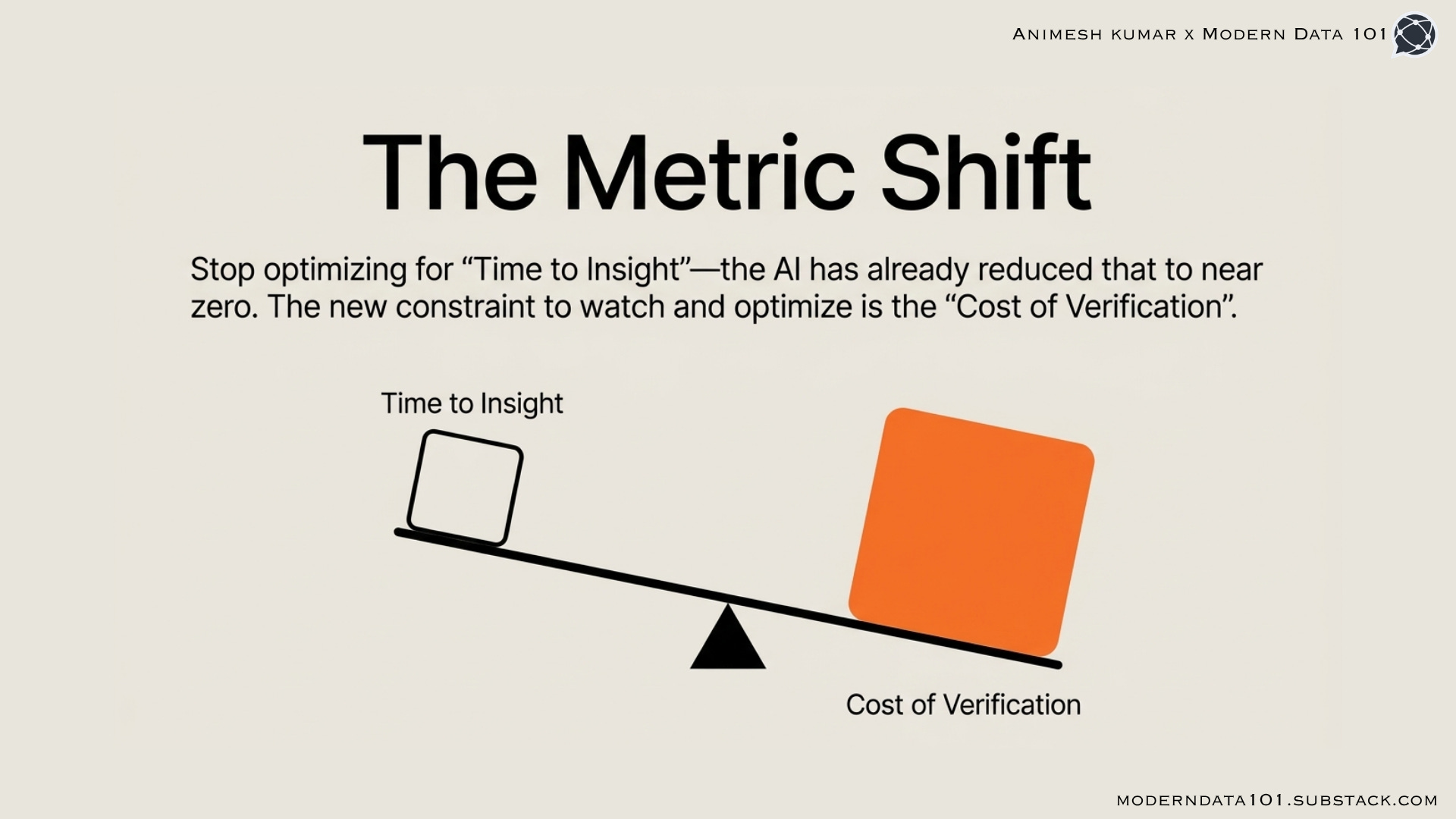
The metric that matters shifts. “Time to insight” stops being the constraint. “Cost of verification” becomes the one to watch.
The library exists. Someone must own the catalogue.
André Gide once wrote that everything has been said before, but since nobody listens, we have to keep going back and beginning all over again.
For the enterprise, a version of the first half is now true: nearly every answer your data can support is computable on demand. The second half is the work that remains. Someone has to decide which answer the organisation listens to, and stand behind it.
That is the Aggregator. It is the human function data leaders should be designing for, hiring for, and building infrastructure around.
Author Connect 💬
Got questions? Find Animesh on LinkedIn or drop a comment below. 💬
Animesh authors frequently on Modern Data 101 alongside a growing community of Data and AI Experts who wield their pens to advance the field. Follow along or grab yours🖋

From the MD101 team 🧡
Verify whether your process is truly AI-native as per Industry Benchmarks
Score one cross-functional process on five links: context, signal, decision, action and learning. The full report explains each link, where the chain usually breaks, and how to build the enabling layer that closes it.
This is an excellent story Animesh, packed with stuff one could explore and argue about. Borges' Library of Babel problem, while animating, does not describe the situation well, the model has a flow that the author could not be aware of in early 1900. A library needs tools such as concordance and catalogue, where books are searchable. Catalogues are implemented with unique keys: human-readable such as ISBN, or machine readable - typically hash codes. The point of such a hash key is to uniquely identify a book, and its place in the library, after reading just a few digits. But in a library that has every possible book, defined as every combination of digits, a unique hashcode would be the size of a book - the hashcode would be the book itself.
That said, I am with your other thought: having everything is like having nothing... We have seen this way before AI. In the country where I grew up, we used to watch TV. There were two programs, 1 and 2. As kids, we knew their schedules by heart and we would come back home in time, to watch kids' program, because there was only one. Then people got cable TV and satellite dishes, so suddenly they got 100 programs, and today, online - thousands. And no one is watching TV any more. With prolifiration of choice comes decrease of value we attach to these choices, and decrease usage.
Five churn numbers usually means five definitions of an active customer sitting in different tables. Give the agent a governed metric it has to call for anything the CFO reports on, and log every answer that came from raw SQL, so you can see how often it went around the definition.