
Demystifying SKOS for Practitioners: A Practical Guide to Controlled Vocabularies
Semantics, standards, and structure: how SKOS, taxonomies, and controlled vocabularies power interoperability, governance, and meaning at scale in modern data ecosystems

About Our Contributing Expert
Heather Hedden | Taxonomy Consultant

Heather Hedden is a globally respected taxonomy consultant and educator whose work has shaped how organisations structure, govern, and retrieve knowledge at scale. With more than two decades of hands-on experience, she brings rare depth across taxonomy design, information architecture, metadata, and ontologies, translating conceptual clarity into practical systems that materially improve search, discoverability, and decision-making. As the author of the seminal book The Accidental Taxonomist, now in its third edition, Heather has educated and influenced generations of practitioners, establishing herself as one of the most authoritative voices in the field.
Heather advises enterprises, platforms, and institutions on building sustainable, standards-aligned taxonomy programs, while also training professionals through courses, workshops, and conferences worldwide. Her contributions extend beyond consulting into stewardship of the discipline itself, including active involvement in ISO standards for thesauri and long-standing editorial leadership with BARTOC. Known for her intellectual rigour, generosity in teaching, and unwavering commitment to quality, Heather continues to elevate the practice of knowledge organisation for the modern information economy. We’re thrilled to feature her unique insights on Modern Data 101!
We actively collaborate with data experts to bring the best resources to a 15,000+ strong community of data leaders and practitioners. If you have something to share, reach out!
🫴🏻 Share your ideas and work: community@moderndata101.com
*Note: Opinions expressed in contributions are not our own and are only curated by us for broader access and discussion. All submissions are vetted for quality & relevance. We keep it information-first and do not support any promotions, paid or otherwise.
Let’s Dive In
There is a growing interest in “semantics” among data experts, such as in developing semantic data models and semantic layers. Information professionals, meanwhile, have always been involved with semantics (whether or not they called it that) in developing classification systems, indexes, taxonomies, tagging systems, and metadata schemas.
Semantics is about meaning, rather than just strings of text. The same text string can have different meanings in different contexts, and the same concept can be represented by different text strings for different users, use cases, and systems.
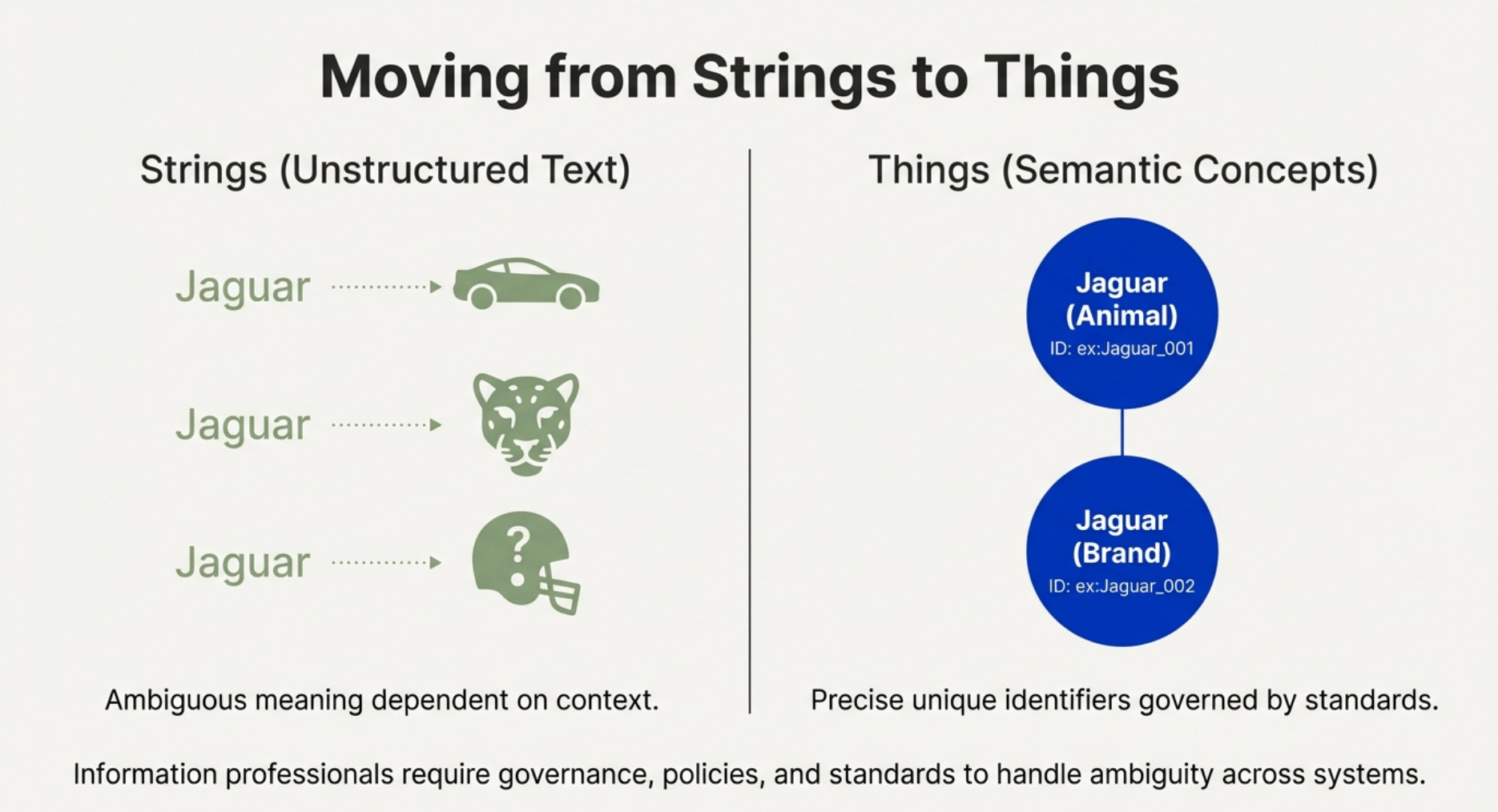
Thus, control, governance, policies, and standards are needed around semantics, especially when it comes to data and information sharing and interoperability across systems, repositories, and users.
Simple Knowledge Organization System or SKOS, a Semantic Web standard, has become the leading data model for consistency and interoperability for knowledge organization systems.
Semantic Web Standards
The ultimate information-sharing platform is the World Wide Web, whose core standards have been developed primarily by the World Wide Web Consortium (W3C) since its founding in 1994.
This has included standards for basic hypertext technologies, including HTML (HTML5 in its final version), CSS, XML, and Internationalized Resource Identifiers (IRI). As web standards became adopted both behind the firewall within enterprises and for web-bases (SaaS), Semantic Web standards became important for the technology and data administration of organizations, and not just the World Wide Web.
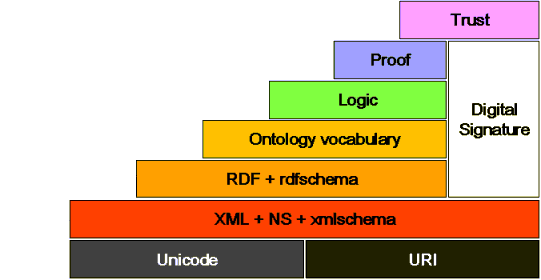
The extension of the web technologies to support greater semantics in the hypertext links is known as the Semantic Web, or Web 3.0, which is also relevant to organizations. To this end, the W3C developed additional recommendations, with the foundational standard or data model being RDF (Resource Description Framework).
The W3C defines RDF as a “standard model for data interchange on the Web.” The principles of RDF are that the web of data is based on interlinked statements of subject-predicate-object “triples” and all resources have URIs (or IRIs).
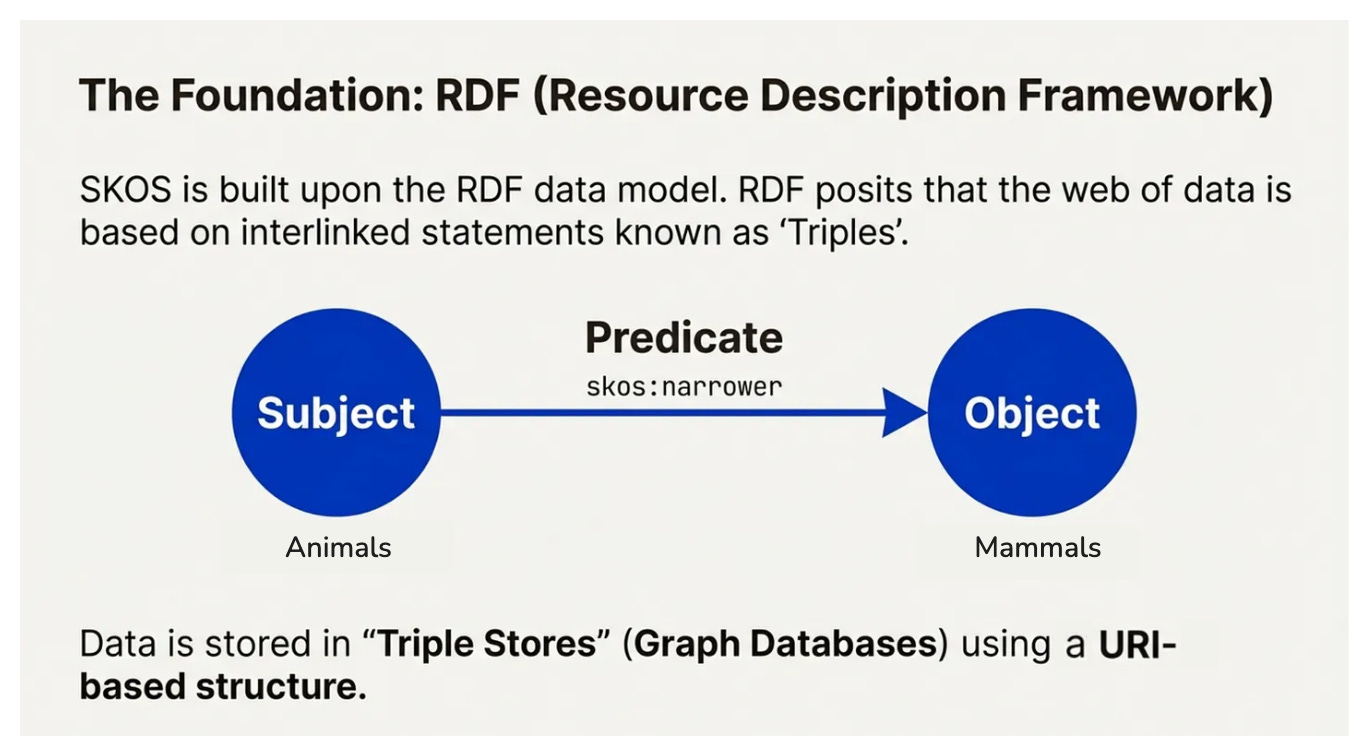
In addition to the web and web applications, there is now a class of graph database management systems based on RDF, which are commonly known as “triple store” or RDF graph databases.
Other standards based on RDF are, in order of publication, from 2004 through 2017: RDFS, GRDDL, SKOS, POWDER, PROV, RIF, SAWSDL, RDB2RDF, OWL, SPARQL, RDFa, JSON-LD, and SHACL.
This may seem like an alphabet soup, but some of these standards are more prevalent and important to understand than others. RDF, RDFa (embedded structured data in HTML), SPARQL (the standard query language for RDF), and JSON-LD (JSON-based serialization for Linked Data, used by developers) are widely used in systems today.
OWL, RDFS, SKOS, and SHACL are especially used by semantic experts, knowledge graph experts, knowledge and data engineers, ontologists, and taxonomists. The other standards have more limited adoption and use.
Leveraging the Combined Power of Standards
Since these standards are all based on the RDF data model, the standards and technologies can be used in combination.
Controlled vocabularies modeled in SKOS can be integrated with ontologies modeled in RDFS and described more fully in the OWL language, and all can be expressed in a computer-readable form of JSON-LD (among other serializations) and then queried using SPARQL.
Knowledge Organization Systems
The Semantic Web standard SKOS stands for Simple Knowledge Organization System. The concept of a “knowledge organization system” comes from the field of library and information science.
According to the International Society for Knowledge Organization (ISKO)’s Knowledge Organization Encyclopedia, knowledge organization systems are
…functional items designed for organizing knowledge and information, and making their management and retrieval easier…they are basically made of terms/concepts. | (Source)
Broadly defined, knowledge organization systems include term lists with definitions and/or other data (including dictionaries, glossaries, gazetteers, and terminologies) and structured arrangements of terms or concepts (including taxonomies, subject heading schemes, classification schemes, thesauri, and ontologies).
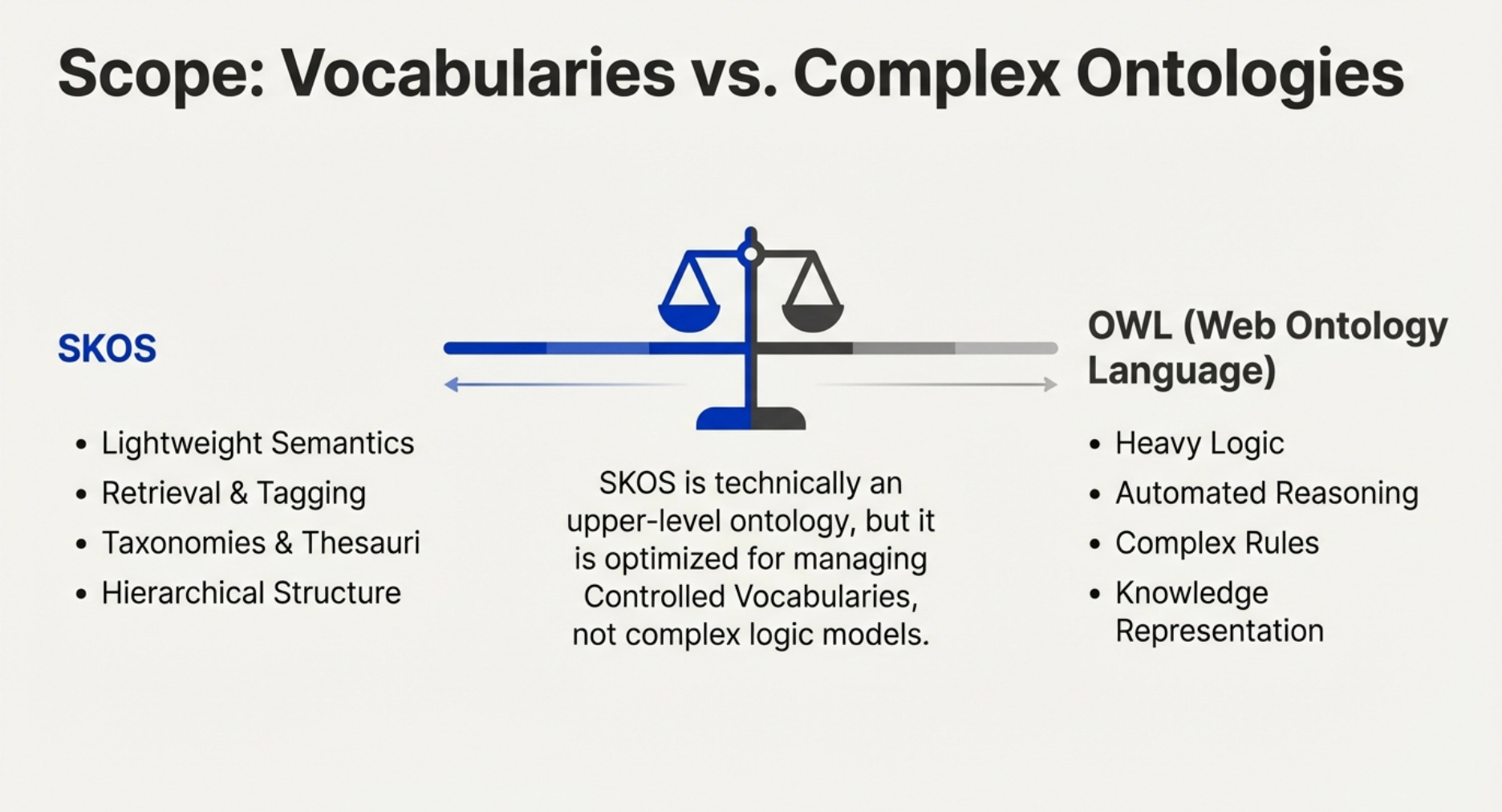
Although ontologies are considered knowledge organization systems, they are better known as knowledge representation systems. SKOS supports these various kinds of knowledge organization systems with the exception of ontologies, since there are other standards from the W3C for ontologies to support their greater complexity.
SKOS does not support all knowledge organization systems, and we usually refer to what is supported by SKOS as “vocabularies.”
Most software today for creating and managing knowledge organization systems, especially ontologies, thesauri, and taxonomies, is based on semantic web standards.
SKOS (Simple Knowledge Organization System)
SKOS was developed by the W3C starting in 2006 and published in 2009, with the objective of supporting the publishing, sharing, and linking of knowledge organization systems on the Web and thus contributing to the Semantic Web.
SKOS was adopted relatively quickly by both open source and commercial vendors of software for managing thesauri and taxonomies.
Thus, SKOS has become the standard data model to support interoperability (importing, exporting, exchange/sharing, and linking) of vocabularies, even when they are not shared publicly on the Web.
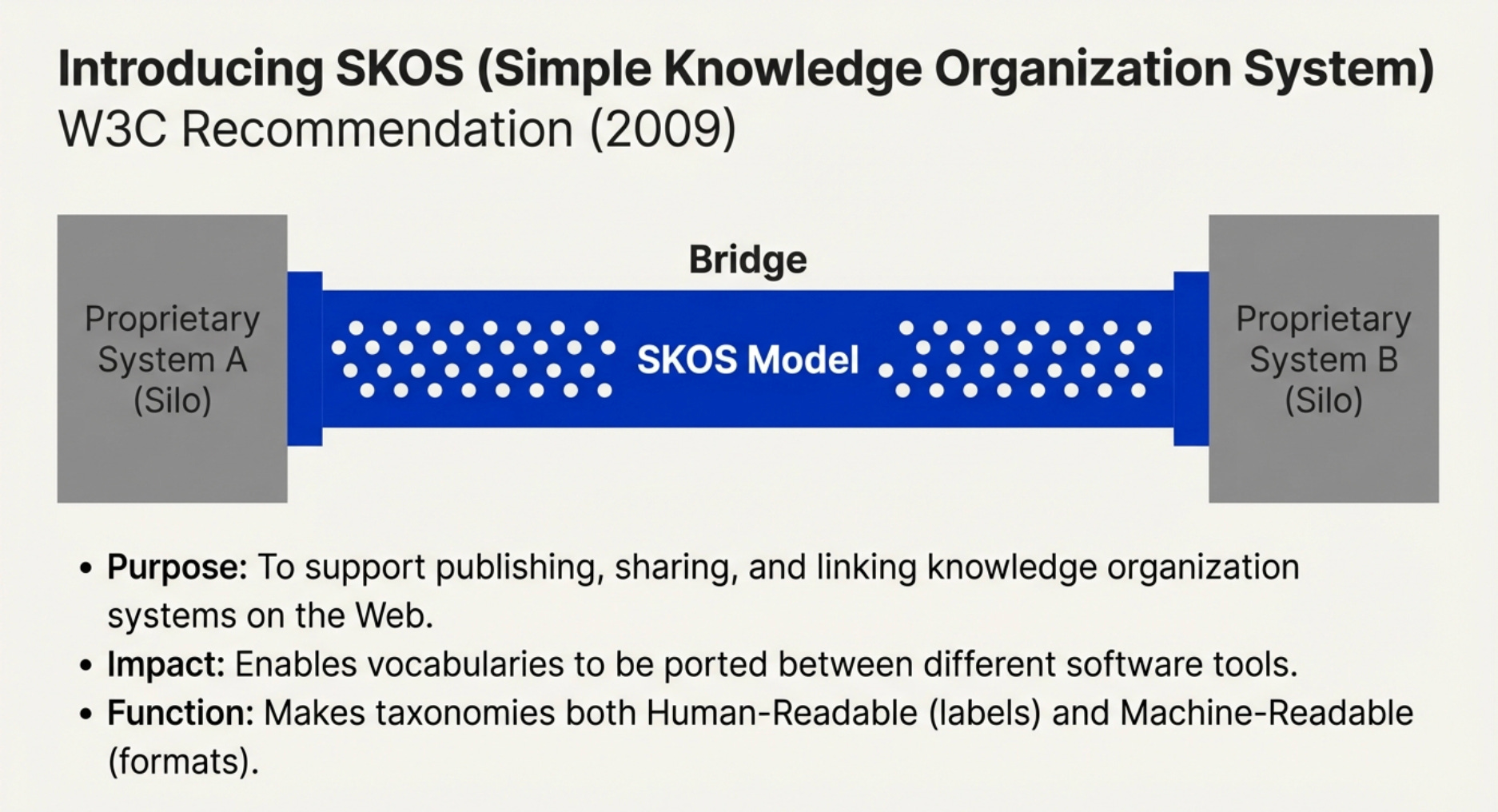
Of course, most software is also Web-based (SaaS), so following Web protocols, such as using URIs, is practical even for managing proprietary data.
Although SKOS is often referred to as a “standard,” more precisely, it is a common data model recommended by the W3C for making knowledge organization systems both human-readable and machine-readable, in addition to being interoperable.
An example of machine-readable presentation for the concept with the preferred label of Animals in English, the alternative label of Creatures in English, and the preferred label of Animaux in French would be:
ex:animals rdf:type skos:Concept;
skos:prefLabel “animals”@en;
skos:prefLabel “animaux”@fr;
skos:altLabel “creatures”@en.
The designations before the colons are the namespaces, which for our taxonomy example taxonomy is ex. The namespace of skos is used to prefix all SKOS elements.
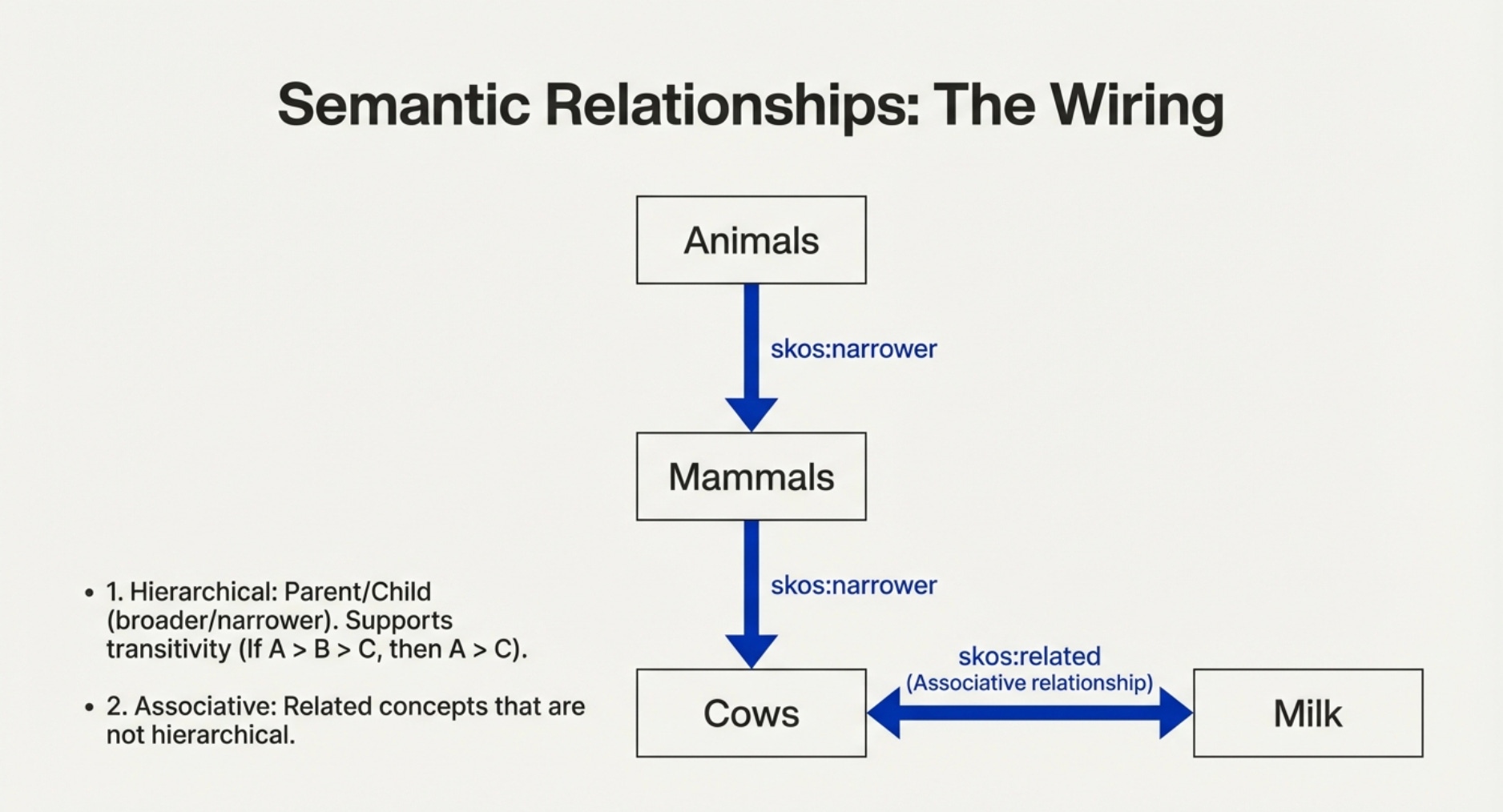
An example of expressing a hierarchical relationship between two concepts as a subject-predicate-object statement is:
ex:animals skos:narrower ex:mammals.
SKOS takes a concept-approach to modeling vocabularies, and the concepts have various types of properties, including both types of relationships to other concepts and attribute data, such as various types of labels and notes.
If you are familiar with ontologies, you will recognize the features of classes, properties, and attributes. SKOS actually is an upper-level ontology, which is then used for modeling domain-specific vocabularies. However, if you are not familiar with ontologies, understanding that the SKOS model is an ontology is not necessary, though, to use SKOS.
It’s also not necessary to be an expert on SKOS when creating and managing taxonomies or thesauri, now that nearly all taxonomy/thesaurus management software is based on SKOS, and what is presented in the user interface is more user-friendly, such as “Preferred Label” instead of prefLabel.
SKOS Elements
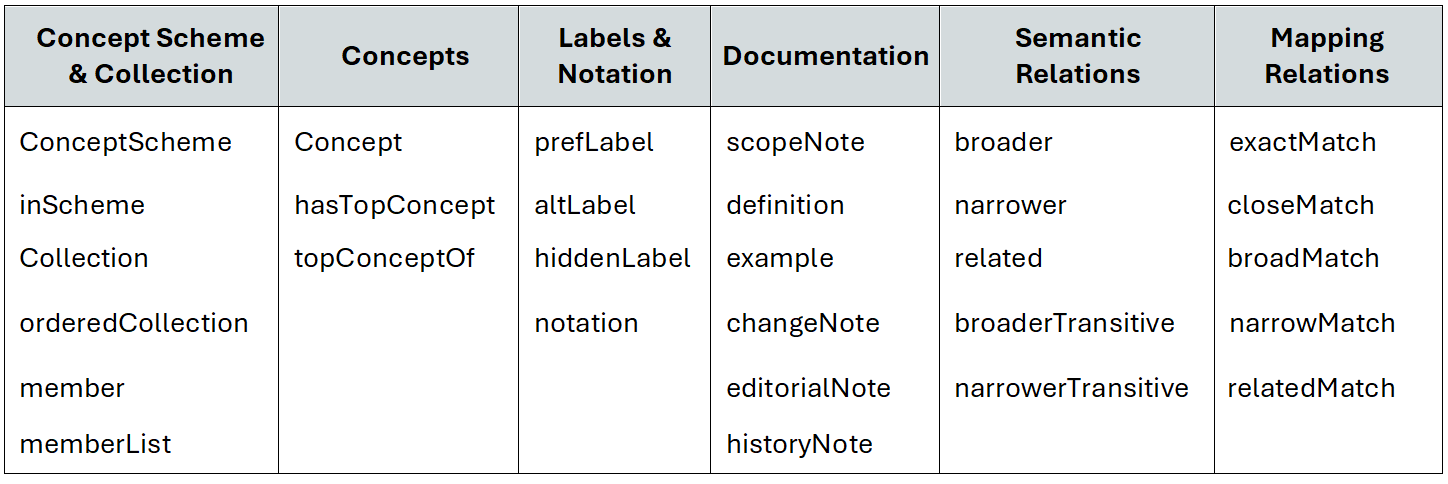
The following table presents all of the elements of SKOS, grouped by type:
Concept Scheme
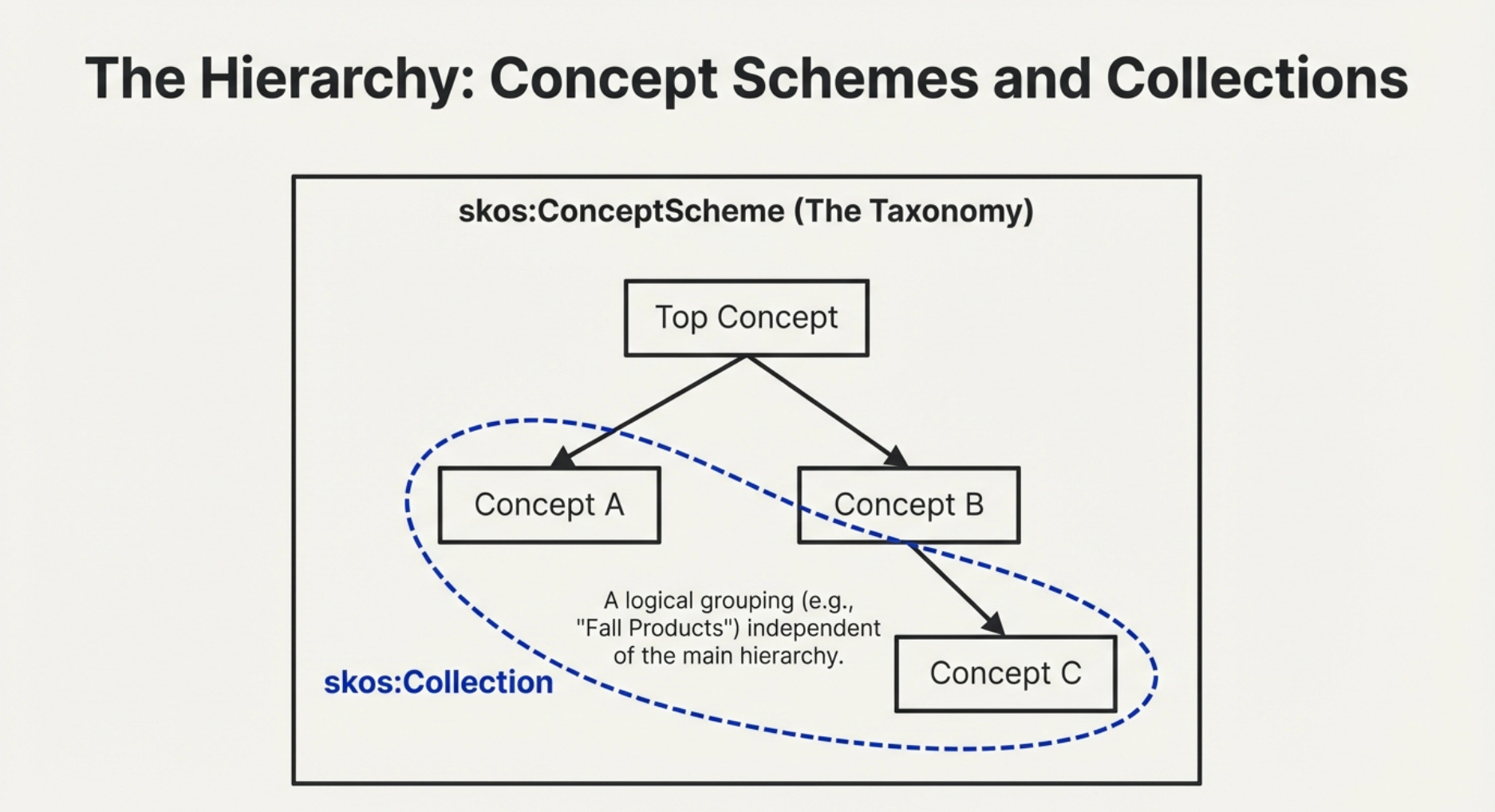
The “concept scheme” is the highest level of organization for SKOS vocabularies. A concept scheme is a collection of concepts. Concepts are arranged in hierarchical relationships of broader/narrower to each other. The relationship between the highest level of a taxonomy hierarchy and the concept scheme is instead that of “top concept”.
Collection
There is an additional, optional way to organize concepts, and that is by designating a “collection” to which selected concepts belong based on some other designated criteria that is not simply based on hierarchy. Use of collections allows you to create one master taxonomy, in which subsets of it are used in different implementations.
Concepts & Labels
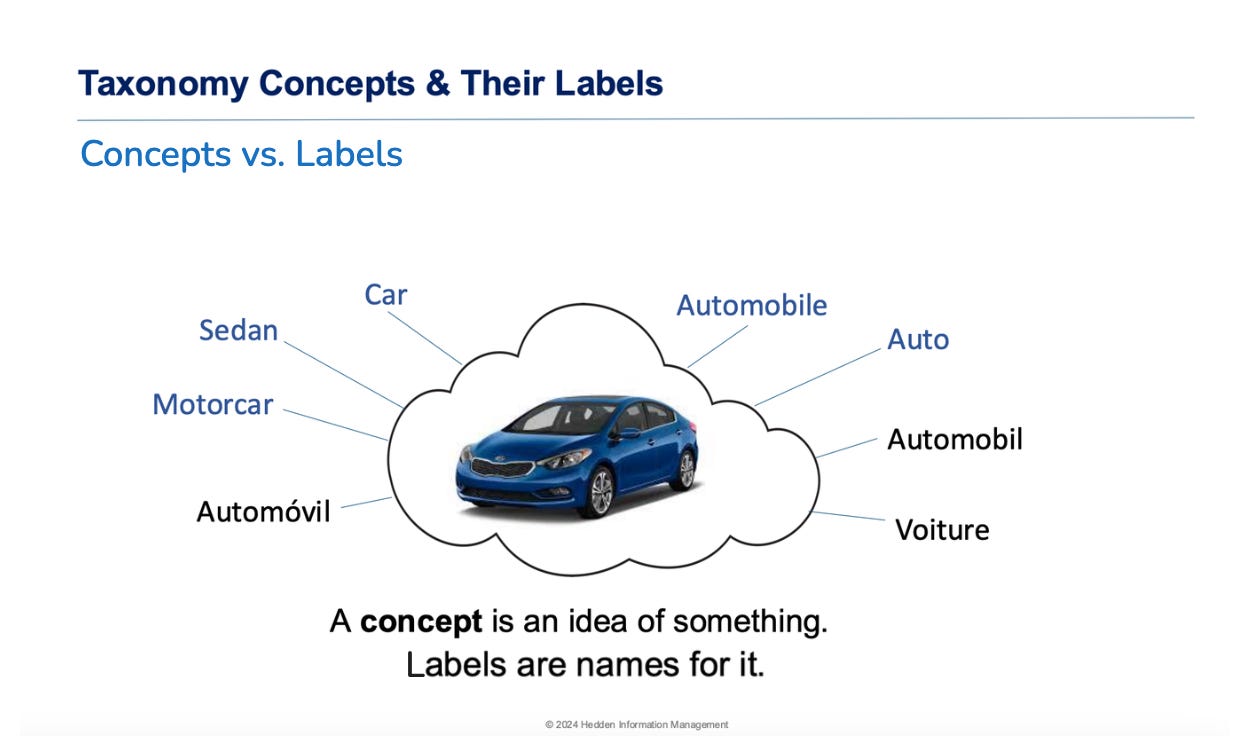
Concepts are things or ideas that have labels. Each concept has one designated “preferred label” (per natural language, if it is in a multilingual vocabulary) and any number of “alternative labels,” to designate synonyms or variants.
A “hidden label” is an optional kind of alternative label that is designated not for display in certain circumstances or user interfaces. “Notation” is a field designated for use in classification schemes that have a numeric or alphanumeric code corresponding to the concept’s classification.
Notes
Concepts may have various notes, such as a “scope note” or a “change note”, definitions, and even examples. A scope note is a standard field in traditional thesauri, and it is used to indicate any restrictions on the meaning and use of a concept for the vocabulary’s context. Notes are used as needed, and their inclusion is optional. The use of definitions tends to be determined by an organization’s editorial policy.
Semantic Relationships
The relationships available between concepts are (1) hierarchical, involving the inverse pair of “broader” and “narrower,” and (2) associative, involving the reciprocal relationship of “related.”
The related concept relationship is standard in thesauri and optional in taxonomies, although most taxonomies make little, if any, use of “related.” The hierarchical relationships of broader and narrower are inherently transitive through multiple levels of hierarchy, thus supporting the inferencing of hierarchy.
There also exists the inverse pair of “broader transitive” and “narrower transitive,” which in practice are not used directly in the construction of a taxonomy, but rather are derived via reasoning from the direct relationships and thus may be used in statements of SPARQL queries to query the taxonomy.
Mapping Relations
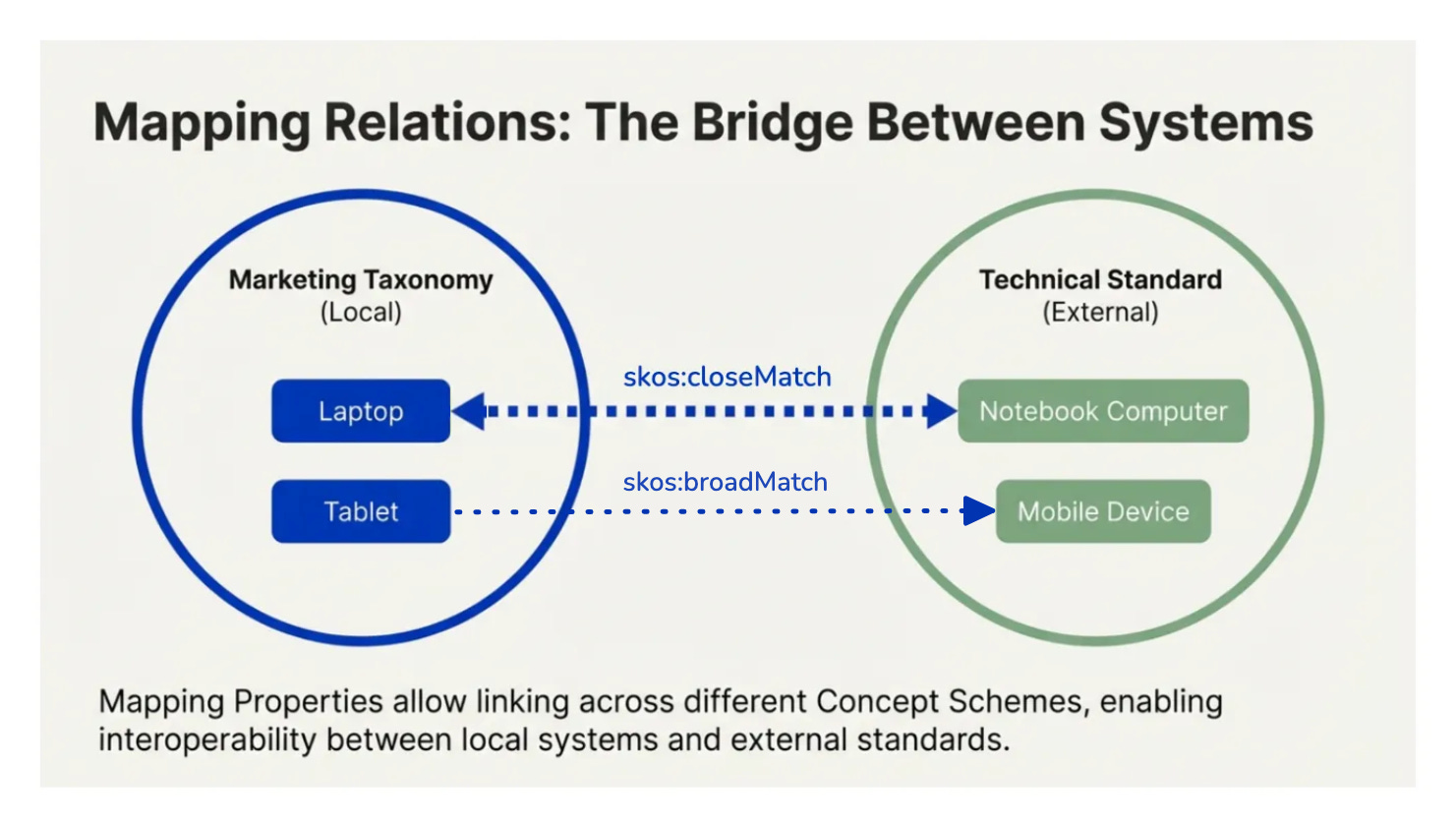
Finally, SKOS includes a set of mapping relations, which did not exist previously in thesauri. These relationships are for use across different concept schemes, or different taxonomies or vocabularies, as they may be called.
Use of SKOS mapping relations allows you to link, map, or connect taxonomies together on a concept-by-concept level. These different taxonomies may be on your local server, or they may be external but linked on the web with URLs.
Controlled Vocabularies
Most knowledge organization systems managed in SKOS are controlled vocabularies. Controlled vocabularies are knowledge organization systems that have a particular focus on managing concepts or terms and their labels and that are used especially for tagging or indexing content to support findability and retrieval.
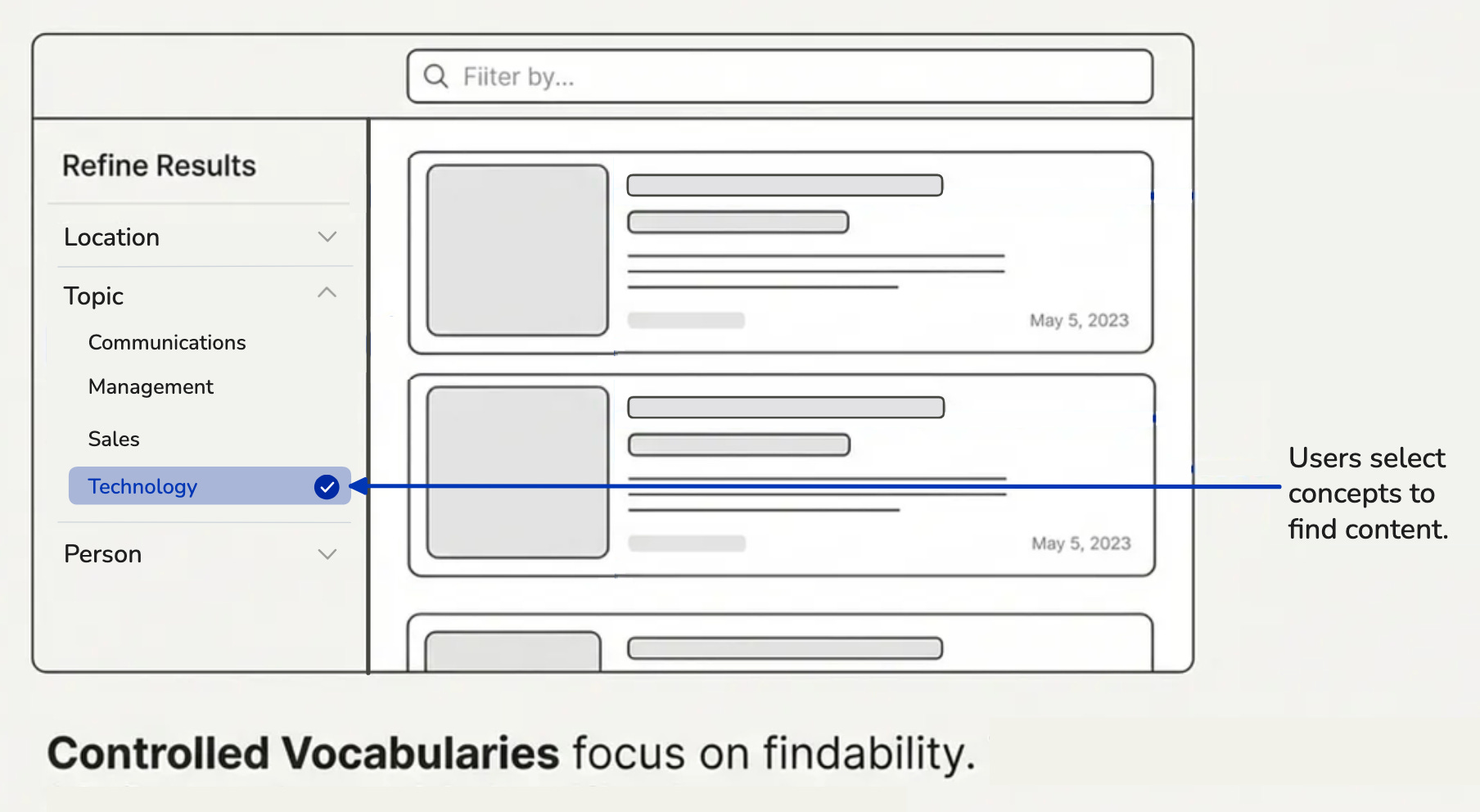
Users select a concept or category from a controlled vocabulary to retrieve the content that has been tagged with it. Controlled vocabularies exclude certain knowledge organization system types, such as dictionaries or glossaries, where the focus is on defining words.
Controlled vocabularies also exclude classification systems, which focus on mutually exclusive class hierarchies, whose labels are of lesser importance, since often a system of alphanumeric codes is used.
Ontologies are also not considered controlled vocabularies, even if they include controlled vocabulary features, since ontologies have other features and uses.
The following are common types of controlled vocabularies, starting with the most semantically rich:
Thesauri
An information thesaurus (in contrast to a type of dictionary of synonyms) is a structured, semantically controlled vocabulary comprising terms and both hierarchical (broader-narrower) and associative (related).
Notes, especially scope notes, tend to be used in thesauri. Another basic feature of thesauri is the use of synonyms or variants to point to the preferred term. Traditional, pre-SKOS thesauri have been based on “terms” rather than concepts and labels, but a thesaurus built on the SKOS model, with concepts and labels, functions just the same for users.
Among controlled vocabularies, thesauri are distinguished by having formal standards that provide recommendations for style, format, and construction of thesauri. These include:
The international standard ISO 25964. Thesauri and interoperability with other vocabularies
The American standard ANSI/NISO Z39.19 Guidelines for the Construction, Format, and Management of Monolingual Controlled Vocabularies
Taxonomies
Taxonomies are more informal and varied than thesauri. They are characterized by a hierarchical or category-based organization of terms/concepts. Unlike most thesauri, taxonomies have a limited number of hierarchies to which all concepts belong.
The top-level grouping of taxonomy concepts may be by “facet” or aspect type (e.g., topic, location, organization, person type), which may be implemented in a faceted search/browse user interface. Facets may or may not have further hierarchy within them. When designing a faceted taxonomy, each facet usually corresponds to a SKOS concept scheme.
The name “taxonomy” may suggest classification, but a taxonomy is not a classification system that has mutually exclusive classes. The hierarchy of a taxonomy does not imply a classification or hierarchy of things but rather provides a logical way to organize and find the concepts that are used in tagging and retrieval.
The ISO and ANSI/NISO thesaurus standards are also relevant to taxonomies to the extent that they are applicable. Taxonomies are widely used in business and industry to support information access, both for internal/enterprise and customer/public-facing use.
Name Authorities
Name authorities are lists of named entities or proper nouns, such as names of people, companies, organizations, brand-name products, laws, publications, etc. The lists are not hierarchical, unlike a taxonomy, but alternative labels or variants (synonyms) are typical, and are supported by SKOS.
The designation of “name authority” comes from library science, and the best-known example is the Library of Congress Name Authorities. With SKOS, each named authority would be a concept scheme.
Concepts in a name authority typically have additional descriptive attributes, such as birthdate for people and headquarters location for companies. SKOS does not support the creation of such additional customized attributes, although RDFS does, so combining SKOS with RDFS (for ontologies) fully supports the details of named entities.
Term Lists
Term lists are any controlled lists of terms, typically to pick from values in various metadata properties. Sometimes the designation of “controlled vocabulary” is used synonymously with this simplest kind of vocabulary.
In SKOS, each term list is a Concept Scheme. As with name authorities, there is no hierarchy in simple term lists, so all terms are top concepts of their concept scheme. Term lists also lack alternative labels. Although it may seem as if SKOS is not needed for simple term lists, in practice, term lists often exist alongside other metadata properties, each as a SKOS concept scheme.
For example, controlled vocabularies for tagging and retrieving documents may have facets managed as concept schemes for each of the following: topics (hierarchical taxonomy or thesaurus), named people (authority file), publication language (term list), document type (term list), and source (term list).
Final Note
Controlled vocabularies, such as taxonomies and thesauri, existed before SKOS as a standard was published, but the vocabularies were created and managed in application silos in different applications, and they could not easily be shared, exported, and imported.
With vocabularies based on the SKOS model, they can easily be shared, linked, and reused. This has led to a greater alignment of vocabularies and the information to which they are tagged, with the resulting benefits of improved enterprise-wide information intelligence and knowledge sharing. This, in turn, has further promoted the benefits and uses of controlled vocabularies, which has led to even wider adoption and use.
MD101 Support ☎️
If you have any queries about the piece, feel free to connect with the author(s). Or feel free to connect with the MD101 team directly at community@moderndata101.com 🧡
Author Connect
Connect with Heather Hedden on LinkedIn 💬
Or dive into her work on these platforms:
From MD101 team 🧡
🧡 The Data Product Playbook
Here’s your own copy of the Actionable Data Product Playbook. With 3500+ downloads so far and quality feedback, we are thrilled with the response to this 6-week guide we’ve built with industry experts and practitioners. Stay tuned to moderndata101.com for more actionable resources from us!
 | A guest post by
|